

The Birth of a Digital Nation: Verdis Claims Unclaimed Danube Territory
In a world where virtually every square inch of land is claimed by established nations, the concept of founding a new country appears utterly fantastical. Yet, Daniel Jackson, a determined 20-year-old holding both British and Australian citizenship, asserts he has accomplished precisely this extraordinary feat. Jackson serves as the self-proclaimed president of the Free Republic of Verdis, a minuscule parcel of forested sand along the Danube River, situated in the contentious border zone between Serbia and Croatia. He argues this land qualifies as terra nullius—territory unclaimed by any sovereign state. His ambitious project has galvanized thousands of digital supporters, assembled a volunteer government, and even produced its own passports. Ironically, Jackson himself is prohibited from entering the very territory he claims to govern. Following an attempt to settle the land in 2023, Croatian authorities expelled him and imposed a lifetime ban, forcing the aspiring president to administer his micronation from exile.
The Legal Basis: A Border Dispute Creates Unclaimed Land
The legal foundation for Verdis originates from a technical disagreement concerning the Danube River border between Croatia and Serbia. Historically, the international boundary followed the river's course. However, over decades, the Danube's channel has naturally shifted, leading to conflicting interpretations from both nations. Croatia maintains the border should adhere to historic cadastral maps, while Serbia contends the boundary is the river's central line. This diplomatic stalemate has resulted in several small pockets of land, including the area Jackson calls Verdis, falling outside both countries' official claims.
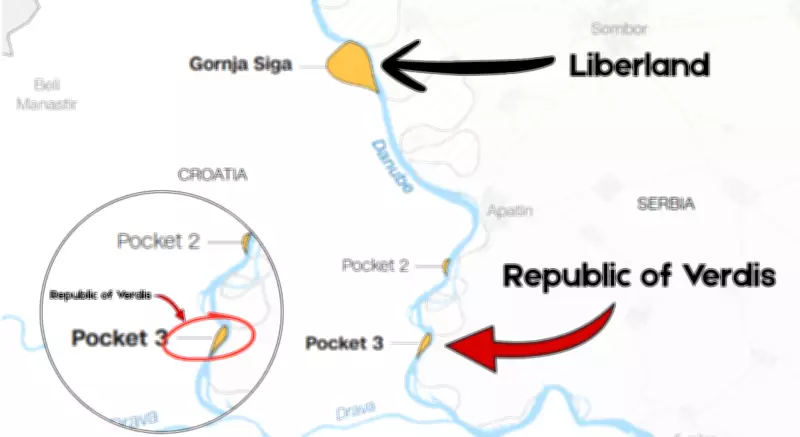
Under established international law, such zones can occasionally be classified as terra nullius, a Latin term meaning "nobody's land." Two specific areas along this disputed stretch have been identified this way. One is Gornja Siga, where Czech politician Vít Jedlička established the libertarian micronation Liberland in 2015. The other is known as Pocket 3, the sandy, forested strip that Jackson now claims as the sovereign territory of Verdis.

Jackson articulates the claim's logic with straightforward clarity: "This piece of land was unclaimed, as neither Croatia nor Serbia wanted it. Croatia insists this piece of land is part of Serbia, whereas Serbia considers its border to be the central line of the Danube. That allowed the oldest active claimants under international law, which is Verdis in this case, to be rightful to the land."
A Teenager's Vision: From Online Experiment to Nation-Building
The seeds of Verdis were planted years ago when Jackson was still a schoolboy. Born in Australia to British parents and raised in Melbourne, he attended Waverley Christian College. At just 14 years old, he and a group of friends began scouring online maps for unusual geographical anomalies. "It was a bit of an experiment – we wanted to do something unique. And I thought: let’s make it a reality," Jackson later recalled. His collaborators included school friends and individuals from Southeast Europe he met online. Together, they discovered the uninhabited Danube territory and resolved to transform it into a country.
The self-proclaimed Free Republic of Verdis occupies Pocket 3 along the Danube, near Pocket 1 where Liberland is located. The group named it Verdis, derived from the Latin "viridis" meaning green, highlighting their commitment to environmental protection. The territory spans approximately 124 acres, or about half a square kilometer. In size, it is marginally larger than Vatican City, the world's smallest recognized nation, and equivalent to roughly 75 football fields. The land consists primarily of forest and scrubby riverbank and has never sustained permanent human habitation.

Building a State: Symbols, Government, and Digital Growth
Jackson formally declared the Free Republic of Verdis in 2019 after being elected president by his supporters. The group promptly embarked on constructing the apparatus of statehood. They designed a flag featuring pale blue and white horizontal stripes and created a coat of arms blending Serbian and Croatian cultural symbols. The emblem incorporates a white stork as the national bird, oak trees representing unity and strength, wavy lines symbolizing the Danube, and heritage motifs from both nations.
A functional government was established, complete with ministers for foreign affairs, internal affairs, infrastructure, and defence, alongside volunteer ambassadors and officials. Two administrative offices were opened—one in the United Kingdom and another in Serbia—staffed by volunteers managing the project. Verdis has drafted basic laws, written a constitution, and begun issuing passports and identity cards, though these documents lack international recognition.
Much of Verdis's expansion has occurred in the digital realm. Jackson reports the project has attracted thousands of supporters, particularly among Generation Z internet users fascinated by alternative governance and digital citizenship. Approximately 3,000 people have applied to become Verdisians, many via an e-Residency program enabling digital participation in state institutions. By late 2025, Verdis officials reported around 400 physical citizens holding passports and ID cards.
The e-Residency application process requires prospective members to first purchase an annual €50 e-Resident Plus plan, hold it for at least 11 months, and then apply for citizenship. Applicants must secure endorsements from two existing Verdisian citizens or provide a background check, remain active in Verdis forums, commit to future relocation, and pay a €300 processing fee. Fast-track options exist for those making significant contributions to the project.
The Settlement Attempt and Croatian Response
For years, Verdis existed primarily online. However, in October 2023, Jackson and supporters attempted to physically occupy the territory. They traveled to the Danube, planted their flag, and initiated what they termed the "settlement phase" of nation-building, with plans for rotating citizen groups to maintain a continuous presence. The effort lasted less than a day. "It was short-lived," Jackson told CNN Travel. Croatian police arrived the following morning, dismantled the camp, and detained the settlers for questioning. "They broke the camp apart," he said. The group was held for about 12 hours before deportation. Most received three-month bans from Croatia, but Jackson and Vice-President Hector Bowles were issued lifetime bans, deemed "a threat to homeland security."
Croatia's government firmly rejects the terra nullius claim. In a statement to CNN, the Croatian foreign ministry dismissed the Verdis and Liberland projects as "provocative actions without any basis in law." The ministry stated Croatia was merely protecting its external border and the Schengen Area, Europe's passport-free zone. Officials emphasized that disputed borders do not automatically create unclaimed land, noting both Croatia and Serbia "share an understanding of and respect for a fundamental principle of international law: the fact that a pending delimitation does not render any space a terra nullius ('no man’s land') open to occupation by a third party."
Life in Exile and Ongoing Struggles
Jackson now operates Verdis from the United Kingdom, describing himself as effectively "in exile." Residing with a family friend in Dover, he works remotely as a freelance game developer on Roblox while coordinating Verdis's government. Project funding derives from donations, merchandise sales, and a citizenship-by-investment scheme. Cryptocurrency enthusiasts once raised over $37,000 through an unaffiliated digital token called $Verdis. The government covers ministers' travel costs for meetings or attempted territory visits.
Accessing Verdis has grown increasingly difficult. Jackson reports Croatian authorities have installed coastal cameras, and patrol boats swiftly intercept vessels nearing the land. "If you even hover your boat for 10 minutes in the territorial waters, a Croatian police boat will be on its way very quickly," he says. Some Verdis boats vanished after the 2023 deportation, possibly seized by Croatian authorities.
Verdis supporters have staged protests outside the Croatian embassy in London, accusing authorities of blocking access. Jackson notes nationalist Balkan groups have posted videos burning the Verdis flag online. Despite these challenges, he remains undeterred. "I still believe that sooner or later we will be back on the land and Croatia will have to respect international law, including Verdis’ territorial integrity. We will never give up on our goal. We hope to have positive relations with Croatia in the future. We want to work with them," he told CNN Travel.
The Future of a Digital Nation
Currently, Verdis functions with a temporary government while Jackson remains barred from the claimed territory. The group recently opened a second embassy in Novi Sad, Serbia, aiming to garner support among younger Serbs and Croats interested in a neutral microstate promoting peaceful coexistence. Jackson does not plan to remain president indefinitely; his long-term goal is to step down and become a Verdis citizen once the country is established, passing leadership to another.
Reflecting on Croatian authorities, Jackson remarked, "They haven’t tried to annex us and I think they’re irritated we haven’t given up the claim to the land. Maybe they’re worried we’re going to become a lawless state." For him, the question is not if Verdis will exist, but when. "We’ve held protests outside the Croatian embassy, they’re trying to blank us out as much as possible," he says. Yet, his conviction remains unshaken: "It’s a matter of time."





