

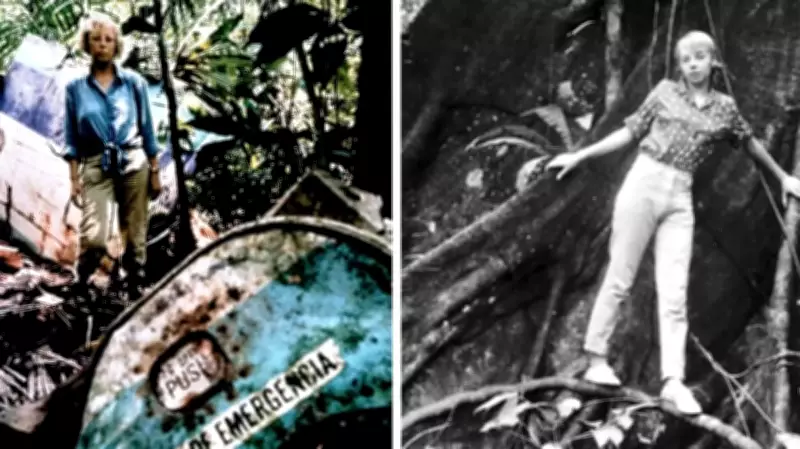
The Unimaginable Survival of Juliane Koepcke
At just 17 years old, Juliane Koepcke was not seeking adventure or fame. She was simply trying to return home for Christmas with her mother. On December 24, 1971, they boarded LANSA Flight 508 in Lima, Peru, destined for Pucallpa and then their family's biological research station deep in the Amazon rainforest.
A Catastrophic Mid-Air Disaster
Approximately twenty minutes before their scheduled landing, the peaceful sky transformed into a violent storm. A powerful lightning strike directly hit the aircraft, causing it to disintegrate mid-air. Koepcke, still securely fastened in her seat, was violently ejected from the disintegrating plane and plummeted toward the dense rainforest canopy below.
Miraculously, she was the only person among all passengers and crew to survive the catastrophic crash.

Waking Up in a Green Nightmare
What makes Koepcke's account so profoundly haunting is not merely the scale of the tragedy, but the surreal imagery it evokes: a teenage girl falling through open air and regaining consciousness beneath the Amazon canopy, with jungle greenery replacing the sky above.
Reports indicate she fell approximately 3,000 meters—nearly three kilometers—before crashing through the forest layers. Against all odds, she regained consciousness with relatively minor injuries considering the impossible descent she had just endured.
Her torn dress, single remaining sandal, and the profound shock of finding herself utterly alone in a hostile, unfamiliar green world have become legendary elements of survival folklore. Yet the factual details behind her ordeal are even more startling.
Eleven Days of Relentless Endurance
The plane crash was merely the beginning of her harrowing journey. Koepcke then spent eleven agonizing days navigating through the Amazon's treacherous terrain, transforming survival into an extraordinary test of human endurance.
During those endless days, she confronted:
- Sweltering tropical heat and humidity
- Thick, impassable mud and dense vegetation
- Relentless insect swarms and potential predators
- Overwhelming fear and uncertainty about rescue
She was a wounded, disoriented teenager, completely isolated in one of Earth's most unforgiving environments. That she continued moving forward at all makes her story feel almost supernatural.
A Childhood That Unknowingly Prepared Her
Koepcke was not an unprepared outsider suddenly thrust into the wilderness. She had grown up at Panguana, her parents' biological research station in the Peruvian jungle. Both her parents were accomplished zoologists, and she described herself as a true "jungle child"—raised among the plants, animals, and natural rhythms of the rainforest.
This background proved crucial, because survival in the Amazon requires more than mere physical toughness. It demands:
- Familiarity with the environment
- Patience and mental resilience
- The ability to maintain orientation when panic would be natural
The same forest that had swallowed the aircraft was, in a paradoxical way, a place she fundamentally understood. This knowledge didn't make her ordeal easy, but it likely made her eventual escape possible.
Why This Story Continues to Captivate
Part of why Koepcke's narrative remains so powerful decades later is its resistance to simplistic interpretation. While it's tempting to frame it as a miraculous headline—and the miracle is genuine—the story contains deeper, more complex layers:
- Profound personal loss (her mother perished in the crash)
- The brutal randomness of survival
- The psychological weight of being the sole survivor
Following initial media attention, Koepcke deliberately withdrew from public life, refusing to become a conventional celebrity survivor. This intentional silence has paradoxically amplified the story's impact, preserving its raw authenticity.
The Enduring Legacy of Her Survival
More than fifty years later, Juliane Koepcke's experience remains astonishing: a seventeen-year-old girl, the only surviving passenger, walking for eleven days through the Amazon after her plane disintegrated mid-air.

Yet the deeper narrative is quieter and profoundly personal. It's about:
A daughter flying home to her father.
A mother who didn't survive the crash.
A girl raised by scientists who had learned to interpret the forest's language long before it became her only path to safety.
Her story serves as a powerful reminder that survival rarely appears heroic in the moment. More often, it manifests as slow, stubborn movement—one deliberate step after another—through fear, pain, and exhaustion.
Perhaps this is why Koepcke's account lingers long after the initial shock has faded. It's not merely about surviving a fall from the sky. It's about what it truly takes to keep moving forward when everything familiar has suddenly vanished.





