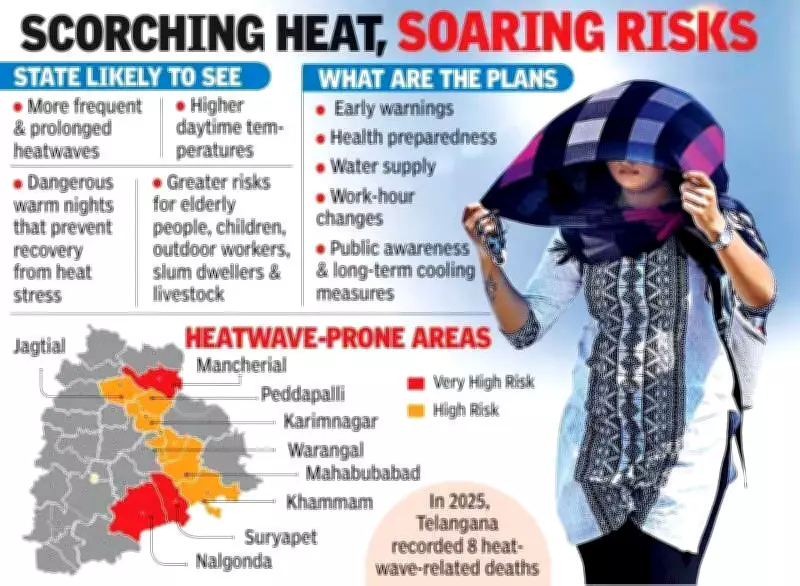
The Telangana government has unveiled its 'Heatwave Action Plan 2026' as the state braces for another intense summer. Several districts, including Adilabad, Nirmal, Jagtial, Kumuram Bheem Asifabad, Mancherial, and Mulugu, have been listed as highly vulnerable to heatwaves.
Key Measures Under the Plan
The plan emphasizes preparedness through an early warning system featuring 1,091 automated weather stations, mandal-level monitoring, color-coded alerts, three-day forecasts, and the TS-Weather mobile app. Alerts will be disseminated via SMS, WhatsApp, and LED displays. Cooling centers will be established in schools, community halls, and bus stands, along with 'chalivendrams' providing drinking water and buttermilk. Hospitals will stock ORS and IV fluids, and emergency services '108' and '104' will be activated. School and labor timings will be revised to avoid peak afternoon heat.
Criticism from Experts
Despite these measures, the plan has drawn sharp criticism from environmentalists, climate researchers, and urban planners. They argue that it barely addresses the root causes of Telangana's worsening heat conditions.

Dr. T V Ramachandra, environmental scientist at the Indian Institute of Science (IISc), Bengaluru, stated: 'When you replace lakes with concrete and trees with buildings, you're not just changing the landscape, you're changing how the weather behaves locally. This trapped heat pushes temperatures up, which can in turn contribute to more convective activity, resulting in heavier downpours.' He added that excessive concretization has led to erratic rainfall distribution, reduced groundwater recharge, and worsening urban heat stress.
Urbanization and Ecological Concerns
Critics say Telangana's cities are 'baking under their own infrastructure,' pointing to unchecked urbanization, widening roads, shrinking lakes, falling groundwater levels, and continuous loss of tree cover. They cite the recent removal of over 100 acres of greenery in Kancha Gachibowli and protests over tree felling near KBR National Park as examples of ecological concerns being sidelined for development projects.
Uday Krishna, an environmentalist from Vata Foundation, noted: 'Every day, we receive calls of tree felling. The very districts listed as highly vulnerable — Adilabad, Bhadradri Kothagudem, Kumuram Bheem Asifabad, and Nirmal — all witnessing intense heat conditions, have seen degradation of surrounding forest areas.' He further highlighted encroachments into continuous forest stretches in Mulugu and Jayashankar Bhupalpally, while Hyderabad and Rangareddy have steadily replaced natural landscapes with layouts, roads, and commercial infrastructure. 'There are also recently approved road projects through Eturnagaram Wildlife Sanctuary and diversion of forest lands in Nalgonda and Nagarkurnool districts for reservoir projects. Lesser trees mean lesser shade and lesser evapotranspiration. Land heats up faster, nights remain warmer, and heatwaves intensify,' he added.
Broader Climate Implications
Experts warn that the consequences extend beyond heat. According to National Remote Sensing Centre (NSRC) data, nearly 67% of rainwater in urban areas now escapes as surface runoff instead of percolating into the soil, worsening both water scarcity and urban flooding.
Professor Anjal Prakash, author with the Intergovernmental Panel on Climate Change (IPCC) and research director at Bharti Institute of Public Policy, ISB, said rising greenhouse gas emissions, deforestation, industrialization, and vehicular pollution are contributing to warming land and sea temperatures. He also noted that erratic rainfall patterns hint at broader climate change issues.
Call for Sustainable Urban Planning
Experts caution that without significant intervention, such weather trends may become the new normal. G Sailu, environmental scientist with the Union Ministry of Environment, Forest and Climate Change, said: 'This is a wake-up call for both policymakers and citizens. We need urban planning that factors in climate resilience, reviving lakes, increasing green cover, and preparing infrastructure for more volatile weather.'

Unless governments address forest diversion, lake encroachments, and unsustainable urban growth, adaptation measures alone may offer only temporary relief. 'The state is simultaneously announcing heat mitigation plans while clearing green cover for roads, layouts, and reservoirs. That contradiction itself explains why every summer is becoming harsher than the last,' Sailu concluded.