

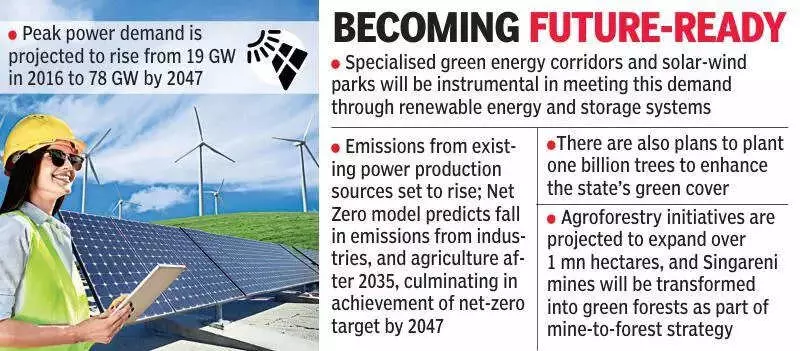
The Telangana government has unveiled an ambitious and comprehensive strategy to achieve net-zero emissions by 2047, marking a significant milestone in the state's environmental leadership. This groundbreaking initiative forms the core of the Telangana Rising 2047 plan, which envisions transforming the state into a "Living Carbon State" with 50% greenery coverage by 2047.
Revolutionizing Transportation and Energy Infrastructure
One of the most ambitious targets in the roadmap involves completely transforming the state's transportation system. The government aims to achieve 100% electric transportation by 2030, with projections indicating that Hyderabad will host the largest electric bus fleet in the entire country. This massive shift will be supported by the establishment of 6,000 public charging stations across Telangana by 2030.
The energy sector is set for a massive overhaul with the recently announced Green Energy Policy 2.0, which aims to create a cohesive legal framework integrating renewable energy, grid systems, and storage infrastructure. Currently, Telangana boasts an impressive renewable energy capacity of 11,399 megawatts, with plans to add an additional 20,000 megawatts by 2030.

Transforming Agriculture and Industrial Sectors
The agricultural sector is undergoing a significant transformation, particularly in districts like Ranga Reddy, Nagarkurnool, and Jogulamba Gadwal, where solar agriculture is entering a new phase. In regions including Nalgonda, Suryapet, Siddipet, and Karimnagar, the government is focusing on reducing water consumption in rice cultivation while achieving higher yields.
Key strategies include installing energy-efficient solar pumps, developing solar microgrids, introducing electric tractors, establishing biochar production facilities, and completely prohibiting stubble burning. A specific environmental target aims to reduce methane emissions from livestock by 30% to 40%.
The industrial sector is set for equally dramatic changes, with plans to establish shared carbon capture and storage infrastructure across various industries. Pilot carbon capture and storage projects are already being initiated at power plants in Ramagundam, Singareni, and Bhadradri to effectively mitigate carbon emissions.
Waste Management and Green Industrial Transformation
Through the Telangana Waste to Wealth initiative, the government aims to minimize waste generation, promote resource recycling, and transform urban areas into clean, sustainable industrial hubs. Starting from 2030, landfilling of organic waste will be completely banned across the state.
Substantial infrastructure projects include biomethanation and biochar production facilities in Hyderabad, Warangal, Karimnagar, and Nizamabad. Additionally, methane capture and compressed biogas plants will be developed in Jawahar Nagar, Warangal, and Khammam. A major facility capable of generating 200 megawatts of electricity from waste will be constructed within the Greater Hyderabad Municipal Corporation area.
The industrial transformation includes converting 80% of red and orange industries within the Outer Ring Road into eco-industrial parks by 2030. This initiative will be supported by a Green Industrial Fund specifically designed to promote low-carbon technologies. Districts such as Peddapalli, Nalgonda, and Yadadri Bhuvanagiri are poised to become centers for floating solar projects, while large-scale battery energy storage systems are being developed in regions including Shankar Palli and Ramagundam.
The Telangana Mobility Valley is expected to position the state as a national hub for electric vehicle manufacturing and hydrogen technologies. Digital monitoring, reporting, and verification systems will guide micro, small, and medium enterprises through their green transformation, utilizing digital tools to track production, emissions, resource usage, quality, and performance.
The comprehensive net-zero roadmap targets near-elimination of emissions from waste, industries, agriculture, and animal husbandry by 2047, with the ultimate goal of reducing greenhouse gas emissions by over 90% within the same timeframe.






