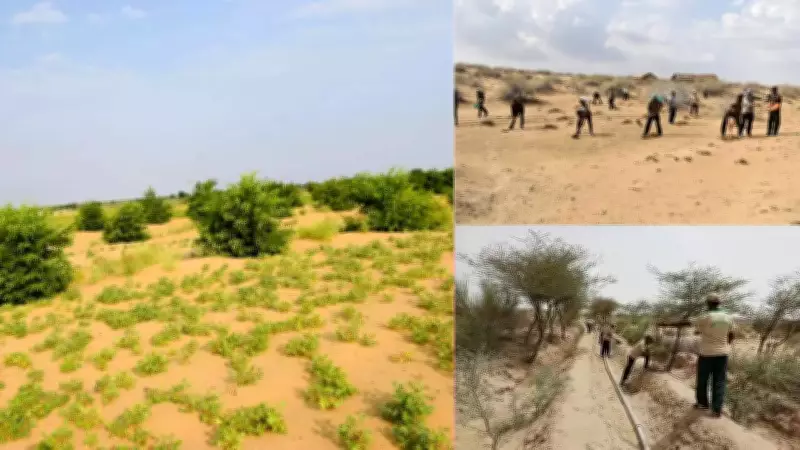
JAISALMER: Over the past four decades, India's Thar Desert has undergone a remarkable transformation. Once known for its vast stretches of barren sand, extreme temperatures, and scarce rainfall, large parts of the desert are now supporting thriving agriculture.
Satellite imagery and scientific studies reveal a significant increase in vegetation cover across western Rajasthan, raising an important question: Is this a sustainable agricultural success story or an emerging environmental challenge?
The Transformation of the Thar Desert
The Thar Desert, also known as the Great Indian Desert, covers nearly 320,000 square kilometres and accounts for around 10 percent of India's land area. Temperatures frequently exceed 50 degrees Celsius, while rainfall remains sparse and highly seasonal. For decades, the region was regarded as unsuitable for large-scale agriculture.

The turning point came with the expansion of major irrigation projects, particularly the Indira Gandhi Canal Project (IGNP). Extending nearly 650 kilometres, the canal has carried water from Punjab's river systems deep into the desert districts of Rajasthan. Combined with traditional water-harvesting systems such as taankas and khadins, the project has enabled cultivation across nearly 1.86 million hectares of land. Today, regions that once consisted of shifting sand dunes produce substantial quantities of wheat, mustard, cotton, mung bean, and other crops. Rajasthan has emerged as the country's leading mustard-producing state, while improved agricultural productivity has strengthened food security and created employment opportunities for thousands of rural families.
Factors Behind the Greening
According to former director of the Arid Forest Research Institute (AFRI), MR Baloch (IFS), several factors have contributed to the increase in greenery across western Rajasthan. Apart from the canal network, extensive afforestation drives over the past seven decades, social forestry programmes, plantation activities along roads and canals, and large-scale environmental initiatives have played a significant role.
He noted that schemes such as MGNREGA have supported water conservation, pasture development, pond construction, and plantation activities in rural areas. Modern agricultural practices, including agroforestry, drip irrigation, and improved plantation techniques suited to sandy soils, have further enhanced vegetation growth.
Baloch said Government data also reflects this trend. According to the Forest Survey of India, Rajasthan recorded a notable increase in green cover between 2013 and 2023, with forest cover rising by approximately 26.38% and tree cover by nearly 37.9%.
Environmental Impacts
Senior groundwater scientist and in-charge of the ground water board department, Dr Narayan Das Inkhia, said the growing greenery is gradually changing the environmental landscape of western Rajasthan. Increased vegetation has contributed to higher moisture levels, reduced evaporation rates, and a rise in average rainfall in parts of the desert. Rising groundwater levels near canal networks have also provided additional support to agriculture while reducing dependence on irrigation water.
However, experts caution that the desert's green revolution carries environmental risks. Excessive irrigation has led to rising groundwater levels and increasing soil salinity in some regions. Poor natural drainage causes waterlogging, while mineral-rich groundwater leaves salt deposits on the soil surface after evaporation, reducing long-term soil fertility.
Former maharawal of Jaisalmer, Chaitanya Raj Singh, emphasized that while irrigation, modern farming practices, and farmers' efforts have transformed the region, the ecological costs must not be ignored. He warned that the desert's unique ecosystem, native grasslands, wildlife, and bird habitats are facing increasing pressure due to changing land-use patterns.
Balancing Growth and Sustainability
Experts advocate precision irrigation, groundwater management, satellite-based monitoring, and conservation-focused planning to balance agricultural growth with environmental sustainability. The story of the Thar Desert remains one of India's most remarkable development achievements, yet it also serves as a reminder that long-term prosperity depends on protecting the fragile ecosystem that makes the region unique.