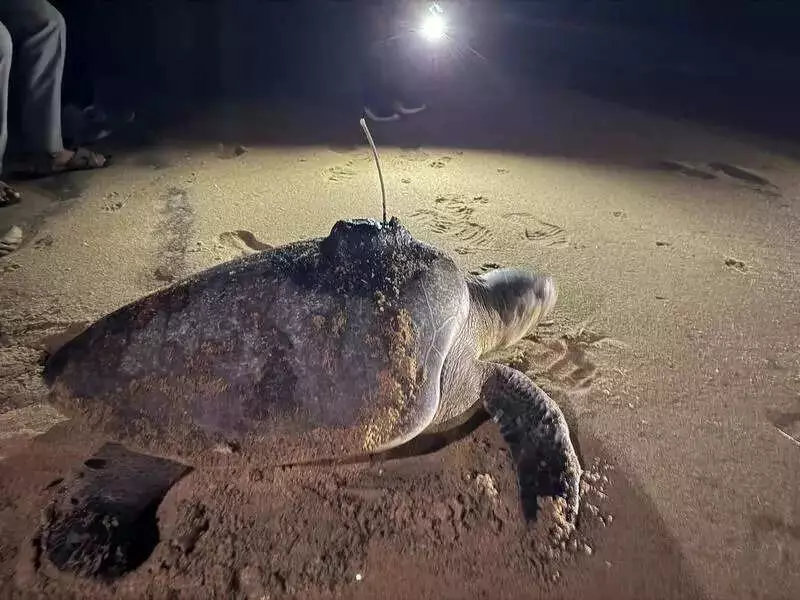
In a landmark move for marine conservation in Tamil Nadu, state wildlife authorities successfully deployed a satellite transmitter on a female Olive Ridley sea turtle this Thursday. The historic event took place on Besant Nagar beach in Chennai after the turtle completed its nesting process.
A Pioneering Step for Turtle Conservation
State Forest Secretary Supriya Sahu announced that this is the first instance of satellite tagging a sea turtle in Tamil Nadu. The device will enable scientists to monitor the reptile's journey across the ocean in real time. "The satellite transmitter will enable real-time monitoring of the turtle's movements in the ocean," Sahu stated, highlighting the project's significance.
The initiative is a collaborative effort involving researchers from the Wildlife Institute of India, the Tamil Nadu Advanced Institute for Wildlife Conservation and Research, and the Chennai wildlife circle. Together, they will analyze the satellite data to trace the turtle's path. The forest department has proposed tagging a total of 20 sea turtles along the state's coastline during the current nesting season.

Meticulous Tagging Process and Vital Statistics
After the turtle laid its eggs, officials briefly held it in a box on the beach. Researchers then conducted a detailed examination, which included:
- Recording a series of morphometric measurements.
- Weighing the animal, which came in at approximately 40 kg.
- Preparing the carapace (shell) by lightly scrubbing it with sandpaper, cleaning it with water, and treating it with ethanol and acetone.
- Securely attaching the satellite transmitter.
Based on its size and the large clutch of more than 130 eggs it laid, officials identified the turtle as a likely first-time nester. They estimated its age to be between 25 and 30 years. The satellite transmitter is programmed to send data every hour, providing an unprecedented, detailed log of its oceanic travels.
Long-Term Goals for Species Protection
Supriya Sahu explained the broader conservation objectives behind the tracking project. "This will help us identify congregation areas, foraging grounds and nesting habitats," she said. Understanding these patterns is crucial for developing effective protection strategies for the vulnerable Olive Ridley species.
In addition to the satellite program, the department plans a large-scale flipper tagging exercise. Over multiple nesting seasons, officials aim to tag about 5,000 Olive Ridley turtles along the Tamil Nadu coast. Flipper tagging will generate long-term data on nest site fidelity, movements between different rookeries, and survivorship rates. This information is vital for shaping future conservation management plans.
This dual-tagging approach marks a significant advancement in Tamil Nadu's efforts to study and safeguard its marine turtle populations, combining cutting-edge technology with traditional methods to ensure their survival.