

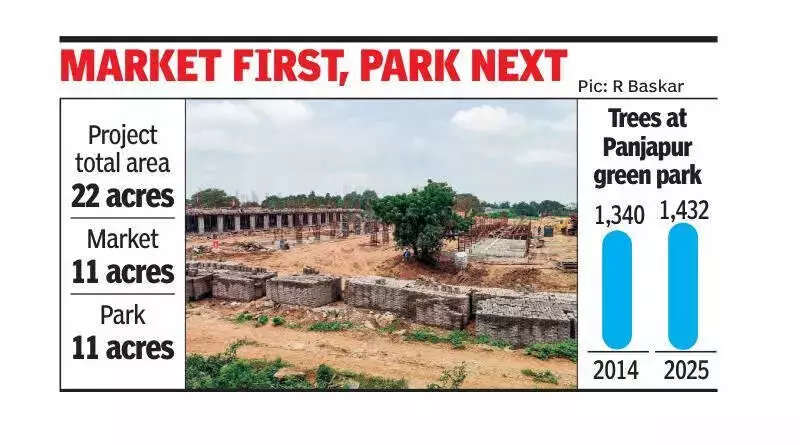
The development of a promised public park in Panjapur, Trichy, has been pushed to a later date, causing significant concern among environmental activists and local residents. The Trichy Corporation has stated that the park will only be developed after the construction of a new integrated vegetable market is fully completed. This decision comes despite a Madras High Court directive to retain half of the project site specifically for green space.
Court Order and Broken Promises
The controversy began when the state government decided to develop a massive vegetable market at a cost of ₹236 crore on a site along the Trichy-Madurai National Highway that was originally earmarked for a green park. Environmentalists, led by the Green Park Protection Committee, challenged this move in the Madras High Court. In response, the court directed the local body to retain 11 acres—half of the total project site—for the development of a public park.
However, members of the committee now report that while construction of the market is progressing rapidly, the space for the public park has not been formally demarcated on the ground. "Several trees have been cut silently at the project site," said K Chandrasekar, one of the petitioners. He revealed that in response to an RTI query, the corporation stated it would mark boundaries and develop the park only after work on the integrated market is finished.

Loss of Green Cover and Public Funds
The environmental cost of the project is already substantial. The original Panjapur green park was home to 1,432 trees. Furthermore, the local body had engaged the community in its upkeep, collecting annual sponsorship from 312 residents for maintaining specific trees. Residents argue that since public funds were used to develop a part of the original park, the corporation has a responsibility to earmark the space and develop the new public park simultaneously with the market construction, not sequentially.
Corporation's Justification and Public Disappointment
A source from the Trichy Corporation defended the decision, citing practical difficulties. The concern is that developing a park adjacent to an active, large-scale construction site would make its upkeep nearly impossible, as ongoing work would likely disrupt and damage the green space. "Soon after work for the market is completed, we will redevelop the remaining park area for public use," the source assured.
This explanation has done little to assuage the worries of environmentalists and citizens. They see the delay as a potential risk that the promised green lung for the area might be further compromised or neglected. The situation highlights the ongoing tension between urban development projects and the preservation of essential environmental spaces in growing cities like Trichy.






