

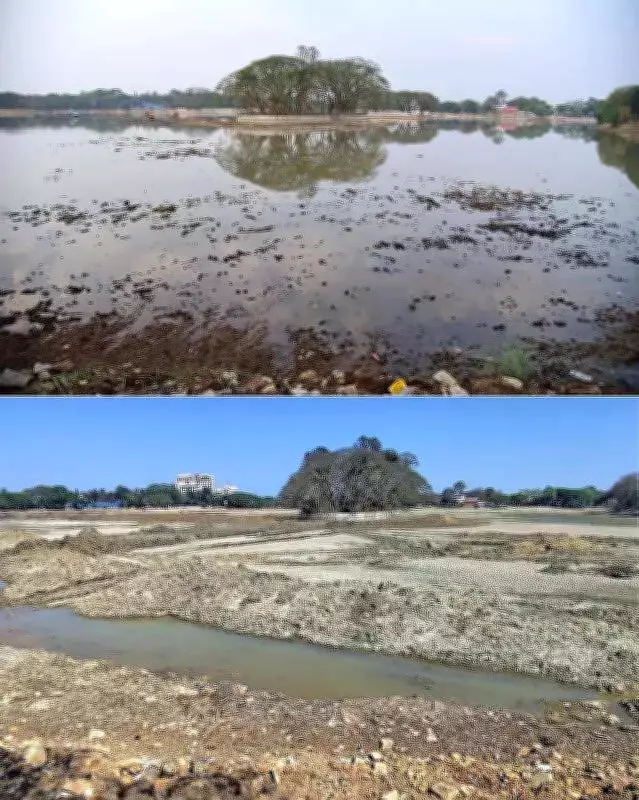
Bengaluru: The redevelopment and desilting of Ulsoor Lake, initiated nearly two decades after major restoration efforts, has encountered a temporary halt following recent rainfall that refilled certain areas. This has slowed critical desilting work ahead of the monsoon season.
Project Details and Current Status
The rejuvenation project, costing nearly Rs 25 crore, encompasses desilting and upgrades to civic infrastructure at this historic waterbody. However, rainwater inflow after April 19 has complicated excavation efforts. Engineers from the Bengaluru Central City Corporation stated that the future of desilting now hinges on the intensity of pre-monsoon showers expected through May. "We will wait for the next three days based on weather forecasts. The only way forward is to dewater the lake again and resume desilting," an engineer explained. "As of now, we have opened the channel to ensure water flows out and does not remain stored in the lake."
Officials added that if heavy pre-monsoon showers persist, authorities may have no choice but to pause desilting until the monsoon concludes. "We hope to get rain-free days before the monsoon fully sets in so we can complete the remaining work," the engineer said, noting that around 60% of desilting has been completed so far. Civil works, however, are expected to continue irrespective of rain and remain on track for completion within the 11-month project timeline.

Plastic Waste: An Unexpected Challenge
As work progresses, officials have encountered an unforeseen obstacle: massive quantities of plastic waste buried deep beneath the lake bed. "As we dig, more and more garbage is surfacing. We did not anticipate this at such a scale," the engineer remarked. Desilting is currently being carried out only to a depth of 0.5 to 0.6 metres, significantly less than the originally proposed 1.5 metres, limiting the extent of lake restoration. The presence of plastic waste has further complicated operations.
Unlike silt, embedded garbage cannot be removed using heavy machinery and would require manual labour, which was not included in the original project scope. "Even if we dig deeper, we are likely to continue finding garbage. Most of it enters through stormwater drains," the engineer said, adding that authorities have yet to devise a mechanism to systematically remove the accumulated waste without delaying the project.
Citizen Opposition to Concretisation
The redevelopment has drawn sharp criticism from environmental activists and citizens, who allege ecological degradation, excessive concretisation, and alteration of the lake's natural structure. A recent citizen inspection of the lake sparked concerns over the pace and nature of work. Activists claimed that while authorities had assured round-the-clock desilting to prepare for the monsoon, activity at the site appeared minimal. "We were told machines would run 24/7 to prepare for the rains. Instead, much of the site appeared idle during the day," said Rajgopalan R, founder of Bengaluru Coalition, a civic forum.
Among the strongest criticisms are allegations of overuse of concrete along the lake bund and damage to surrounding ecology. Vinod Jacob, an activist, described a recent visit to the lake as "a heartbreaking eye-opener," alleging that steel and concrete are transforming the waterbody into a "sterile water tank." "Bengaluru deserves better. We need to protect our lakes, not pave them over," he said, raising concerns over tree roots being exposed and the possibility of trees collapsing during the monsoon.

Walkway of Contention
At the centre of citizen criticism is the construction of a nearly 15-foot-wide concrete walkway, which activists claim extends around 20 feet into the lake bed, replacing an existing mud pathway and modifying the natural bund slope. "There are reasons why lake bunds are designed with gradual slopes. What is being built now is vertical, heavily concretised and ecologically damaging," Rajgopalan said, adding that fish populations and bird activity around the lake have also reduced. Citizen groups are now considering approaching the National Green Tribunal, arguing that such redevelopment models could be replicated across other city lakes if left unchecked.





