US Expands Military Footprint in Gulf Amid Escalating Iran Tensions
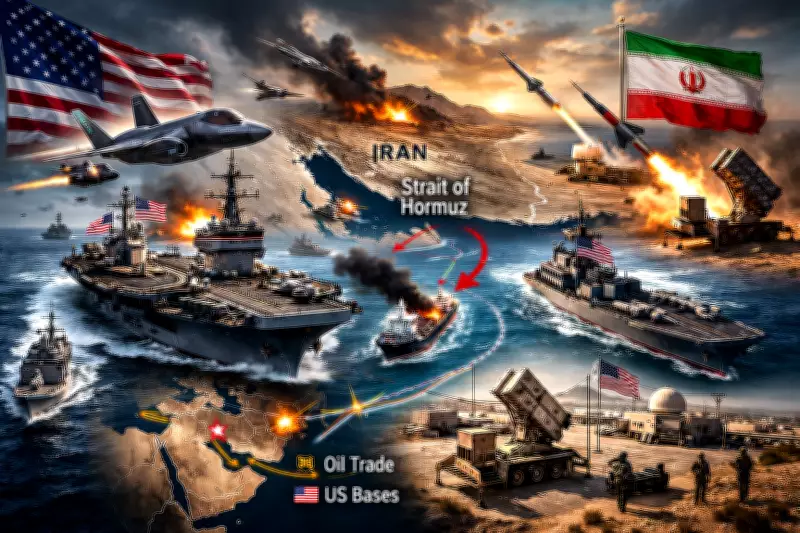
The United States has dramatically increased its military presence in the Gulf, assembling one of its most formidable regional deployments in recent memory. This strategic build-up involves warships patrolling vital sea lanes, stealth fighter jets repositioned to Middle Eastern bases, reinforced missile defense systems, and the deployment of two aircraft carrier strike groups to the area.
Washington Cites Iran Nuclear Program and Strait Security
American officials have directly linked this military expansion to ongoing tensions with Iran, particularly concerning Tehran's nuclear ambitions. The deployment is also framed as a measure to ensure security in the strategically crucial Strait of Hormuz, a global energy artery through which nearly 20% of the world's oil and gas supplies transit.
This military posture follows Iran's recent live-fire naval exercises, during which Tehran temporarily closed sections of the Strait of Hormuz for several hours. Iranian media reported missile launches from coastal and inland positions into designated maritime zones, highlighting the potential for disruption in this vital waterway.

Dual Carrier Strike Groups Form Naval Centerpiece
At the heart of Washington's Gulf military strategy are two powerful aircraft carrier strike groups—a deployment scale not witnessed in the region for years. The USS Abraham Lincoln is currently operating approximately 150 miles off Oman's coast in the Arabian Sea. This nuclear-powered Nimitz-class carrier leads a formidable strike group featuring Arleigh Burke-class guided-missile destroyers equipped with Tomahawk land-attack cruise missiles, Aegis air-defense systems, and advanced anti-submarine capabilities.
Simultaneously, the USS Gerald R. Ford—the U.S. Navy's most technologically advanced carrier—has entered the Mediterranean Sea after crossing the Atlantic. This deployment creates a two-axis strike geometry, allowing American forces to approach potential Iranian targets from multiple directions while complicating Tehran's defensive planning.
Comprehensive Naval and Air Power Deployment
The current U.S. military configuration in the region includes approximately 15 destroyers positioned across the Persian Gulf, Red Sea, and eastern Mediterranean, alongside submarines operating discreetly in theater. Collectively, these naval assets possess the capability to launch more than 600 Tomahawk cruise missiles—precision weapons designed to strike hardened infrastructure, missile batteries, and air-defense networks from considerable distances.
Complementing this naval power, Washington has quietly reinforced its air dominance capabilities. Satellite imagery and flight tracking data indicate that approximately 18 F-35A Lightning II stealth fighters have redeployed to Muwaffaq Salti Air Base in eastern Jordan from RAF Lakenheath. With additional aircraft already stationed in theater, the base's potential order of battle now includes around 30 F-35As, supported by F-15E strike fighters, EA-18G Growler electronic warfare aircraft, A-10 ground-attack jets, and MQ-9 Reaper drones.
Strategic Implications of Strait of Hormuz Tensions
The Strait of Hormuz represents one of the world's most critical economic chokepoints, with approximately 20 million barrels of oil passing through daily. Nearly half of India's crude imports and about 60% of its natural gas imports transit these waters, with China, Japan, and South Korea also heavily dependent on this maritime corridor.
Iran's temporary closure during recent drills, though brief, sent significant signals to global energy markets. Tehran's parliament has supported closure measures, though ultimate authority rests with the Supreme National Security Council under Supreme Leader Ayatollah Ali Khamenei, who has warned that even "the strongest army in the world" could suffer irreversible damage.

Asymmetric Military Balance and Strategic Uncertainty
While the United States maintains overwhelming conventional military superiority with its global reach, advanced surveillance networks, stealth aviation, and integrated command systems, Iran possesses significant asymmetric advantages. Tehran's strength lies in its geographic position along the Strait of Hormuz, its dispersed and hardened military installations, and its substantial investment in short- and medium-range ballistic missiles, cruise missiles, and sophisticated drones.
Iran's military strategy emphasizes layered defense rather than direct confrontation, including Revolutionary Guard naval units employing fast-attack craft and swarm tactics, along with networks of allied militias and proxy forces across Iraq, Syria, Lebanon, and Yemen. This creates multiple potential pressure points that could be activated in response to any U.S. military action.
Diplomatic Context and Potential Scenarios
Indirect nuclear negotiations continue in Geneva, with both sides acknowledging limited progress but deep differences. Washington insists any agreement must curb uranium enrichment and address elements of Iran's missile program, while Tehran maintains enrichment as a sovereign right and resists linking missiles to nuclear discussions.
The current military build-up has sharpened diplomatic leverage while simultaneously narrowing the margin for error, as even minor incidents could derail negotiations. Potential U.S. actions include targeted strikes on nuclear or missile facilities, reliance on missile defenses to absorb retaliation, or using military pressure to force stricter negotiation terms.
Iranian response options could involve striking U.S. bases across the Gulf using missile saturation tactics, disrupting the Strait of Hormuz through naval or missile action, or activating proxy networks across multiple regional fronts.
Global Stakes and Calculated Brinkmanship
The Gulf region currently resembles a tightly packed strategic chessboard, with carriers and destroyers patrolling strategic waters, stealth aircraft operating within range of Iranian airspace, and missile systems on both sides remaining alert. In this environment, miscalculation represents the greatest danger, as a drone interception, missile test, naval encounter, or error in judgment could trigger rapid and difficult-to-contain escalation.
Whether this military posture remains calibrated deterrence or shifts into direct conflict will depend on political decisions in coming weeks. The stakes extend far beyond the Gulf, potentially affecting global energy markets, regional alliances, and the broader balance of power in the Middle East—precisely why Washington must carefully weigh the costs before taking any final steps.