

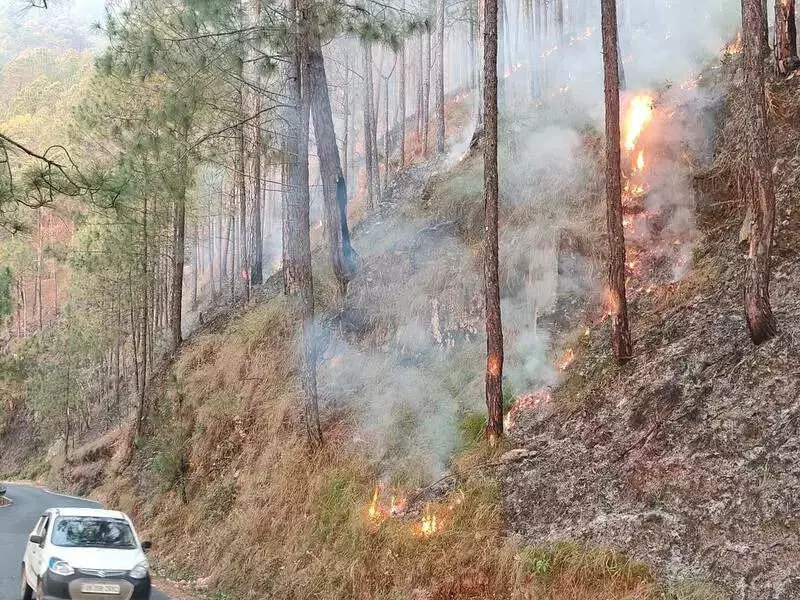
The Uttarakhand High Court has once again voiced its deep frustration over the state government's persistent inaction in tackling the recurring menace of forest fires. During a hearing on Friday, the court highlighted the administration's failure to implement a series of judicial directives issued since 2021, meant to protect the Himalayan forests from devastating blazes.
Court's Frustration Over Paper Compliance
A division bench comprising Chief Justice G Narendar and Justice Subhash Upadhyay heard the matter, where the amicus curiae (friend of the court) presented a grim picture. The counsel informed the bench that despite repeated orders over the past three years, no effective steps have been taken on the ground. "Every fire season, the forests of Uttarakhand continue to burn. Whatever compliance has been filed is merely on paper," the amicus submitted.
The court concurred with this assessment, noting that if its directions had been implemented sincerely, the incidence of forest fires would have seen a significant reduction. Chief Justice Narendar pointedly observed that whatever actions the state had taken were only in compliance with court orders, and no concrete, independent measures had been initiated by the government itself.

Key Recommendations and Postponed Hearing
The hearing was notable for the scheduled briefing by environmentalist Professor Ajay Rawat, who was to present expert recommendations on forest-fire prevention via video conference. However, due to network issues, his presentation was postponed. The court accepted his request and rescheduled the next hearing for December 10, 2024.
In the meantime, the bench reiterated several crucial recommendations. A primary focus was on reviving and constructing traditional water channels known as 'khaals' in the higher Himalayan regions. The court directed that water from natural sources be stored in these channels and that they be interconnected to form a network. This system is envisioned to act as an effective fire line during the peak fire season. Importantly, the court ordered that khaals be created even in areas lacking natural water sources.
A History of Unheeded Directives
The bench recalled that it had taken suo motu cognisance of the issue back in 2021, prompted by newspaper reports on widespread forest fires. The State Legal Services Authority had also sought judicial intervention to protect forests, wildlife, and the environment, leading to several directives. "However, the directions remain largely unimplemented, necessitating revival of the case," the court noted.
The failure spans years. The High Court revealed that as early as 2017, it had issued comprehensive guidelines for forest-fire prevention. These included forming village-level committees and conducting mass awareness campaigns. "To date, these instructions have not been enforced," the bench stated bluntly.
The amicus curiae also critiqued the current firefighting strategy, highlighting the high cost and limited effectiveness of using helicopters to douse fires. Instead, he strongly advocated for strengthening village-level fire management committees, arguing that local groups could respond to outbreaks faster and more effectively than centralised systems.
The court has consistently warned that forest fires are not just a seasonal nuisance but a major ecological threat. In earlier hearings, the bench noted that these fires are accelerating temperature rise across the higher Himalayas and contributing to extreme weather events like cloudbursts, leading to loss of life and property. The upcoming December hearing will see if the state can finally present a credible plan for action, moving beyond mere paper compliance to tangible, life-saving measures on the ground.






