Wargame Simulation Exposes NATO Vulnerabilities in Baltic Region
A comprehensive military wargame conducted by former NATO, German, and European officials has delivered a stark warning: Russia could "achieve most of its goals" in the Baltic states within mere days. The simulation highlights how Moscow could exploit hesitation within the alliance and the absence of clear leadership from the United States to secure strategic advantages.
Detailed Scenario Set in October 2026
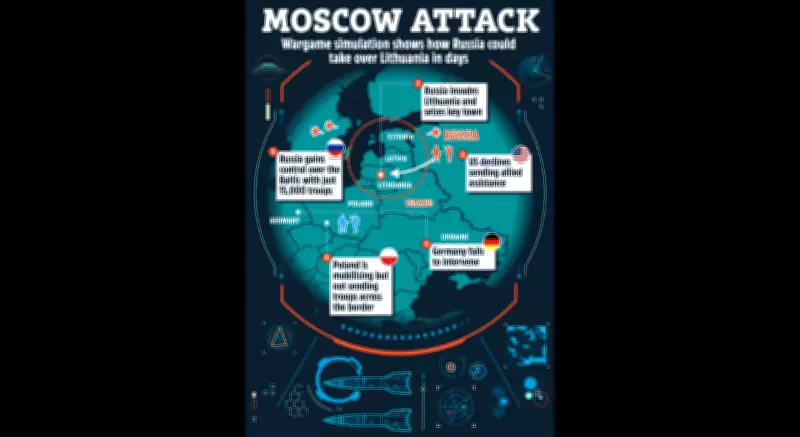
The exercise, jointly organized in December by Die Welt newspaper and the German Wargaming Centre at Helmut Schmidt University, played out a fictional yet meticulously detailed scenario set in October 2026. It envisioned Moscow using fabricated claims of a "humanitarian crisis" in the Russian exclave of Kaliningrad to justify a rapid military incursion into southern Lithuania, specifically targeting the critical city of Marijampolė.
Marijampolė represents a vital junction of European infrastructure. The Via Baltica highway, a crucial route used by the European Union and Ukraine, runs southwest toward Poland. Simultaneously, an east-west road connects Belarus and Kaliningrad—a route Lithuania is treaty-bound to keep open for Russian traffic. Control of this city would effectively sever NATO's land connection to the Baltic states, isolating them strategically.

How the Simulated Incursion Unfolded
In the simulation, Russia deployed an initial force of approximately 15,000 troops, framing its advance as a limited humanitarian operation rather than a full-scale invasion. The United States, in a pivotal decision, declined to invoke NATO's Article 5—the collective-defense clause that mandates all members come to the aid of an ally under attack.
Germany, despite having a brigade already deployed in Lithuania, did not intervene after Russian forces used drones to lay mines near a military base. Poland mobilized its forces but ultimately refrained from sending troops across the border. Within days, the game suggested, Moscow had secured effective control over the Baltic theater without escalating into a wider conventional war.
Insights from Participants and Analysts
Bartłomiej Kot, a Polish security analyst who played the role of Poland's prime minister in the exercise, told The Wall Street Journal: "The Russians achieved most of their goals without moving many of their own units. What this showed to me is that once we are confronted by the escalatory narrative from the Russian side, we have it embedded in our thinking that we are the ones who should be de-escalating."
Franz-Stefan Gady, a Vienna-based military analyst who assumed the role of Russia's chief of the general staff, emphasized that Russian success depended less on military strength than on political expectation. "Deterrence depends not only on capabilities, but on what the enemy believes about our will, and in the wargame my 'Russian colleagues' and I knew: Germany will hesitate. And this was enough to win," he explained.
Parallel Exercises and Broader European Concerns
A parallel public-journalistic wargame conducted by Die Welt reached similar conclusions, showing Germany responding initially with sanctions, maritime measures in the Baltic Sea, and internal civil-protection preparations, while avoiding direct military confrontation. As military facts were established on the ground, the burden of escalation shifted decisively onto NATO, making reversal increasingly costly and risky.
The exercise brought together former senior political decision-makers, retired military leaders, and NATO officials, including Oana Lungescu, NATO's former principal spokesperson, and Eberhard Zorn, Germany's former inspector general of the Bundeswehr. Participants operated independently, and the scenario was not scripted, adding to its realism.
The findings emerge amid growing concern across Europe that Russia may pose a more acute threat to NATO sooner than previously assumed. Last year witnessed repeated incursions by Russian drones and aircraft into NATO airspace, which officials and analysts described as probes designed to test alliance responses.

Netherlands Defence Minister Ruben Brekelmans told the Wall Street Journal that his government had assessed that "Russia will be able to move large amounts of troops within one year," adding: "We see that they are already increasing their strategic inventories, and are expanding their presence and assets along the NATO borders."
Warnings from Former NATO Spokesperson
Oana Lungescu, reflecting on the wargame, warned that a frozen or unfavorable settlement in Ukraine could leave Moscow more dangerous, not less. "Russia could become even more dangerous to NATO after some sort of peace in Ukraine, especially if it's a bad peace," she said, calling the simulation "very realistic, unfortunately."
While the scenario was fictional, its designers stressed that its purpose was not prediction but exposure: to reveal how decision-making, hesitation, and alliance politics might unfold under intense pressure, and how quickly military realities could outpace diplomatic intent. This simulation serves as a crucial wake-up call for NATO members to reassess their strategic preparedness and unity in the face of potential threats.