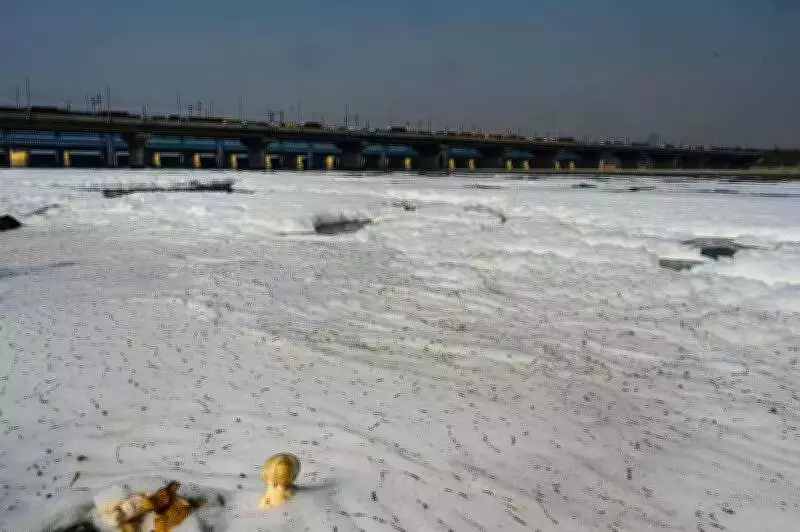
Yamuna River Pollution Resurfaces with Thick White Froth at Kalindi Kunj
New Delhi is witnessing a distressing environmental relapse as the Yamuna River at Kalindi Kunj is once again blanketed with thick white froth. This alarming visual evidence marks the quiet return of severe pollution to this critical river stretch in the national capital.
Lack of Urgent Response Contrasts with Previous Action
While both the characteristic stench and foam have reappeared, the urgency to remediate them appears conspicuously absent. This stands in stark contrast to last October, when the Delhi government swung into action ahead of Chhath Puja with daily inspections and substantial freshwater releases from the Hathnikund Barrage. The current response is marked by official silence.
The Delhi Pollution Control Committee (DPCC) has yet to release any river water quality assessment for January or offer any explanation for the delay. This lack of transparency raises serious concerns about monitoring and accountability.

Political Context and Temporary Solutions
Yamuna pollution dominated public discourse during the 2025 Delhi Assembly elections, with political parties sparring over sewage treatment failures and river rejuvenation promises. The massive freshwater releases from Hathnikund Barrage last October temporarily diluted pollutants, banishing froth and odor, but experts describe this as merely cosmetic and event-driven.
"Wastewater is not being treated. That's why frothing is visible again," said environmental activist Pankaj Kumar. "In October, the river had nearly 10 cusecs of freshwater flow. Now it is virtually nil. Almost all wastewater generated in Delhi-NCR is reaching the river untreated or poorly treated," he alleged.
Structural Problems and Questionable Data
Experts point to structural factors that exacerbate the pollution crisis. The ITO gates remain permanently open while barrages like Kalindi Kunj trap pollutants such as surfactants and phosphates. Questions have been raised about the credibility of DPCC's Yamuna reports for November and December 2025, which were also delayed.
While these reports claimed improvement compared to the previous year, several indicators did not align with ground reality. For instance, at Kalindi Kunj, biochemical oxygen demand (BOD) — which measures the river's capacity to heal itself — reportedly improved in November and December, even as frothing and stench returned after freshwater releases stopped.
"How can the river appear visually clean in October, but show worse BOD readings than November and December when froth returned?" Kumar asked, calling the data "illogical."
Several drains recorded BOD levels exceeding 100mg/l, yet corresponding river stretches showed improvement in official data. The Times of India reported these discrepancies in November 2025 and again this January, while DPCC did not respond to queries.
Environmentalists Warn of Slipping Monitoring
Environmentalists warn that with the river out of the political and festive spotlight, monitoring appears to be slipping. The Central Pollution Control Board does not independently assess the Yamuna in Delhi and relies entirely on DPCC's data.
"The Yamuna was treated like a tap — turned on for elections and festivals, then shut off," said river activist Bhim Singh Rawat. "Without year-round environmental flows and functional sewage treatment plants, frothing will remain a permanent feature."
Long-Term Solutions and Ongoing Projects
The Centre, along with the Delhi government, recently reviewed three long-stalled dam projects on the Yamuna — Lakhwar in Uttarakhand, Renukaji in Himachal Pradesh, and Kishau on the border of both states. These projects, delayed for over 25 years, are expected to bring environmental flow to the river, potentially diluting pollutants.
However, even during the temporary improvement in October, pollution levels remained far above acceptable standards. The recurring froth at Kalindi Kunj serves as a stark reminder that without comprehensive, sustained intervention, the Yamuna's health will continue to deteriorate, posing significant risks to public wellbeing and the ecosystem.