Lahore Roof Collapse Kills 14 Children
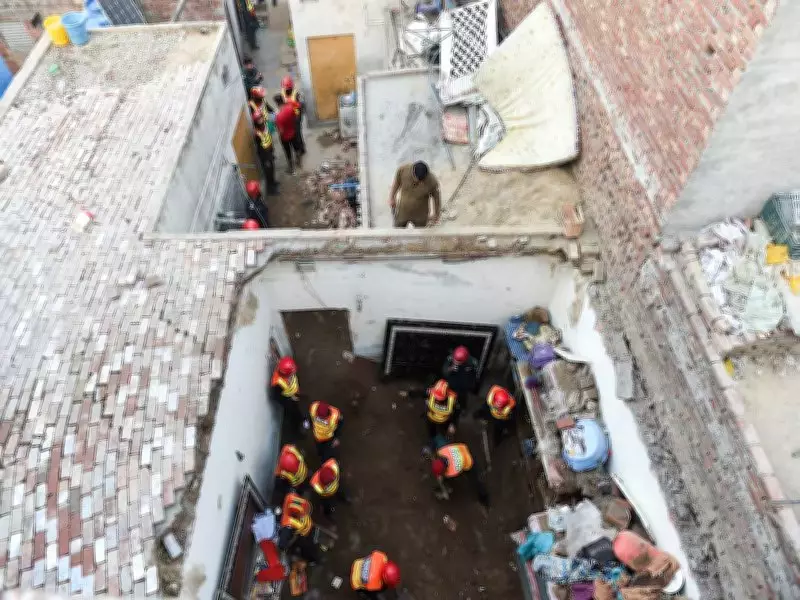
A roof collapse in Lahore's Kahna area on June 30 claimed the lives of 14 children, with affected families pointing to systemic poverty and deep-seated administrative failure in Pakistan rather than individual blame, according to a report by Dawn.
The incident occurred at a home-based tuition centre where children aged five to 14 were being taught. Several other youngsters and their teacher remain under treatment at a local hospital. The tragedy has once again exposed the grim reality faced by impoverished citizens under Pakistan's failing governance.
Families Forgive Teacher, Blame State Neglect
Hassan, a local labourer living on the same dilapidated street, lost his youngest son, five-year-old Arkam. "We have forgiven the teacher for the death of our son," Hassan said while sitting outside her home. The teacher, Anila, who taught children from the locality, was also injured alongside her daughter in the collapse.

A subsequent visit to the site revealed that the house stood empty, as male members of the family had been taken into custody by Lahore police while the women fled the scene.
Hazardous Structures Reflect State Abandonment
The entire neighbourhood comprises almost entirely half-built, hazardous structures mirroring the ill-fated tuition centre. The narrow, winding street eventually connects to a road leading to Katchwana village in Kahna. "Most people here are very poor and build their homes slowly whenever they get some money to afford it," a resident told Dawn, underscoring the lack of state support or enforcement of building regulations for impoverished families.
Locals further revealed that Katchwana Road was originally planned as a 50-foot-wide link to Ferozepur Road, but unchecked encroachments have compromised public safety. "This might not be the last tragedy in this area, as many people have occupied the sewage drain and built houses on top of it," the resident warned, highlighting how a complete lack of municipal oversight has left citizens vulnerable to further disasters.
Two Decades of Deteriorating Conditions
The area's unsafe conditions have worsened over the last two decades, with large families packed into cramped, poorly constructed spaces. Residents frequently add precarious extensions to their homes whenever they manage to scrape together funds. "We are trying to just survive," another resident added in the Dawn report, capturing the desperation of ordinary citizens left entirely to their own devices by the administration.
Recalling his late son, Hassan shared that Arkam was eager to study but had not yet been formally enrolled in a school. "To prepare him for school, we sent him to the tuition centre in the neighbourhood. My other children are not interested in studying, and Arkam's older brother does not go to school as he is training to be a tailor. He [Arkam] wanted to become a police officer," he lamented.
Warnings Ignored Before Collapse
Hassan also revealed a harrowing instance of structural neglect before the collapse, noting that a child had previously been injured by a falling tile. Even the mason working on the building and the children themselves had urged the teacher to dismiss the class. "She did not listen to them, and we lost our children," he regretted, noting that the cash-strapped family was undertaking the construction work independently with just a single labourer.
Following public outrage, Punjab Chief Minister Maryam Nawaz visited the locality to offer condolences, stating that the grief she felt upon receiving news of the children's deaths was beyond words. In a typical knee-jerk reaction by Pakistani law enforcement, government departments detained two individuals, including the property owner. DIG Operations Faisal Kamran confirmed that the contractor who built the structure had also been detained.

Crackdown on Home-Based Tuition Centres Criticised
Further compounding the misery of the poor, Punjab Education Minister Rana Sikandar Hayat announced a crackdown to shut down unregistered academies and schools, with the district education authority actively serving notices. However, critics have slammed the move, questioning how the administration realistically plans to register hundreds of thousands of home-based tuition centres that fill the vacuum left by Pakistan's broken public education system.
Speaking to Dawn, All Pakistan Private School Management Association President Kashif Adeeb Jawadani pointed out that these home-based academies, largely run by female teachers in every neighbourhood, are a direct by-product of the state's economic failures. "Due to the socio-economic circumstances of both the teachers and the parents, such tuition centres and academies are the only option for the poor," Jawadani stated.
He argued that, instead of threatening impoverished citizens with fines and legal cases, the government should have provided a grace period, free registration and long-term financial support. He further questioned the state's high-handedness, asking, "If such educational institutions, along with low-fee private schools, are shut down, what alternative is being provided by the government?"
Recurring Tragedy of State Neglect
The tragedy underscores a grim and recurring reality in Pakistan, where institutional apathy, unchecked structural violations and a failing public education system continue to force the poorest segments of society into hazardous conditions, leaving them to bear the fatal costs of state neglect.