

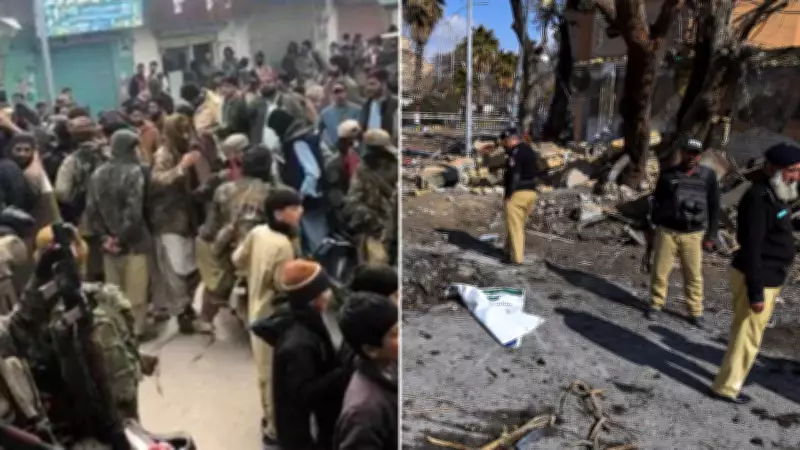
The Balochistan Liberation Army (BLA) rebels have asserted a significant escalation in their ongoing conflict with Pakistani security forces, claiming to have inflicted heavy casualties and captured strategic positions during the second phase of Operation Herof. According to their statements, over 200 Pakistani military personnel were killed in more than 40 hours of coordinated attacks across Balochistan.
Official Casualty Figures and Government Response
Contrasting the rebel claims, news agency AP reported that the offensive raid has resulted in 33 fatalities so far. This includes 18 civilians, among them five women and three children, and 15 security personnel. Provincial Chief Minister Sarfraz Bugti condemned the violence, highlighting an incident where rebels stormed a Baloch labourer's home and killed civilians.
Bugti further countered the BLA's assertions by stating that Pakistani troops had eliminated 145 BLA rebels in the past two days, describing this as the highest number in decades. "The bodies of these 145 killed terrorists are in our custody, and some of them are Afghan nationals," he declared, suggesting external involvement in the insurgency.

Scope and Impact of the BLA Offensive
The BLA issued a detailed statement outlining the scale of their "coordinated" attack, which they say targeted 48 locations across 14 cities in Balochistan. Key urban centers affected include Quetta, Noshki, Mastung, Dalbandin, Kalat, Kharan, Panjgur, Gwadar, Pasni, Turbat, Tump, Buleda, Mangochar, Lasbela, Kech, and Awaran.
In addition to the claimed military casualties, the rebels reported capturing 14 personnel as hostages and causing substantial material damage. They allege destroying over 30 government properties, such as banks, offices, and prisons, and setting more than 23 "enemy" vehicles on fire.
How the Attack Unfolded
The offensive involved a combination of gunfire and suicide bombing attacks across multiple locations in Balochistan. The BLA acknowledged losing seven of their fighters during the operation, including four "Fidayeens" from their elite Majeed Brigade unit, who were female combatants.
BLA spokesperson Jeeyand Baloch emphasized in a statement that their rebels maintained a presence across sites, exerting "decisive pressure" on security forces and local administration. The statement noted that Pakistani forces had failed to regain control in several areas, including parts of Quetta, while cautioning that the casualty figures cited were preliminary.
Operational Details and Rebel Strategy
In a subsequent communication, the BLA detailed the squads involved in the operation, which included the Fateh Squad, the Majeed Brigade, the intelligence wing "ZIRAB", and STOS. "Fateh Squad, the Majeed Brigade, intelligence wing 'ZIRAB', and STOS are advancing across various cities and areas with mutual coordination, placing multiple enemy structures under simultaneous pressure," the statement explained.
The rebels highlighted public support as crucial to their operations, reiterating a policy of non-harm towards locals who do not obstruct their fighters. "The officials were freed on humanitarian grounds, with the BLA reiterating that it does not consider police, Levies, or local civil administration as direct adversaries if they do not resist its fighters," the statement said.
It further clarified, "Local officials who do not obstruct fighters would not be harmed. However, personnel who side with Pakistani security forces or attempt to block BLA operations would be treated as adversaries." This approach underscores the group's attempt to differentiate between combatants and non-combatants in the conflict zone.






