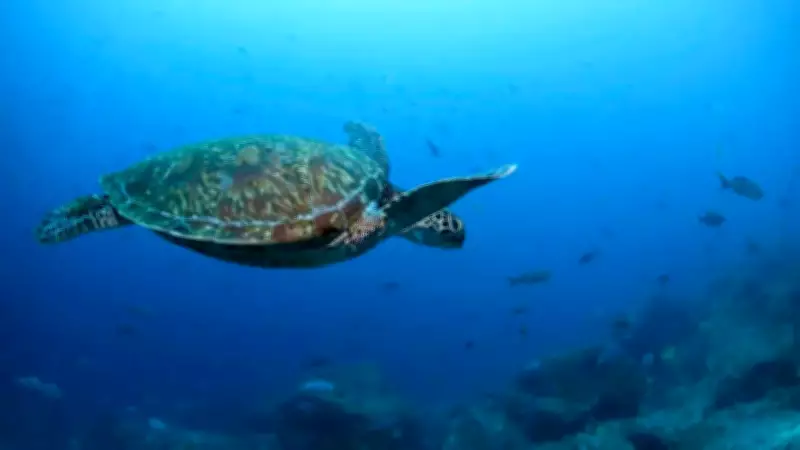
China's Ministry of State Security has alleged that foreign intelligence agencies are deploying marine animals equipped with sensors, such as "spy turtles" and "spy fish," to gather sensitive data in Chinese waters, describing it as part of an "invisible secret war." In a post on the WeChat platform on Friday, the ministry claimed that large marine animals were found with sensors attached while swimming in Chinese waters. These animals were reportedly collecting real-time data on water temperature, salinity, and ocean currents, transmitting the information overseas via satellite. The ministry did not specify where the animals were found or which nations were suspected of overseeing the alleged espionage.
Devices Can Act as Sentries or Lighthouses
The ministry stated that foreign spy agencies have long attempted to analyze Chinese naval activities, create underwater maps of the country's coastline, and monitor its offshore oil and gas deposits. It described several categories of "maritime spies." Some act as underwater "sentries," lurking on the seabed for extended periods to collect hydrographic data and information on vessel movements. Others function as drifting "secret agents" that move with ocean currents. A third category serves as underwater "lighthouses," which the ministry claimed could guide foreign submarines through Chinese waters while concealing their movements. The ministry also reported finding buoys deployed by an overseas marine research institute, equipped with meteorological sensors capable of tracking acoustic signatures of Chinese submarines in real time. It cited a new type of "wave glider" powered by wave motion and solar energy, which it said was transmitting military-related maritime environmental data and information on vessel activities.
Technical Characteristics Outlined
National security agencies said the devices share three characteristics: advanced technical performance enabling long-term automatic operation or remote control; complex and powerful functions including data storage, analysis, and transmission; and a high degree of equipment integration with self-destruct mechanisms that activate after missions are completed. The Chinese government offers financial rewards to fishermen who discover suspected spying equipment in national waters. Incentives reportedly range from 50,000 to 500,000 yuan (approximately £5,500 to £55,000), depending on the significance of the find.

Similar Claims Made in the Past
China regularly makes claims of espionage in nearby waters, including the South China Sea, the East China Sea, and the Taiwan Strait, which are among the most militarily sensitive and heavily contested waterways globally. In 2024, China stated it had identified "lighthouses" hidden on the ocean floor that could guide foreign submarines and "pre-set the field for battle." Allegations of marine animals being used for military purposes are not new. In 2023, British intelligence said Russia was enhancing security at its Sevastopol Black Sea fleet base by deploying trained bottlenose dolphins to counter enemy divers. In 2019, a beluga whale appeared off the Norwegian coast wearing a harness with a mount for a small camera, sparking speculation it had been trained to spy for the Russian navy; Moscow never issued an official response. As with previous statements from Beijing, no external agencies have confirmed the existence or use of animal-mounted tracking systems in Chinese waters.