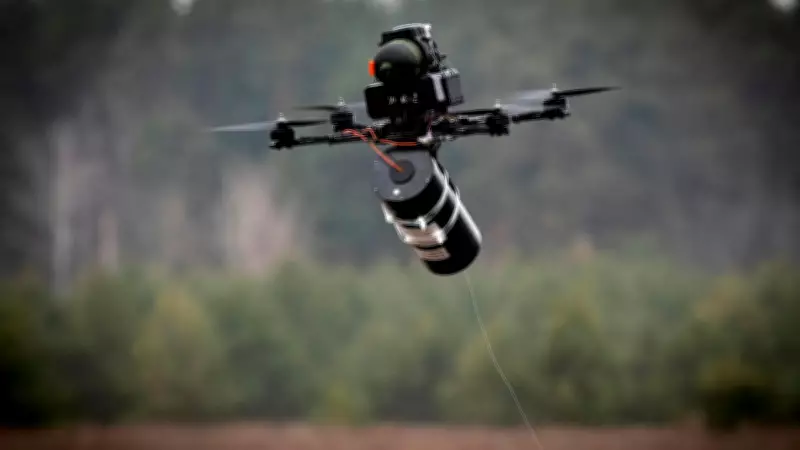
Hezbollah's deployment of inexpensive fibre-optic drones is posing new operational challenges for Israeli troops in southern Lebanon, prompting the military to adjust its tactics in response to an increasingly lethal threat.
The devices are small, inexpensive and widely available, resembling "children's toys," said Orna Mizrahi, a senior researcher at the Institute for National Security Studies. The military "does not have nowadays any response for that, because they didn't prepare themselves for such low-tech explosives," Mizrahi was quoted as saying by AFP.
Unlike conventional drones guided by GPS or radio signals, which can be disrupted, Hezbollah has been deploying devices tethered to their launch sites by thin fibre-optic cables that can extend for dozens of kilometres. These drones are piloted in first-person view (FPV), using screens or virtual reality goggles that require minimal training. Their speed and precision allow them to inflict significant damage on Israeli targets, while the absence of electronic signals makes them difficult to detect, leaving troops reliant on radar or visual identification, often only after it is too late.

Asymmetrical Warfare
Hezbollah's use of fibre-optic drones reflects a broader shift towards asymmetrical warfare, according to Orna Mizrahi. In recent days, the group has increasingly relied on such drones, marking a departure from the heavy rocket barrages it launched in the early weeks of the conflict. Experts say the cost of assembling these fibre-optic drones ranges from a few hundred dollars to about $4,000, depending on the components, many of which are readily available on platforms such as AliExpress, as cited by AFP.
On Friday, Hezbollah's media chief Youssef al Zein confirmed their use and said the drones are being manufactured within Lebanon. "We are aware of the enemy's superiority, but at the same time we are exploiting its weak points," he said.
Drone Threat Outpaces Defences
A senior Israeli military official said the army is still adapting to the threat posed by fibre-optic drones, relying on a mix of protective measures developed from past experience. "So far, we're using force protection technologies and other protections that we learned from other places, from our own experience with nets, with barriers," the official told journalists on Tuesday. "But it's a threat that we're still adapting to, there's nothing that is foolproof," the official added, noting that the military is also "learning" from the war in Ukraine, where such drones have become widespread.
Israeli news website Mako reported in 2024 that Ukraine, which has developed significant drone warfare expertise since the Russian invasion, had offered to share its knowledge with Israel several years ago, but the proposal was declined. "There was no concrete response," Ukraine's former defence minister Oleksii Reznikov told Mako at the time.
The latest war between Israel and Hezbollah erupted on March 2, when the group launched rockets into northern Israel, two days after the United States and Israel began military action against its main backer, Iran. Since then, Israel has carried out hundreds of airstrikes and launched a ground offensive in southern Lebanon, capturing dozens of towns and villages along the border.
Amid the escalation, Lebanon and Israel have held their first direct talks in over three decades, despite technically remaining in a state of war since Israel's founding in 1948. A 10-day ceasefire announced in Washington took effect on April 17 and was later extended by three weeks. Lebanon's health ministry said on Friday that the conflict has killed at least 2,618 people and wounded 8,094 others.