

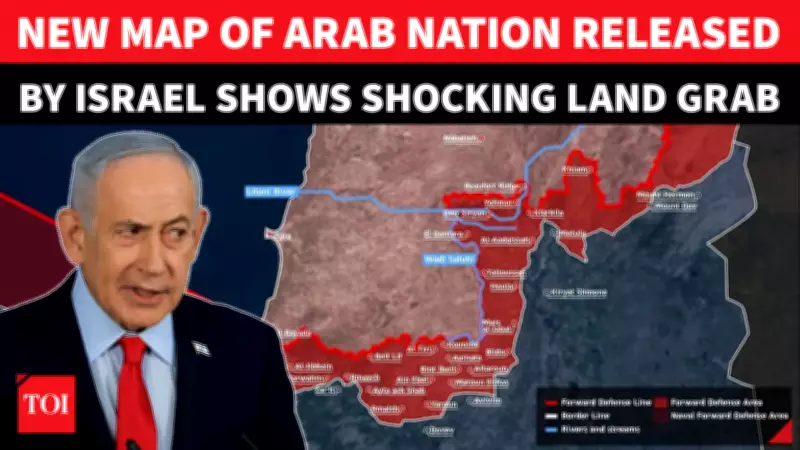
IDF Map Reveals Deep Lebanon Incursion, Signals Long-Term Military Presence Amid Fragile Truce
Israel's military has unveiled a concerning new "forward defense line" that extends deep into southern Lebanese territory, despite an existing U.S.-brokered ceasefire agreement with Hezbollah. This strategic military deployment raises serious questions about Israel's intentions to establish a permanent buffer zone and maintain long-term troop presence beyond its internationally recognized borders.
Military Expansion Despite Diplomatic Agreements
The Israeli Defense Forces (IDF) have publicly revealed detailed maps showing their advanced positions well inside Lebanese territory. This military expansion comes at a particularly sensitive time, as the region operates under a fragile ceasefire arrangement that was negotiated through American diplomatic channels. While Israeli officials claim these deployments are necessary for national security and threat prevention, Lebanese authorities report extensive collateral damage including massive infrastructure destruction, civilian casualties, and widespread displacement of local populations.
Hezbollah's Response and Regional Implications
Hezbollah, the powerful Lebanese militant group, has issued stern warnings demanding complete Israeli withdrawal from Lebanese territory. The organization views the IDF's forward positions as a violation of Lebanese sovereignty and the ceasefire terms. Meanwhile, Iran has explicitly linked broader regional diplomacy to Israeli actions in Lebanon, creating additional layers of complexity to an already volatile situation. This interconnection suggests that developments on the Israel-Lebanon border could significantly impact wider Middle Eastern geopolitics.

Ceasefire Under Mounting Pressure
The U.S.-brokered ceasefire, which was intended to de-escalate tensions between Israel and Hezbollah, now faces growing uncertainty and mounting pressure. Military analysts observe that the IDF's deep penetration into Lebanese territory signals a potential shift toward a more permanent military posture rather than temporary defensive measures. This development has sparked international concern about the sustainability of the ceasefire and the possibility of renewed hostilities.
Humanitarian and Strategic Consequences
The situation on the ground presents multiple challenges:
- Humanitarian crisis with reports of civilian casualties and displacement
- Infrastructure damage affecting southern Lebanese communities
- Strategic implications for regional stability and diplomacy
- Potential precedent for long-term military occupation beyond recognized borders
Regional observers note that this military deployment represents more than just tactical positioning—it suggests a fundamental shift in Israel's security approach toward Lebanon. The creation of what appears to be a de facto buffer zone could have lasting consequences for Lebanese sovereignty and regional power dynamics.
Broader Geopolitical Context
The Israel-Lebanon border tensions occur within a complex geopolitical landscape where multiple regional actors maintain vested interests. Iran's explicit linkage of broader diplomacy to Israeli actions in Lebanon adds another dimension to the crisis, potentially transforming what might have been a localized conflict into a proxy confrontation with wider implications. The fragile ceasefire now hangs in the balance as military movements continue and diplomatic positions harden on all sides.
This development marks what many analysts describe as a dangerous new phase in Middle Eastern conflicts, where ceasefire agreements face constant testing and military posturing increasingly takes precedence over diplomatic solutions. The international community watches with growing concern as tensions escalate along one of the region's most volatile borders.






