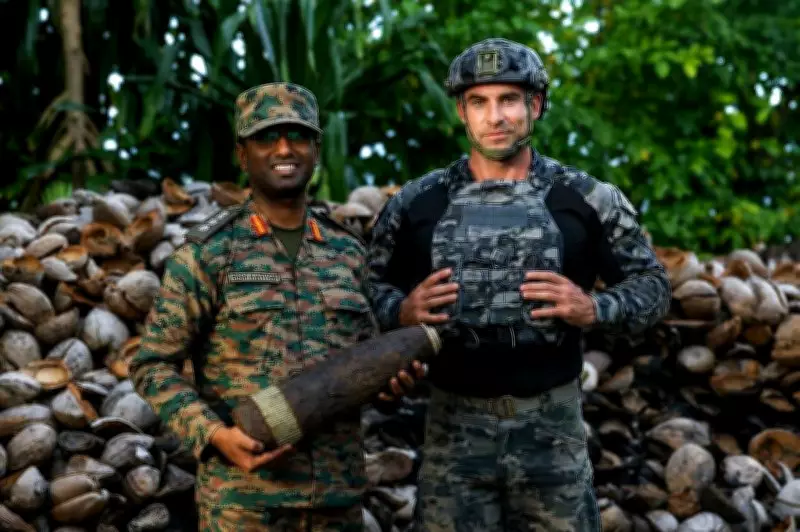
For the first time, an Indian Army observer participated in Australia's Operation Render Safe, a mission to clear unexploded ordnance from World War II. The latest edition of the operation was held in Papua New Guinea from June 15 to June 19, 2026.
Operation Render Safe and India's Role
Led by the Australian Defence Forces (ADF), Operation Render Safe takes place annually or after an urgent request from a Pacific Island nation to address the danger posed by remnants of explosives from World War II. According to the Indian Army, the engagement is aimed at enhancing interoperability and cooperation in unexploded ordnance (UXO) and explosive remnants of war (ERW) reconnaissance and disposal operations. It aids professional military exchanges and explosive ordnance disposal (EOD) expertise among participating nations.
The ADF website states that Operation Render Safe contributes to collective regional security through safe disposal of remnants of explosives and provides education and training to enhance the security capabilities of Australia's Pacific partners. The Indian Army added that the participation reflects India's growing commitment to regional security, defence cooperation, and capacity building across the Indo-Pacific region.

A Forgotten Chapter: Indian POWs in New Guinea
Amid thriving bilateral ties between India and Australia, the operation brought attention to a tragic and largely ignored chapter in Indian military history involving thousands of prisoners of war (POWs) held captive in terrible conditions by Japanese forces during World War II. Approximately 40,000 Indian soldiers of the erstwhile British Indian Army were captured by the Japanese, mainly after the fall of Singapore in February 1942. While many joined the Indian National Army (INA), over 10,000 were transported to various camps in New Guinea, where they endured untold tales of courage, sacrifice, resilience, and survival.
In a paper titled 'Great in adversity: Indian prisoners of war in New Guinea', Peter Stanley, principal historian at the Australian War Memorial, noted that official histories provide scant coverage as Indian POWs have been largely overlooked in war literature of India as well as the Allied forces. He wrote, "Despite the neglect, the ordeal of Indian POWs was as severe as those of the less in number British and Australian troops who were captured in the fall of Southeast Asia. Unlike their British and Australian comrades, they have not published memoirs, nor have they been the subject of historical works. They remain substantially neglected."
Harsh Conditions and Survival
More Indians were transported by the Japanese to New Guinea than anywhere else. They were forced to work in labour camps in harsh conditions, constructing airfields and fortifications in dense jungles while enduring severe starvation, tropical diseases, and execution. Many did not survive to the end. Narinder Singh Parmar, an educator based in Australia, wrote a book on the experiences of his father, Major Chint Singh, a native of Himachal Pradesh who served with the 12th Frontier Force Regiment during the war. He said that over two years, many POWs died in the thick jungles and swamps due to diseases, malnutrition, torture by the Japanese, or bombings by the Allied forces. They were even deprived of medical aid. Of 2,400 captives at the camp, only his father and 10 others were rescued by Australian forces in September 1945. Tragically, the other ten died in a plane crash while heading home in November 1945. Chint Singh, who should have been on board, was needed for testimony in the trials of Japanese soldiers charged with war crimes, making him the sole survivor among the 2,400 Indian POWs.
The US Army Center for Military History described the campaign in New Guinea as all but forgotten except by those who served there, noting that diseases thrived on the island. "Though Malaria was the greatest threat, dengue fever, dysentery, scrub typhus and a host of other tropical diseases awaited unwary soldiers in the jungles. Scattered, tiny coastal settlements dotted the flat malarial north coastline, but inland, the lush tropical jungle swallowed men and equipment," the Center said.

Discovery and Aftermath
The status of Indian POWs became significant when they began to be rescued as Allied forces led by General Douglas MacArthur advanced along the northern coast of New Guinea. The first indications that Indians were to be found came in March 1944, when Indians were liberated on Los Negros by advancing American forces under MacArthur. Dr. Stanley wrote that the presence of Indian POWs, over 6,000 of whom were during and after the war, had come as a surprise to the Allies.
India-Papua New Guinea Relations
Papua New Guinea, located in the south-western Pacific Ocean, became an independent state on September 16, 1975, and established diplomatic relations with India. Structured ties between the two countries span diplomatic, economic, defence, maritime, science, and education fields, including delegation visits at the highest level and regular bilateral interactions. The country also forms a key element in India's Act East Policy, and Indian Navy warships have made several port calls over the years. The latest round of talks was held in June 2026. The Union Ministry of External Affairs (MEA) stated that the two sides reviewed the full spectrum of bilateral relations, including development partnerships, political engagements, economic cooperation, and cultural ties. They also discussed cooperation in multilateral fora, the Indo-Pacific region, and exchanged views on regional and global developments of mutual interest.