

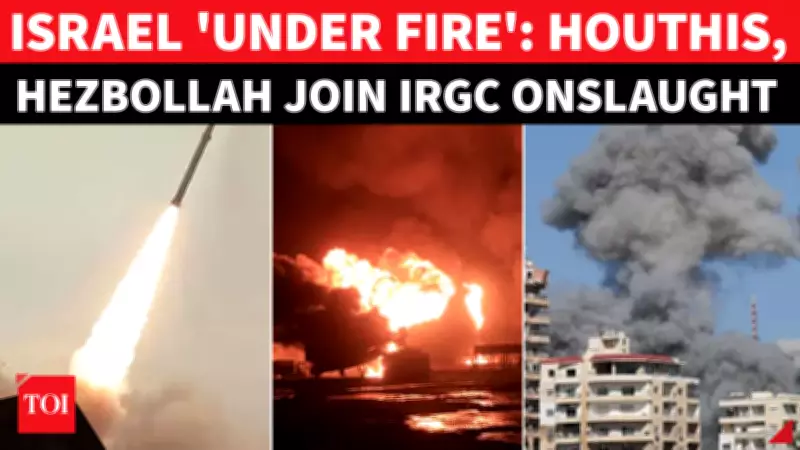
Iran Unleashes Major Military Operation Against Israel with Regional Allies
In a significant escalation of regional tensions, Iran's Islamic Revolutionary Guard Corps (IRGC) has launched a large-scale military operation targeting Israel. Dubbed "Wave 91" under Operation True Promise 4, this assault involved a heavy barrage of missiles and drones aimed at key Israeli cities, forcing millions of civilians into emergency shelters amid widespread panic and reports of destruction.
Coordinated Regional Assault Intensifies Conflict
The attack was notably coordinated with regional militant groups, marking a dangerous expansion of the conflict. Lebanon's Hezbollah and Yemen's Ansarullah, commonly known as the Houthis, joined the IRGC in this synchronized offensive. Their combined forces targeted strategic locations across Israel, including military airbases and critical national infrastructure, aiming to cripple defense capabilities and disrupt essential services.
International military assets were also drawn into the fray. According to initial reports, US military bases located in Kuwait and Saudi Arabia came under fire during the assault. This development signals a worrying widening of the conflict beyond the immediate Iran-Israel theater, potentially drawing in other nations and escalating into a broader regional confrontation.

Iran Claims Additional High-Value Targets Hit
Iranian authorities have made further claims regarding the scope of their operation. They assert that the strike successfully targeted the USS Abraham Lincoln, a prominent United States aircraft carrier, though this has not been independently verified. Additionally, Iran claims to have destroyed a key radar system in the United Arab Emirates (UAE), a claim that, if true, would represent a direct attack on Gulf state infrastructure and further complicate the geopolitical landscape.
These actions have intensified global fears of a rapidly expanding regional war with potentially severe international consequences. The involvement of multiple state and non-state actors across the Middle East raises the specter of a prolonged and destructive conflict that could destabilize global energy markets, trigger humanitarian crises, and draw in major world powers.
The situation remains fluid and highly volatile, with international bodies and governments closely monitoring developments and calling for immediate de-escalation to prevent a full-scale regional war.






