Iranian Cluster Bomb Attack Targets Israel, Injuring Six in Widespread Strike
Iran launched multiple ballistic missiles at Israel on Sunday, including at least one equipped with a cluster bomb warhead, as reported by the Times of Israel. This assault represented the sixth salvo directed at Israel within a single day, escalating regional tensions significantly.
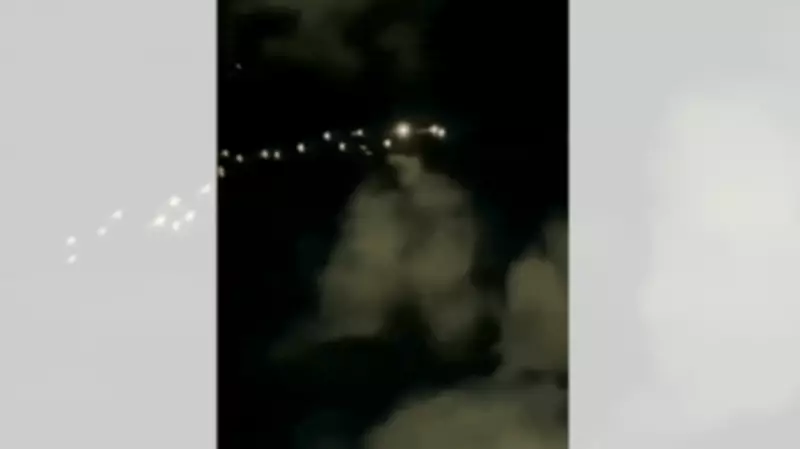
Video footage circulating on social media appears to depict submunitions from an Iranian cluster warhead descending over Israeli territory. In the clip, numerous glowing objects are visible falling separately across the sky, dispersing over an extensive area.
Casualties and Damage Reported Across Central Israel
The attack resulted in six individuals sustaining injuries, with one in serious condition, at two impact sites located in central Israel. Photographs and videos from the scenes reveal widespread destruction, and authorities have documented more than a dozen impact sites throughout the region. Police officials noted that the scattered pattern of impacts strongly suggests the involvement of a cluster bomb warhead on the Iranian missile.

In response, the Israel Defense Forces (IDF) deployed search and rescue teams to the affected areas to manage the aftermath.
Understanding Cluster Bombs and Their Lethal Mechanics
Cluster munitions, or cluster bombs, are weapons engineered to release numerous smaller explosive devices, known as submunitions or bomblets, from a single missile, rocket, or aircraft bomb. According to the IDF, "The warhead of such missiles opens up while descending and scatters around 20 smaller munitions with approximately 2.5 kg of explosives in a radius of about 8 km."
Unlike conventional missiles that detonate in a solitary blast, these weapons burst open mid-air, dispersing dozens of bomblets across a broad zone. Military analysts caution that the deployment of such armaments alters conflict dynamics dramatically. Instead of a single explosion at a specific point, a cluster warhead can scatter many smaller bombs over a wide area, thereby increasing civilian casualties and causing more extensive infrastructure damage.
International Concerns and Speculation Over External Support
Israeli experts have indicated that Iran may have received assistance from external sources for these deadly missiles, with speculation pointing toward potential transfers of military technology from either Russia or China. This raises questions about international arms proliferation and its implications for regional stability.
The 2008 Convention on Cluster Munitions (CCM), which took effect in 2010, prohibits the use, development, production, acquisition, and transfer of cluster munitions. To date, 111 countries and 12 other entities have signed this treaty, underscoring global humanitarian concerns.
Why Cluster Bombs Pose Significant Challenges in Warfare
Cluster bombs rank among the most contentious weapons in modern warfare due to their indiscriminate nature. Once the main warhead opens in the air, the bomblets spread across a large area and detonate on impact, making it difficult to distinguish between military and civilian targets. This characteristic has drawn sharp criticism from humanitarian organizations.
Key features of cluster munitions include their ability to hit multiple targets simultaneously, scatter dozens of bomblets over an extensive zone, and elevate risks to vehicles, infrastructure, and human lives. The broad dispersal of bomblets significantly heightens dangers for civilians caught in the crossfire.
Missile Defense Systems Tested by Cluster Warhead Complexity
Israel's Iron Dome defense system is designed to track single incoming projectiles, such as Grad or Fajr rockets. If a rocket carries a cluster warhead, it remains a unified target for most of its trajectory. The Iron Dome's Tamir interceptor employs a proximity fuse: when it nears the incoming rocket, it explodes, fragmenting the rocket's casing with shrapnel. If intercepted early enough, the cluster submunitions inside can be destroyed or neutralized mid-air before scattering.
For long-range ballistic missiles, Israel relies on the Arrow Missile Defense System, which intercepts targets at high altitudes, often outside the atmosphere with Arrow 3.

However, cluster warheads complicate missile defense efforts considerably. The small bomblets released over a wide area cannot be tracked individually by missile defense radars. Systems like Iron Dome or Arrow must attempt to halt multiple falling submunitions simultaneously, increasing the likelihood that some may penetrate defenses.
One of the most severe risks associated with cluster bombs stems from unexploded bomblets. These can remain on the ground like concealed landmines, posing long-term threats to civilians and emergency responders even years after a conflict has concluded.