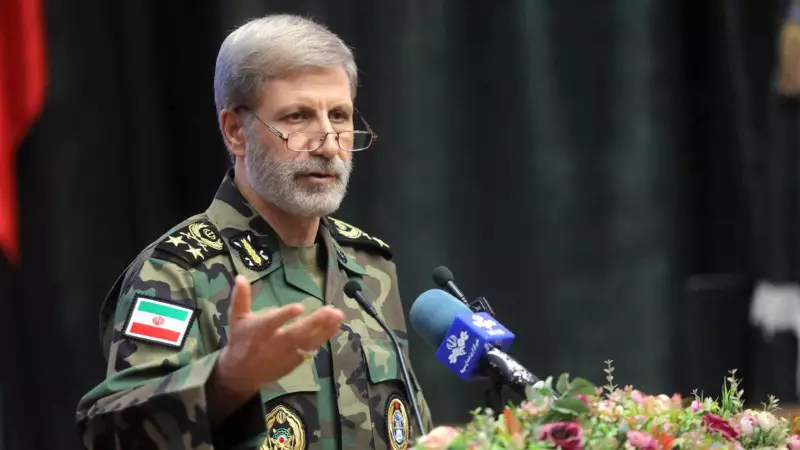
In a sharp escalation of rhetoric, a senior Iranian military commander has issued a stark warning, stating that Iran's armed forces are prepared to launch a pre-emptive strike against the United States. This comes in direct response to recent threatening statements made by former US President Donald Trump.
Trump's Provocative Remarks Spark Iranian Warning
The immediate catalyst for this tense exchange was a social media post by Donald Trump. On his Truth Social platform, the former President and current presidential candidate wrote a strongly worded message. He stated that if he were President again, any attack by Iran on the United States would be met with a retaliatory strike "1,000 times greater in magnitude." This post was made on a Saturday, directly referencing the possibility of an Iranian assault.
Iran's response was swift and came from a high-ranking official. Major General Abdolrahim Mousavi, the commander-in-chief of Iran's army, addressed the media on Sunday. He declared that no threat from an American would go unanswered. General Mousavi emphasized that the Iranian military maintains a high level of readiness and possesses a clear understanding of its enemies' tactics and strategies.

Iran's Doctrine of Pre-emptive Action
The core of the Iranian warning revolves around the concept of a pre-emptive strike. General Mousavi explicitly stated that the Iranian armed forces "will not wait for the enemy" to make the first move. He argued that waiting for an enemy to act is not a principle followed by Iran's military doctrine. Instead, they reserve the right to strike first if they perceive a credible and imminent threat.
This stance is not entirely new in the context of Iran's strategic posture, but its public declaration in response to a US political figure's comments marks a significant moment. The general framed this capability as a defensive necessity, a means to protect Iran's sovereignty and national security from what it views as hostile American intentions, especially those voiced by Trump.
A History of Tensions and the Shadow of Trump's Policies
The current war of words cannot be separated from the recent history between the two nations. During Donald Trump's presidency from 2017 to 2021, US-Iran relations deteriorated dramatically. Key actions by the Trump administration included:
- Unilaterally withdrawing the United States from the 2015 Iran nuclear deal (Joint Comprehensive Plan of Action).
- Reimposing and escalating harsh economic sanctions on Iran, crippling its economy.
- Authorizing a drone strike in January 2020 that killed Qasem Soleimani, a top Iranian general and key military figure. This action brought the two countries to the brink of direct military conflict.
For Iran's military leadership, Trump's recent comments are seen as a continuation of this aggressive policy. General Mousavi's warning is interpreted as a message that Iran will not adopt a passive stance if faced with a renewed Trump administration that follows through on its threats.
The situation presents a delicate challenge for current diplomatic channels. While the Biden administration has attempted to engage in indirect talks to revive the nuclear pact, progress has been stalled. The specter of Trump's potential return to power and his aggressive rhetoric is now actively shaping Iran's military pronouncements and strategic calculations, raising the risk of miscalculation in an already volatile region.