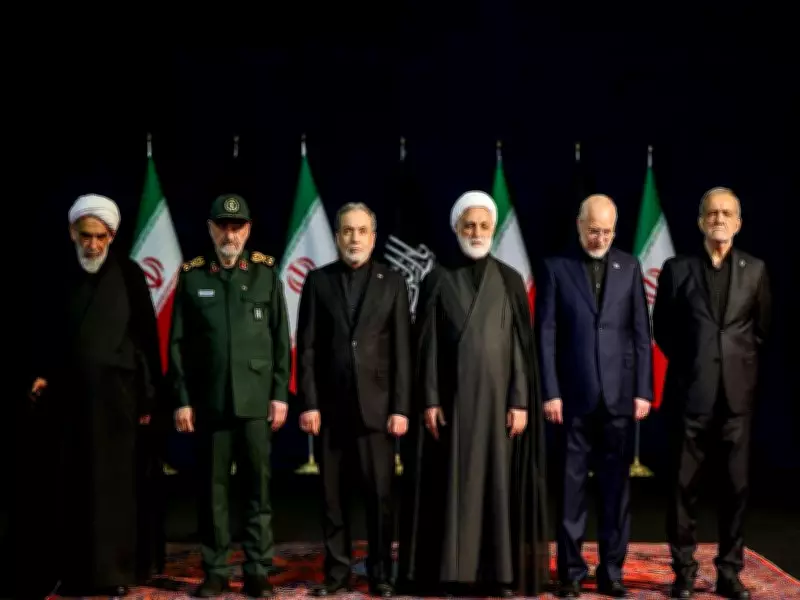
Iran's top leaders converged at the Imam Khomeini Grand Mosalla in Tehran on Friday for the funeral of Ayatollah Ali Khamenei, who was killed in US-Israeli strikes on February 28 this year. The solemn ceremony saw the heads of Iran's three government branches paying their last respects to the slain supreme leader.
High-Profile Attendees at the Ceremony
Among those present were Iranian military commander Mohsen Rezaee, Foreign Minister Abbas Araqchi, Chief Justice Gholamhossein Mohseni Ejei, Parliament speaker Mohammad Baqer Qalibaf, and President Masoud Pezeshkian. The gathering underscored the unity of Iran's political and military leadership in mourning the loss.
Indian dignitaries also paid tribute ahead of the formal state funeral. The Embassy of Iran in India posted on X that People's Democratic Party president Mehbooba Mufti and Congress foreign affairs head Salman Khurshid were among delegates preparing to travel to Tehran. Minister of State for External Affairs Pabitra Margherita and Bihar Governor Lt. Gen. (Rtd.) Syed Ata Hasnain departed from Delhi on Friday to join the proceedings.

Global Delegations Flock to Tehran
Leaders from across the world arrived to honor the late leader. According to state broadcaster Press TV, Georgian President Kavelashvili, Iraqi President Amidi, and Tajik President Rahmon were present. Pakistan Army Chief Asim Munir and Prime Minister Shehbaz Sharif also landed in Iran. Hezbollah families, including those of Sayyed Hassan Nasrallah and Imad Mughniyeh, paid respects, along with Palestinian scholars, Lebanon's Amal Movement, and Omani and Russian delegations.
He Wei, Vice Chairman of the Standing Committee of China's National People's Congress, and Igor Sergeyenko, Chairman of the House of Representatives of Belarus, met Iran's Parliament Speaker Ghalibaf on the sidelines of the ceremony.
Security Concerns and Family Absence
Heightened threat matrix directly impacted the immediate family. Current Supreme Leader Mojtaba Khamenei will not attend the funeral due to intense security concerns, according to his representative in India, Ayatollah Hakim Elahi. The domestic security environment remains sensitive following provocative statements from Israeli Defence Minister Israel Katz, who had previously remarked that the late leader was 'marked for death.'
In response, Iranian Foreign Minister Abbas Araghchi clarified that any operational threat against the current leadership would face immediate and forceful retaliation. Maj. Gen. Ali Abdollahi, commander of Iran's Khatam al-Anbiya Central Headquarters, warned adversaries against any miscalculation, declaring, 'We warn the enemies of a strong Iran... to avoid any miscalculation and to consider the harsh and regret-inducing responses of the sons of the Iranian nation in the Armed Forces to any threat or aggression.'
Funeral Procession and Public Mourning
The leader's body, along with those of his companions, was transferred to Tehran's Grand Mosalla early Friday for a two-day public farewell ceremony. President Pezeshkian called on Iranians from all backgrounds to participate, posting on X: 'As heroic Iran prepares to bid farewell to the sincere servant of Islam and the Revolution, I invite all people, regardless of ethnicity, religion, political taste or orientation, to participate with enthusiasm, dignity and in historic numbers, demonstrating a lasting image of national unity and loyalty to the lofty ideals of the Islamic establishment.'
According to Press TV, the multi-day funeral is expected to draw between 15 and 20 million mourners. Ceremonies will continue on Saturday and Sunday with the body lying in state at the Grand Mosalla, followed by a funeral procession through Tehran on Monday. Further rites are scheduled in the holy city of Qom, followed by ceremonies in Baghdad, Karbala, and Najaf in Iraq, before burial in Mashhad on July 9.