

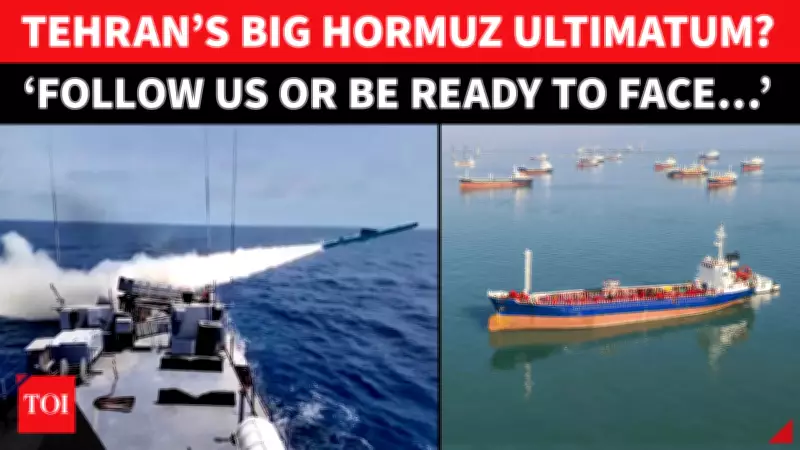
The rules of the Strait of Hormuz are being rewritten in real time. The Islamic Revolutionary Guard Corps (IRGC) has issued a blunt warning to the world's fleet: deviate from the Iranian-approved corridor, and you will be met with force. As the United States attempts to force open a "one-way lane" under what it calls "Project Freedom," Tehran is doubling down, asserting that no ship moves through the strategic waterway without its permission.
Escalating Tensions in the Strait
The standoff has reached its most dangerous moment yet. With oil prices jumping sharply and reports emerging of U.S. vessels being trapped near Oman, the battle for control over this 21-mile-wide chokepoint is intensifying. The IRGC's warning comes as part of a broader Iranian strategy to assert dominance over the Strait of Hormuz, through which about 20% of the world's oil passes.
Iran's Position and Demands
Tehran has made clear that it considers the strait its sovereign territory and that any unauthorized passage is a violation of its security. The IRGC has warned that ships not following the designated corridor will be considered hostile and subject to immediate action. This position has been reinforced by recent military exercises and the deployment of fast attack boats and naval mines.

US Response and Project Freedom
The United States, under the Trump administration, has responded with "Project Freedom," an initiative aimed at ensuring freedom of navigation. However, the project has faced significant challenges, with reports suggesting that some U.S. vessels have been blocked or delayed by Iranian forces. The situation has led to a sharp increase in oil prices, as markets react to the potential disruption of global oil supplies.
Global Implications
The standoff has drawn international concern, with many nations calling for de-escalation. The United Nations has urged both sides to engage in dialogue to avoid a wider conflict. Meanwhile, shipping companies are facing difficult decisions, with some choosing to reroute vessels at significant cost, while others seek insurance for war risk. The situation remains fluid, with both sides showing no signs of backing down.
As the world watches, the Strait of Hormuz has become a flashpoint for broader geopolitical tensions between Iran and the United States. The outcome of this standoff could have far-reaching consequences for global energy security and regional stability.






