

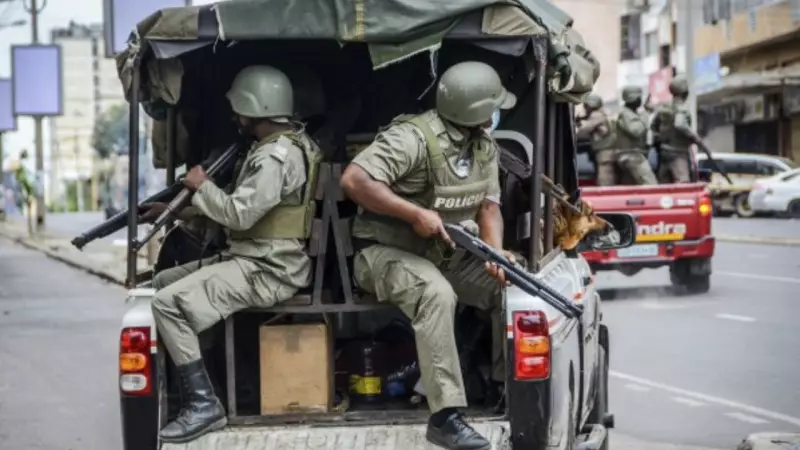
In a bold demonstration of resurgent strength, armed militants affiliated with the Islamic State stormed a mosque in northern Mozambique's coastal town of Mocimboa da Praia last month, according to eyewitness accounts. The incident has raised alarm bells about the group's renewed presence in the gas-rich region following the collapse of critical US aid funding.
Mosque Takeover and ISIS Banner Display
The confrontation unfolded when armed men linked to ISIS entered the mosque and ordered residents to gather, demanding the keys to the religious building. Witnesses reported that the group then took control of the mosque's microphone system and unfurled the distinctive black banner of the Islamic State, signaling their return to an area they had previously controlled.
Sumail Issa, the mosque's imam, described the terrifying moment to CNN. "When they called everyone over, as soon as they saw that flag, a colleague and I left, saying we needed the toilet," Issa recounted. He added that he immediately went to notify military authorities about the brazen takeover.

Disturbingly, video footage circulating on social media showed residents recording the event on their phones rather than fleeing, indicating both the normalization of such incidents and the militants' ability to move through the area without facing significant resistance from security forces.
Broader Context of Regional Instability
This mosque seizure occurs against the backdrop of eight years of continuous conflict in Mozambique's Cabo Delgado province, a region blessed with enormous natural gas reserves but plagued by violence, killings, and land seizures. The coastal town of Mocimboa da Praia itself was held by insurgents from August 2020 to August 2021, a period marked by widespread displacement and destruction of infrastructure.
Following that occupation, Mozambican forces alongside Rwandan troops deployed at Maputo's request managed to reestablish a degree of stability, allowing many displaced residents to return to their homes. Western governments had expanded aid efforts during this period, contributing to the improved security situation.
Impact of US Aid Withdrawal
The recent deterioration in security coincides directly with the rollback of support from the US Agency for International Development (USAID). The collapse came after an executive order signed by US President Donald Trump in January cut some programs entirely and sharply reduced others, including initiatives specifically designed to strengthen government reach and counter extremist influence.
Mozambique, where more than half the population lives below the poverty line and the median age is just 17, had become heavily dependent on USAID support. In 2024 alone, the agency provided $586 million in assistance, equivalent to approximately 3 percent of the country's entire GDP.
When USAID was shut down, it still had over $2.4 billion in active or planned programs for Mozambique. These initiatives had funded critical services including emergency food distribution, water and sanitation projects, education programs, local governance support, and HIV/AIDS treatment. Funding for HIV/AIDS treatment continues in reduced form at about $160 million.
Particularly significant were USAID programs in Cabo Delgado focused on limiting ISIS recruitment. In Mocimboa da Praia specifically, two grants backed initiatives targeting motorcycle taxi drivers and fishermen - sectors where poverty and limited opportunities have made young men vulnerable to extremist recruitment.
A former senior USAID official told CNN that "the abrupt end of USAID programs opened the door for insurgents to act with greater freedom and impunity."
Rising ISIS Activity Across Africa
The Mozambique incident reflects a broader pattern of escalating ISIS-linked violence across the African continent. According to data from the Armed Conflict Location & Event Data Project (ACLED), Africa accounted for 79 percent of ISIS's global activity between January and October of this year.

In Mozambique specifically, ISIS operations reached their highest level in October, with the country representing 11 percent of the group's worldwide violent incidents, ACLED reported. This statistic underscores how Mozambique has become an increasingly important theater for ISIS operations globally.
The mosque takeover in Mocimboa da Praia serves as a stark reminder that security gains can quickly reverse when support systems collapse, leaving vulnerable populations at the mercy of determined extremist groups seeking to expand their influence in resource-rich regions.





