

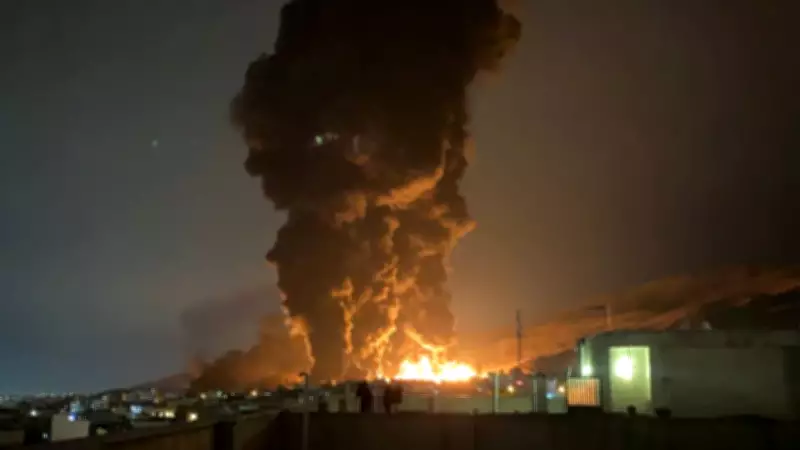
Massive Explosions Rock Tehran and Karaj After Israeli Military Strikes
On Saturday, powerful explosions shook the Iranian capital of Tehran and the nearby city of Karaj, following extensive strikes by the Israeli military on multiple fuel storage complexes. The attacks sent enormous balls of fire and thick smoke billowing into the sky, with videos circulating on social media showing massive columns of flames rising from the targeted areas.
Targeted Energy Infrastructure and Escalating Conflict
The strikes reportedly mark the first assault on Iran's energy infrastructure since last weekend's joint US-Israeli operations. They focused on several oil storage depots located in Tehran and Alborz provinces. One depot in Karaj, situated just west of Tehran, was hit, along with facilities in the Shahr Rey district, which houses Tehran's main oil refinery, and the Shahran oil depot in northwestern Tehran. This latter site had previously been struck by Israel in June of last year, and the latest attack produced a dark plume of smoke visible across the region.
Iran's Ministry of Oil responded swiftly, deploying fire and emergency crews to extinguish the flames. Officials emphasized that there would be no fuel or energy shortages, as precautions had been taken in anticipation of such strikes. According to a source cited by the Times of Israel, three depots in western Tehran—specifically in the Kuhak and Shahran areas—as well as the facility in Karaj, were struck by Israeli fighter jets.

Israeli Military Confirms Strikes and Strategic Objectives
The Israeli military officially confirmed the strikes, stating that the fuel storage and energy complexes were being utilized by Iran's armed forces. Israel described the operation as a "significant strike" aimed at dismantling the military infrastructure of the Iranian government. In a detailed statement, the IDF explained, "The military forces of the Iranian terror regime make direct and frequent use of these fuel tanks to operate military infrastructure. Through them, the Iranian terror regime distributes fuel to various consumers, including military entities in Iran." The military further asserted, "The strike constitutes an additional step in deepening the damage to the military infrastructure of the Iranian terror regime."
Iranian Retaliation and Netanyahu's Warning
In retaliation, Iran's Revolutionary Guards Corps announced it had launched a new wave of attacks on Israel. Israeli Prime Minister Benjamin Netanyahu issued a stern warning, indicating that the US-Israeli bombing campaign in Iran would continue. He declared that the "moment of truth is drawing near" for Iranians to overthrow their government, clarifying that Israel is "not trying to divide Iran" but rather "trying to free Iran."
Netanyahu outlined an ongoing strategy, revealing that Israel has "an organized plan with many surprises" for the next phase of the war, intended "to destabilize the regime, to enable change." Addressing the Iranian people directly, he stated, "It depends on you" to oust the regime and predicted that its overthrow would pave the way for peace between Israel and Iran.
Expansion of Strikes to Ballistic Missile Sites
Beyond the fuel depots, the Israeli military disclosed that it had struck Iran's two "most central" ballistic missile sites. This move signifies an expansion of the strikes to encompass both the country's military and energy infrastructure, escalating the conflict further. The attacks underscore Israel's intensified efforts to cripple Iran's defensive and offensive capabilities amid the ongoing tensions.






