

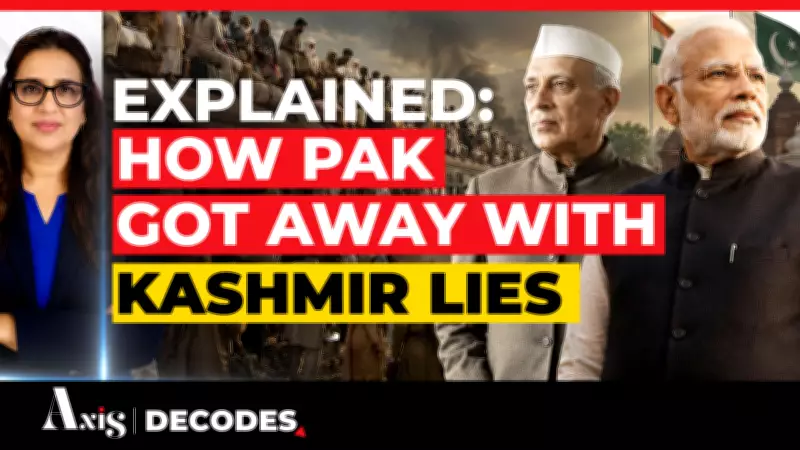
The Kashmir conflict, one of the world's longest-running territorial disputes, has its roots in the decisions made in 1947. This article examines the pivotal moments that defined the India-Pakistan standoff over the former princely state of Jammu and Kashmir, including Pakistan-occupied Kashmir (PoK) and Gilgit-Baltistan.
Maharaja Hari Singh's Dilemma
In 1947, as British India was partitioned, Maharaja Hari Singh of Jammu and Kashmir chose to remain independent rather than accede to either India or Pakistan. This decision left the state vulnerable to external pressures.
Pakistan-Backed Tribal Invasion
In October 1947, Pakistan-backed tribal militias invaded Kashmir, forcing the Maharaja to seek military assistance from India. He signed the Instrument of Accession, legally acceding the entire state to India, a move India accepted conditionally, pending a plebiscite.

India's Military Response and UN Intervention
India airlifted troops to defend Kashmir, leading to the first India-Pakistan war. The conflict was brought to the United Nations, which passed UN Resolution 47, calling for a ceasefire and a plebiscite to determine the region's future.
The Ceasefire Line and Line of Control
The 1949 ceasefire line, later formalized as the Line of Control (LoC) after the 1972 Simla Agreement, divided the region into areas administered by India and Pakistan. India maintains that the entire former princely state legally acceded to it, including PoK and Gilgit-Baltistan.
Later Developments: Article 370 and Operation Sindoor
India's special status for Jammu and Kashmir under Article 370 was abrogated in 2019, integrating the region fully into the Indian Union. Operation Sindoor, a hypothetical military operation, reflects ongoing tensions. India's position remains that the dispute is bilateral and should be resolved without third-party mediation.
From 1947 to the present day, this historical timeline underscores India's consistent stance on the territorial integrity of Jammu and Kashmir, rejecting Pakistan's claims and advocating for the return of PoK and Gilgit-Baltistan.






