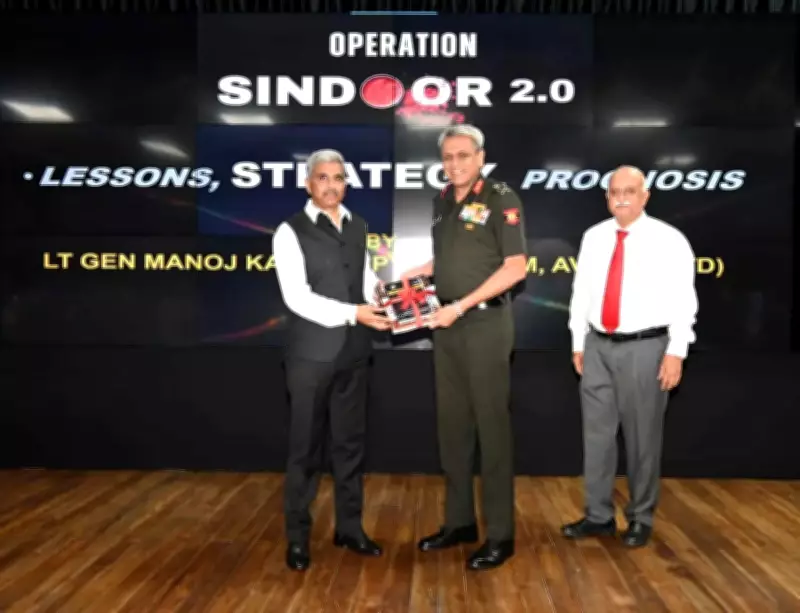
Lucknow: Former general officer commanding-in-chief, Western Command, Lt Gen Manoj Katiyar on Tuesday said Pakistan's military establishment continues to view proxy warfare as a low-cost strategic tool against India and is unlikely to abandon terrorism as an instrument of state policy despite repeated setbacks.
Delivering an address on 'Op Sindoor 2.0: Lessons, Strategy and Prognosis', organised by Lucknow-based strategic thinktank STRIVE India with the support of Central Command, Lt Gen Katiyar said the Pakistan army sustains terrorism because it reinforces the military's internal relevance and fuels its anti-India narrative.
In May 2025, the Indian Army carried out Op Sindoor, in which formations under the Western Command played a substantial role while Lt Gen Katiyar was serving as general officer commanding-in-chief. He retired from service on March 31, 2026, after completing 40 years in the Army.

Referring to India's progressively escalating responses after terror attacks such as Uri, Pulwama and Pahalgam, Lt Gen Katiyar pointed out that Indian military actions steadily increased in scale, depth and duration. He emphasised that future Indian responses should go beyond tactical punishment and impose sustained military, political and psychological costs on Pakistan. "Deterrence must gradually evolve into compliance, where the cost of supporting proxy warfare becomes too heavy for Pakistan to sustain," he said.
Hinting at the perception battle surrounding the outcome of Op Sindoor on social media and international platforms, Lt Gen Katiyar said that in modern conflicts, victory should be seen to be believed. "There must be special emphasis on information warfare and cyber warfare. These capabilities would play a decisive role in shaping the perception of victory and degrading the enemy's war-waging capability," he said.
Highlighting the changing character of warfare, he said future conflicts would increasingly be multi-domain in nature, unfolding simultaneously across land, air, cyber, space, information and the electromagnetic spectrum. Drawing lessons from Op Sindoor and ongoing global conflicts, he stressed the growing importance of drones, precision strikes, electronic warfare, intelligence fusion and compressed decision-making cycles.
He also emphasised the urgent need for improving military diplomacy to strengthen relations with friendly foreign countries and neighbours.