

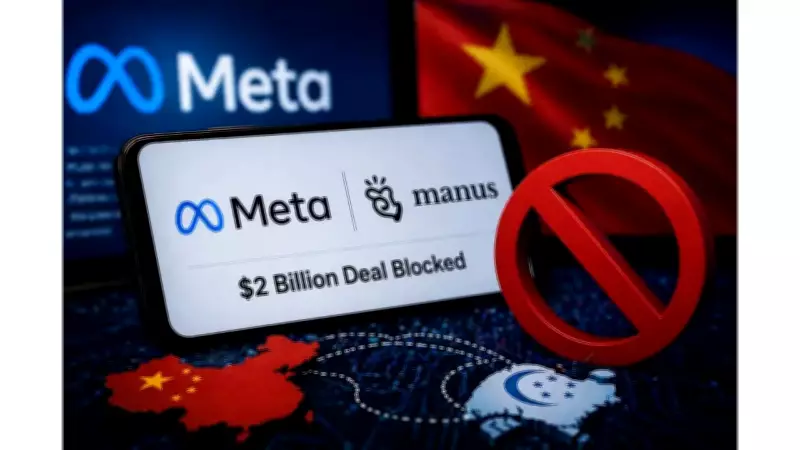
Meta Platforms’ planned acquisition of Manus AI has evolved into a complex global saga intertwining business strategy, regulation, and national security. The $2 billion deal, first announced in December 2025, was initially hailed as a major step in advancing artificial intelligence systems. However, following a review by Chinese regulators, authorities moved to block the transaction by April, citing concerns over technology transfer and foreign control, further escalating tensions between the US and China over AI dominance.
Meta-Manus AI Deal Announced in December 2025
Meta announced that Manus would join its ecosystem to expand AI capabilities across its products. Manus had developed a general-purpose AI agent capable of performing tasks such as research, coding, and data analysis. Meta planned to continue offering Manus as a standalone service while integrating its technology into Meta’s platforms, aiming to scale the technology for millions of businesses and users. Manus confirmed it would maintain its subscription services and Singapore base, ensuring no disruption to existing users.
This acquisition ranked among Meta’s largest, trailing only its $19 billion WhatsApp purchase in 2014 and its up to $15 billion investment in Scale AI in early 2025. Manus, with around 100 employees, was once hailed as the ‘next DeepSeek’. CEO Xiao Hong stated, “Joining Meta allows us to build on a stronger, more sustainable foundation without changing how Manus works or how decisions are made. We’re excited about the future with Meta and Manus working together, and we will continue to iterate the product and serve users.” Meta added, “We are excited to announce that Manus is joining Meta to bring a leading agent to billions of people and unlock opportunities for businesses across our products. Manus has built one of the leading autonomous general-purpose agents that can independently execute complex tasks like market research, coding, and data analysis. We will continue to operate and sell the Manus service, as well as integrate it into our product.”

What Manus AI Does
Manus gained attention earlier in 2025 after launching what it described as a general AI agent. The system is designed to independently carry out complex tasks, including research, automation, and analysis. The company reported that its platform had processed over 147 trillion tokens and helped create more than 80 million virtual computers, underscoring the scale of its technology. AI agents represent a key area for tech companies aiming to build systems that complete tasks without direct human input.
China Begins Review of Meta-Manus Deal
Soon after the deal was announced, Chinese authorities began examining the transaction. Reports indicated that regulators were checking compliance with foreign investment and technology transfer rules. The review was led by the National Development and Reform Commission (NDRC), China’s top economic planning body. Officials were concerned that the deal could lead to the transfer of advanced AI technology to a foreign company. The commission stated it was assessing the deal under national security concerns and adherence to local regulations governing technology transfer and foreign investments. This scrutiny reflects a broader trend in China, where regulators closely monitor deals involving sensitive technologies such as AI.
Manus Founders Questioned, Travel Restricted
In March 2025, the Financial Times reported that Manus co-founders Xiao Hong and Ji Yichao were called for meetings with Chinese officials and questioned about the deal’s implications. Both founders were reportedly barred from leaving the country while the review was ongoing. No formal charges were filed, but the travel restrictions signaled the seriousness of the case.

China Blocks the Acquisition
By April, Chinese regulators ordered both Meta and Manus to cancel the deal, following a review of national security concerns and compliance with export control rules. Officials feared the deal could lead to the loss of key technology developed in China. Manus, while registered in Singapore, has roots in mainland China, with core development in Beijing and Wuhan. Authorities reportedly viewed the company’s move to shift operations abroad as a possible attempt to transfer technology out of the country. Manus became a tech sensation in early 2025 after releasing what it called the world’s first “general AI agent.” In mid-2025, the startup began moving operations to Singapore and shutting down its Chinese social media presence. Beijing’s regulators reportedly feared this was a blueprint for “technology leakage,” where homegrown Chinese innovation is quietly moved abroad for acquisition by American giants like Meta.
Previous reports from the Financial Times and The New York Times claimed that the co-founders were summoned to meetings with Chinese officials in March and have since been barred from leaving the country. Meanwhile, China has been tightening its grip on technology exports since 2020, specifically targeting algorithms. This is seen as a tit-for-tat response after the US pressured ByteDance to sell TikTok’s American operations and previously blocked the sale of Nvidia’s high-end AI chips.
China Gives Meta Deadline to Abort Manus Deal
The Chinese government handed Meta a deadline to undo its $2.5 billion acquisition of Manus, citing national security concerns. According to the Wall Street Journal, Beijing gave the tech giant just a few weeks to completely “disentangle” itself from the startup and return its assets to their original state. The order from the NDRC marks a dramatic intervention in a global tech deal.
What It Means to ‘Unwind’ the Deal
Since December, Meta has integrated Manus’s advanced AI technology into its own systems. Beijing’s order specifically requires Meta to remove any previously transferred technology or data from Meta’s servers, fully return all Chinese assets to their original condition, and allow the startup’s founders to depart Meta as part of the rescission. According to the WSJ report, major investors like California’s Benchmark have already received financial returns from the $2.5 billion sale, complicating the financial disengagement and potentially leading to significant legal hurdles.
Meta’s Strategy and the Importance of the Deal
For Meta, the Manus acquisition was part of a larger plan to strengthen its position in AI. The company has been investing heavily in AI tools that automate tasks and improve user experiences. The Manus deal was among the largest in Meta’s history and was seen as a way to compete with other tech companies working on AI systems. Meta has not issued detailed comments after the block, but the development is a setback for its plans.
Rising Global Tensions Over AI
The Manus case occurs amid stronger US-China positions on technology control. Both countries are introducing policies to limit the flow of advanced technology. China has tightened export rules, while the US has restricted investment in certain sectors. These steps are part of a broader effort to secure leadership in AI. The White House has raised concerns about foreign access to US technology, while China warns about risks to its innovations. Last week, the White House issued an urgent directive accusing China of running a massive, state-sponsored campaign to steal American AI technology. In a memo by Michael Kratsios, Director of the White House Office of Science and Technology Policy, the Trump administration claimed that foreign entities, primarily in China, are engaged in “industrial-scale” efforts to copy and dismantle the US’s most advanced AI systems.
A Sign of Changing Global Tech Landscape
The blocked deal illustrates how technology, business, and geopolitics are becoming closely linked. As AI becomes more important, governments are taking a more active role in controlling its development and sharing. The Manus case is likely to be seen as an example of how such deals can face challenges even after announcement. It also highlights the growing importance of AI agents and competition among companies to build systems that handle complex tasks. As the global tech industry evolves, similar cases may become more common, especially in sectors critical for future growth.
What Is “Singapore Washing”?
The Manus-Meta case is seen as a key example of how ‘Singapore washing’ may no longer work for Chinese and American companies. “Singapore washing” is a strategy used by some startups with Chinese roots to move their headquarters to Singapore, as explained in a CNBC report. Relocating to Singapore allows companies to attract global investors and operate with less direct scrutiny from Chinese and US regulators. Manus followed this path, relocating its base and core operations to Singapore while maintaining links to China. The approach has been popular among founders seeking international funding while managing regulatory risks.
Scrutiny Signals Limits of Offshore Structures
The CNBC report said China’s response to the Manus deal shows that authorities are now focusing more on where technology is developed, rather than where a company is officially registered. Chinese regulators restricted the company’s founders from leaving the country and began examining the deal soon after its announcement. Experts cited in the report said this could mark a shift for startups that relied on offshore structures. Investors and founders are now reassessing strategies as both China and the US increase oversight of AI companies. Some founders may now choose to build companies outside China from the beginning, instead of moving later.
What Lies Ahead
It remains unclear whether Meta and Manus will attempt to revise the deal or explore alternative arrangements, although reports suggest Meta has started preparing to ‘unwind’ the deal. The situation is still developing, and both companies may need to adjust their strategies. The case is likely to influence how future deals are structured, especially in sectors like AI where technology is closely linked to national security. For now, the blocked acquisition serves as an example of how global business, technology, and policy are increasingly interconnected.





