

Operation Epic Fury Ignites Full-Scale Regional War in the Middle East
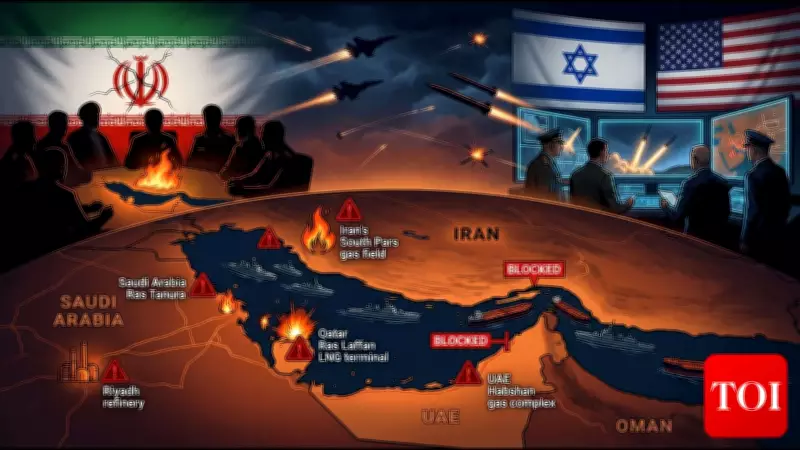
The Middle East has plunged into a devastating multi-front regional war, with the conflict involving Iran, Israel, and the United States escalating dramatically. On Wednesday, March 18, 2026, Israel executed a major airstrike on Iran's South Pars gas field, the world's largest natural gas reserve. This attack marks a critical escalation, as it represents the first direct targeting of core fossil fuel production infrastructure in the ongoing hostilities.
Targeting Critical Energy Infrastructure
The Israeli strike specifically hit gas storage tanks and processing units at the South Pars field, forcing the closure of two refineries in Asaluyeh with a combined capacity of approximately 100 million cubic metres per day. Initial assessments indicate that the damage affects nearly 12% of Iran's total gas production, a significant blow to the nation's energy sector. US President Donald Trump stated on Truth Social that Israel acted alone "out of anger" and that the U.S. "knew nothing" of the specific attack. However, US media reports suggest that Washington was informed in advance but opted out of participation, highlighting the complex dynamics of the alliance.
Chain of Retaliatory Strikes Across the Gulf
The attack triggered a rapid chain of retaliatory strikes across the Persian Gulf, intensifying the regional conflagration. Iran launched ballistic missiles at Qatar's Ras Laffan liquefied natural gas (LNG) terminal, causing "extensive damage" to the facility. Additionally, Iran targeted the Habshan Gas Complex and Bab Oil Field in the United Arab Emirates (UAE) with missiles and drones. While UAE authorities reported that most projectiles were intercepted, they condemned the strikes as a "dangerous escalation," with falling debris causing minor incidents and temporary operational shutdowns for safety checks.

In Saudi Arabia, ballistic missiles and drones were aimed at the Riyadh refinery and the Ras Tanura export hub. Saudi defense forces intercepted several projectiles, but debris ignited a fire near the Riyadh refinery, leading to brief operational halts that further strained global oil markets. Iran also issued threats against other regional energy hubs, prompting evacuations at the Samref and Jubail facilities in Saudi Arabia and the Al Hosn gas asset in the UAE, creating widespread disruption.
Global Energy Markets in Turmoil
The strike on such critical infrastructure has severely rattled global energy markets. Brent crude surged over 5%, rising toward $110–$112 per barrel, reflecting heightened supply concerns. Despite the escalation, President Trump has told reporters he expects the conflict to end in the "very near future," though current developments suggest otherwise.
Diplomatic Fallout and Shifting Alliances
The diplomatic fallout from Iran's 2026 attacks on Gulf Arab states has fundamentally altered the Persian Gulf region's security architecture, ending years of delicate rapprochement and mediation efforts. Following the launch of over 2,000 missiles and drones, the Gulf Cooperation Council (GCC) states have pivoted from neutral bystanders to active participants in the regional confrontation.
The most significant fallout is the destruction of the 2023 Chinese-brokered normalization between Saudi Arabia and Iran. Riyadh has shifted from its 2025 stance of "restraint" to a full military alert, with Saudi Arabia stating that "all trust" in Iran has been "completely shattered." Crown Prince Mohammed bin Salman has authorized potential retaliation and offered to place "all capabilities" at the region's disposal, signaling a hardened stance.
Having borne the brunt of the attacks, the UAE recalled its ambassador from Tehran and shuttered its embassy, describing the strikes as "terrorist attacks." Historically Iran's primary mediators, Oman and Qatar have seen their roles compromised. Qatar issued its strongest-ever condemnation, describing the strikes as a "betrayal" and a "reckless" violation of sovereignty, and expelled Iranian military attaches following the strike on its gas facility.

Assassinations of Iranian Leaders
In another major development, Israel assassinated Iran's Intelligence Minister Esmail Khatib in an overnight attack on March 18, 2026. Khatib, a central pillar of Iran's power structure with decades of intelligence experience, was instrumental in cracking down on internal government corruption and managing the regime's response to domestic protests. His removal is expected to hinder Iran's ability to conduct "cyber-enabled activities" against the U.S. and its allies, as he directed networks involved in cyber espionage and ransomware attacks.
This marked the third assassination of a high-ranking Iranian official in two days, following those of Ali Larijani, Secretary of Iran's Supreme National Security Council, and Gholamreza Soleimani, commander of the IRGC Basij force on March 17. Part of Israel's Operation Roaring Lion, these strikes are severe blows to the Iranian regime's internal and external security apparatus, targeting its inner circle of power.
Objectives and Strategies of the Conflict
The U.S. and Israel appear focused on regime change or total dismantling of Iranian military power. President Trump claimed that weeks of joint U.S.-Israeli strikes have already "decimated" Iran's air force, navy, and leadership, leaving "practically nothing left to target." The operation involves tracking high-value targets deep inside Iran, showcasing high-level intelligence and operational capabilities by the IDF, which aims to disrupt Iran's internal security structure during ongoing anti-government protests.
Israeli Defense Minister Israel Katz announced that the IDF no longer requires additional political approval to target any senior Iranian official, signaling a policy of "no immunity" for the Iranian leadership. On the other hand, Tehran is utilizing a multi-front strategy of military escalation and economic disruption to make the ongoing war prohibitively expensive for the U.S. and Israel, aiming to force a diplomatic off-ramp.
Widening and Escalation of the Conflict
The war between the United States and Israel against Iran has escalated significantly with no early end in sight. Iran launched a massive retaliatory missile and drone attack against Israel following the assassinations of top officials, with the Islamic Revolutionary Guard Corps (IRGC) initiating strikes described as "revenge for the blood of the martyrs." Iran fired around 1,000 missiles and drones targeting Israeli military intelligence headquarters, government buildings, and residential areas in Tel Aviv, using missiles with cluster warheads for the first time to maximize impact.
Retaliatory strikes were not limited to Israel; Iran also targeted U.S. and allied interests across the Gulf, including the U.S. embassy in Baghdad and locations in Kuwait and the UAE. The conflict has expanded to Lebanon, where Israel has escalated operations against Hezbollah, following rocket fire into Israel, with threats of expanding military action and establishing a ground presence. The IDF has begun limited ground operations in southern Lebanon, aiming to remove threats near the border and establish a buffer zone.
Casualty figures are rising steadily across the region. Reports indicate at least 5,000 Iranian security forces have been killed, with civilian tolls also increasing, including 153 killed in a strike on an Iranian girls' school earlier this month. The Iranian retaliatory strikes killed at least two people in the Tel Aviv area, bringing the total death toll from Iranian missile attacks on Israel to 14 by mid-March. There are reports of over 1,300 deaths and heavy casualties in Lebanon, and the U.S. has confirmed 13 American service member deaths to date.
The Strait of Hormuz Crisis
The Strait of Hormuz has become the site of a major international crisis, with Iran targeting maritime traffic and effectively restricting access to the U.S., Israel, and their allies. Shipping traffic has plummeted by approximately 90-95% compared to pre-war levels, causing global oil prices to rise by approximately 40% since the start of hostilities. Roughly 20% of the world's oil transits through this passage, along with 20% of global liquefied natural gas (LNG) and one-third of the world's fertiliser trade.
President Donald Trump called for an international naval coalition to reopen the Strait of Hormuz, but most major U.S. allies, including the UK, Germany, Japan, Australia, Spain, Italy, and Greece, formally declined or expressed strong reluctance to join. Following the refusals, Trump adopted a defiant tone, stating that the US does not "need any help" to reopen the strait and criticizing NATO allies on social media.
Despite the blockade, Iran has allowed selective transit for "friendly" or neutral nations. Three Indian-flagged tankers carrying LPG and crude oil have recently arrived safely in India after crossing the strait, and vessels from China and Pakistan have also been permitted passage. Only about 21 tankers have transited since the conflict began, highlighting the severe disruption.
Conclusion: A Protracted Conflict Ahead
Ending the conflict with Iran is a highly difficult challenge due to entrenched asymmetric military strategies, the lack of a clear post-war political plan, and the existential nature of the conflict for the Iranian leadership. The war has evolved into a "war of attrition" that is difficult for US-led forces to resolve quickly through traditional military means. Iran has adopted a strategy designed to outlast the United States rather than defeat it conventionally, using drones, missiles, and naval threats to create sustained global economic pressure.
Iran perceives this as a battle for survival, making it less likely to accept a quick, humiliating exit or meet all of Washington's demands. Conversely, the U.S. and Israel have initiated the conflict to achieve significant, long-term strategic goals, making it hard for them to accept a compromise that leaves Iran's capabilities intact. Iran has set high conditions for ending the war, including guarantees against future attacks, recognition of its right to uranium enrichment, and reparations, leaving little room for compromise. Therefore, a slow, protracted conflict is the most likely scenario, marking one of the most volatile crises in the region's recent history.





