

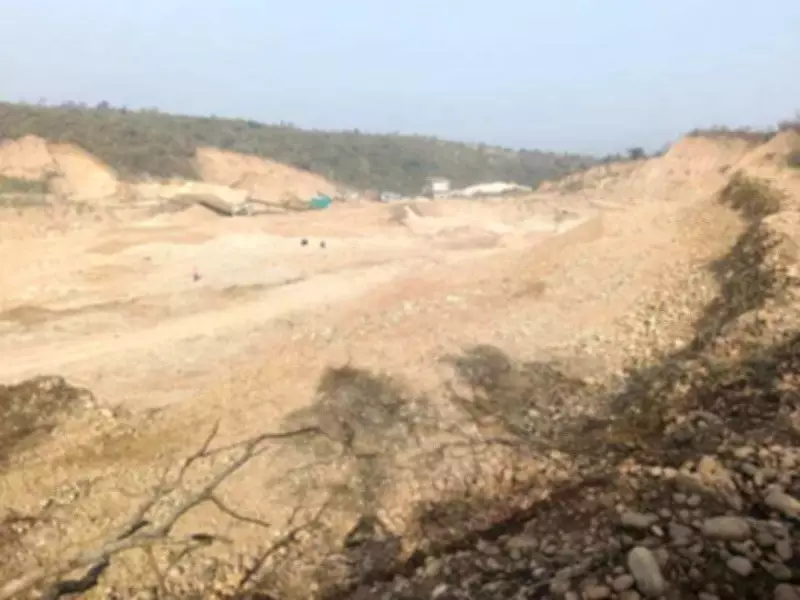
The National Green Tribunal (NGT) has ordered the formation of a joint committee to inquire into allegations of illegal mineral extraction by a stone crusher unit in the Haroli subdivision of Una district, Himachal Pradesh. The directive was issued by NGT Chairperson Justice Prakash Shrivastava, who instructed the committee to visit the mineral site in Nangal Khurd village and examine the claims.
Committee Composition and Mandate
The committee comprises the Una Deputy Commissioner, representatives of the Central Pollution Control Board (CPCB), and the Union Ministry of Environment, Forest and Climate Change. Justice Shrivastava directed the panel to determine the extent of illegal excavation and assess whether the stone crusher unit owner violated conditions of consent to operate (CTO) and environmental clearance norms. The committee has been asked to complete its investigation and submit a report within eight weeks, including recommendations for remedial and punitive measures.
Background of the Case
The tribunal's order came in response to an original application (OA) filed by four residents of Nangal Khurd and social activist Rohit Singh. The applicants accused M/s Mahadev Stone Crusher of engaging in large-scale illegal mineral extraction, far exceeding the sanctioned quantity, which resulted in damage to private agricultural land. According to the application, the approved extraction limit for the unit was 44,000 metric tonnes per year, or 88,000 metric tonnes over two years. However, the unit declared extraction of 1,42,000 metric tonnes over two years, which is 61% above the permitted limit. The applicants further claimed that based on the government's electricity consumption formula, the actual extraction was approximately 3,78,000 metric tonnes over two years, more than four times the permissible limit.

Allegations of Agricultural Land Damage
The applicants also alleged that the unit illegally excavated around 27 kanals of private agricultural land belonging to three applicants, reaching a depth of nearly 100 feet, without any lease or permission. They termed this as "predatory mining," stating that the excavation permanently destroyed the hillslope, stripped the land of all agricultural utility, and removed natural vegetation, creating conditions for monsoon flooding of fields.
Pollution Control Board's Inaction
The application further alleged that despite these violations, the Himachal Pradesh State Pollution Control Board renewed the unit's CTO and failed to act even after its own inspection on December 17, 2025, found five critical deficiencies, including inadequate dust suppression, absence of bag filters, and unmetalled roads. The applicants urged the NGT to cancel the CTO and all mining permissions granted to the unit and impose an environmental penalty, stating that despite repeated complaints, authorities failed to take action.






