

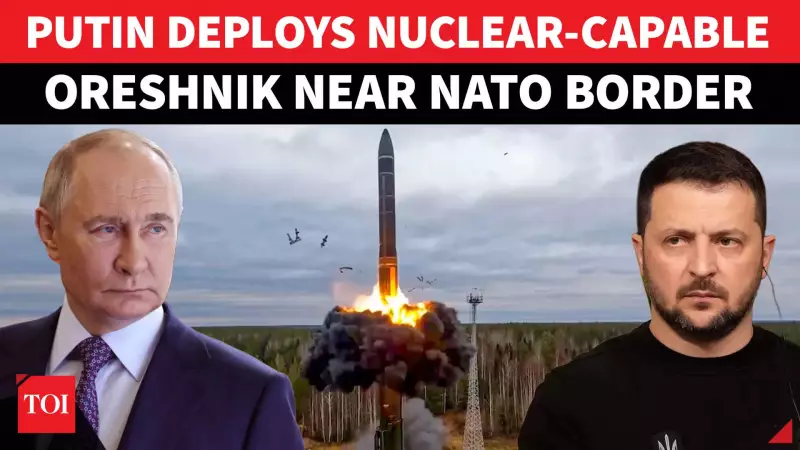
In a significant escalation of military posturing near Eastern Europe, Russia has deployed its advanced nuclear-capable hypersonic missile system, named Oreshnik, to the territory of its ally, Belarus. The move, confirmed by Minsk on December 19, 2025, positions these formidable weapons closer to the North Atlantic Treaty Organization's (NATO) eastern flank, injecting fresh volatility into an already fragile diplomatic climate.
Deployment Amid Delicate Diplomacy
The timing of this military deployment is particularly sensitive. It coincides with a period of intensified peace talks concerning the ongoing conflict in Ukraine. Simultaneously, Ukrainian leadership is actively pressing European Union officials in Brussels for critical financial assistance to ensure the nation's survival against Russian aggression. While Moscow describes the movement of the Oreshnik system as a routine exercise in strategic deterrence, authorities in Belarus have stated that the missiles are now officially on combat duty.
Calculated Move Raises Stakes for EU
This development dramatically raises the geopolitical stakes for European leaders gathered for a crucial summit. A central topic of their debate is the contentious issue of how to utilize billions of dollars in frozen Russian assets to aid Ukraine. Russia's latest missile deployment is widely interpreted as a stark warning, designed to increase the perceived cost of any delay in decision-making by the West and to deepen anxieties about a potential escalation beyond Ukraine's borders. The message appears clear: any substantial move to redirect Russian funds could provoke a severe response.

Broader Context of Rising Tensions
The stationing of the Oreshnik system in Belarus is not an isolated incident but part of a broader pattern of heightened military activity and rhetoric from Moscow. It serves as a powerful reminder of Russia's advanced weapons capabilities and its willingness to project force near NATO member states. This action inevitably forces a recalculation of security risks across Eastern Europe and puts additional pressure on the alliance's collective defense strategies. The move underscores the complex and dangerous interplay between battlefield dynamics in Ukraine and high-stakes diplomacy in European capitals.
As EU leaders weigh their options on funding for Kyiv, the shadow of the newly deployed hypersonic missiles looms large. The situation presents a classic security dilemma: strengthening support for Ukraine is essential, but doing so risks triggering further escalatory steps from a Russia that is visibly bolstering its strategic position. The coming days will test the resolve and unity of the Western alliance in the face of this calculated demonstration of military power.






