

Trump Extends Israel-Lebanon Ceasefire, Warns Iran Amid Fresh Clashes
US President Donald Trump has announced a three-week extension of the fragile ceasefire between Israel and Lebanon after high-level talks at the White House, calling the development a 'historic moment' and expressing hope that leaders from both countries could soon meet in Washington.
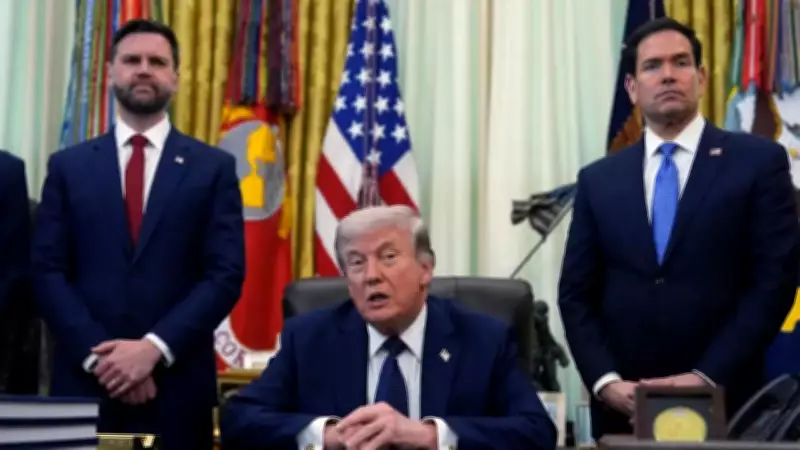
Trump said senior US officials, including Vice President JD Vance and Secretary of State Marco Rubio, met delegations from Israel and Lebanon in the Oval Office. He added that the truce extension could create space for broader peace negotiations and possibly direct engagement between Israeli Prime Minister Benjamin Netanyahu and Lebanese President Joseph Aoun.
Israeli Ambassador Yechiel Leiter described peace with Lebanon as 'not a pipe dream,' saying there were no core disputes that could not be solved. Lebanese Ambassador Nada Hamadeh Moawad also welcomed the talks, describing them as a rare diplomatic opportunity.

However, hostilities continued despite the announcement. Fresh exchanges erupted between Israeli forces and Hezbollah, with rockets launched from southern Lebanon toward northern Israel. Israel said its air defence systems intercepted the projectiles before retaliatory strikes targeted missile launchers and militant infrastructure. Lebanese authorities also reported casualties in separate Israeli attacks.
US officials have increasingly linked any long-term peace arrangement to curbing Hezbollah's military presence in Lebanon. Rubio said the Lebanese people deserve peace and prosperity, but that armed groups operating outside state authority remain a key obstacle.
The ceasefire extension comes amid rising regional tensions involving Iran. Trump refused to disclose details of a ship intercepted while travelling from China to Iran, describing the cargo as 'top secret.' He also warned Tehran against deploying naval mines in the Strait of Hormuz, calling such a move 'very foolish.'
Separately, Rubio said the United States would not block Iran from participating in the upcoming FIFA World Cup, despite speculation over possible replacement scenarios.
Meanwhile, Iran's Supreme Leader Mojtaba Khamenei praised national unity, saying 'a fracture has occurred in the enemy,' while President Masoud Pezeshkian dismissed suggestions of internal division.
The next three weeks are expected to be crucial, with diplomacy offering hope even as military risks remain high.
Renewed Violence Undermines Truce
Despite the ceasefire extension, violence erupted almost immediately. Rockets were launched from Lebanon into northern Israel, according to Israeli officials, who said their defence systems intercepted the projectiles. Israel then carried out retaliatory strikes on launch sites and militant targets in southern Lebanon. Lebanese officials reported injuries, including civilians hurt in artillery shelling in Yater, and fatalities in the Nabatieh region following separate Israeli airstrikes. Hezbollah later claimed responsibility for some rocket launches, saying they were retaliation for earlier Israeli attacks.
Iran's Internal Power Struggles
Iran's Supreme Leader Mojtaba Khamenei is reportedly facing serious medical challenges after surviving a bomb attack, raising fresh questions over his ability to maintain full control as the country navigates war fallout and fragile ceasefire diplomacy. According to a report by The New York Times, Khamenei has undergone surgery on his hand, suffered severe facial burns and is awaiting a prosthetic leg following injuries sustained in the strike. While the report said he remains mentally capable of making decisions, his physical condition has significantly reduced his direct involvement.

The report, citing four officials familiar with the matter, said Khamenei has had limited contact with Iranian military commanders during ongoing negotiations. Analysts believe this has created a power vacuum increasingly filled by the Islamic Revolutionary Guard Corps (IRGC). Sanam Vakil of Chatham House told the publication, 'Mojtaba is not yet in full command or control,' adding that many decisions are being presented to him as 'fait accompli.' Ali Vaez of International Crisis Group also said, 'Mojtaba is not supreme; he might be leader in name, but he is not supreme the way his father was… Mojtaba is subservient to the Revolutionary Guards.'
The report further said the IRGC played a decisive role in halting planned talks with the United States in Islamabad, overriding Iran's civilian leadership, including President Masoud Pezeshkian and Foreign Minister Abbas Araghchi. Khamenei, who reportedly succeeded his father Ali Khamenei after his death in US-Israeli strikes, has not made public appearances or verbal statements since assuming office, reportedly to avoid appearing weak. Communication with him is said to be taking place through sealed, hand-delivered letters.
Trump Escalates Rhetoric Against Iran
US President Donald Trump on Thursday sharply escalated tensions with Iran, saying he had ordered the US military to target Iranian small boats allegedly threatening shipping in the Strait of Hormuz. 'I have ordered the United States Navy to shoot and kill any boat, small boats though they may be... that is putting mines in the waters of the Strait of Hormuz,' Trump posted. 'There is to be no hesitation. Additionally, our mine 'sweepers' are clearing the Strait right now. I am hereby ordering that activity to continue, but at a tripled up level!'
The statement came after the US military announced it had seized another tanker in the Indian Ocean that it said was linked to smuggling Iranian oil. The vessel, identified as Majestic X, was reportedly located between Sri Lanka and Indonesia, according to ship-tracking data. The seizure followed reported Iranian attacks on three cargo ships in the Strait of Hormuz, two of which were allegedly captured.
Trump also intensified his rhetoric in a separate series of posts, portraying Iran as politically divided and militarily weakened. He claimed internal disputes were growing between hardliners and moderates within Tehran's leadership and insisted the United States had sweeping control over the Strait of Hormuz. 'No ship can enter or leave without the approval of the United States Navy' and the waterway was 'sealed up tight' until Iran agrees to a deal, Trump claimed.
The US president also reposted a clip from a commentator that called for killing Iranian leaders who oppose an agreement and destroying Kharg Island, a key Iranian oil export hub from where much of the country's energy shipments move. The latest remarks have raised fresh concerns over a wider regional confrontation, even as Washington continues to say diplomacy remains possible.
US Holds Strait of Hormuz Leverage
Trump said that the United States will keep control of the Strait of Hormuz until Iran agrees to a deal, using the vital oil route as leverage in the ongoing standoff. 'We have total control of it,' Trump said. 'It'll open when they make a deal or something else happens that's very positive.' He made clear the closure is intended to pressure Iran's economy. 'If we open the strait, that means they're going to make $500 million a day. I don't want them to make $500 million a day until they settle this thing,' he said.
The Strait of Hormuz is a narrow shipping lane linking Gulf oil producers to global markets. Disruptions there often drive price swings and raise concerns over supply. Trump acknowledged the impact could be felt by consumers. Asked about fuel costs, he said: 'For a little while.' Still, he said markets have held steady. 'The stock market is at an all-time high… I thought oil would go up to maybe $200 a barrel. And oil is at a very different number than anyone thought,' he said.
The administration pointed to domestic production as a buffer. 'We're putting out right now more oil and gas than we ever have in the history of our country,' Trump said. 'Ships are coming from all over the world to Texas, Louisiana and Alaska… to get oil from the United States while this is closed,' he added. Trump linked the pressure campaign to broader security goals. 'You can't let them have a nuclear weapon,' he said. He also signalled there is no fixed timeline for a resolution. 'I don't want to rush it… we have plenty of time,' he said, suggesting Iran faces increasing strain from restricted oil flows.
Trump Rules Out Nuclear Option
US President Donald Trump on Thursday said he would not use a nuclear weapon in any conflict with Iran, stressing that such weapons should never be used by any nation. Speaking to reporters at the White House, when asked whether he would use a nuclear weapon against Iran, Trump said, 'Why would a stupid question like that be asked?... No, I wouldn't use it. A nuclear weapon should never be allowed to be used by anybody.'
Trump also said the United States has a strong economy and enough oil supply, adding that more ships are heading to the US instead of using the Strait of Hormuz amid efforts to pressure Iran over its nuclear programme. '... We have this unbelievable economy... I called JD, Marco, Howard and Scott and told them that I hate to tell you, but we have to do a little bit of a detour. We have to go to Iran and make sure that they are out of nuclear weapons... A lot of ships are coming to the United States, and they are using the United States instead of the Hormuz Strait... We don't have an oil shortage... We are right now producing more oil than Saudi Arabia and Russia combined... We are taking in millions of barrels of oil from Venezuela,' he said.
Trump further claimed the United States has full control over the Strait of Hormuz and is keeping it closed to increase pressure on Tehran until an agreement is reached. '... I gave them a break. I want to make the best deal. I could make a deal right now. Do you know that if I left right now, we had a tremendous success. It would take them 20 years to rebuild, but I don't want to do that. I want to have it everlasting... What I am doing, I can't tell you that. I don't want to put that kind of timetable on it, but it will go pretty quickly. We will have the Strait opened up. Right now, we have it closed. We have total control of the Strait,' he further said.
Trump added that Iran had proposed reopening the waterway, but he chose not to allow it because of the potential financial benefit to Tehran. 'They would have opened it up 3 days ago. They came to us, and they said, 'We will agree to open the Strait.' All my people were happy except me. I said, 'One minute, if we open the Strait, that means they are going to make $500 million a day.' I don't want them to make $500 million a day until they settle this thing. So I am the one that kept it closed. We have total control of it. It will open when they make a deal or something else happens that is very positive,' he said.
Trump said he is under no pressure to end the West Asia conflict quickly, claiming the US has already achieved most of its military objectives and warning further action remains possible if talks fail. '...How many years was Vietnam?... I took the country out militarily in the first 4 weeks. Now what we are doing is sitting back and seeing what deal. If they dont want to make a deal, then I will finish it up militarily with the other 25% targets. We have hit 78% of the targets that we wanted to hit... It is amazing what we have done...' He also claimed Iran had agreed to halt the execution of several women after a US request. When asked whether Iran must stop funding Hezbollah, Trump replied, 'Yeah, they will have to cut that off. That is a must.'
US Maintains Blockade, Warns Iran
US President Donald Trump said Washington has full control over its blockade measures against Iran, describing them as highly effective and claiming no one is able or willing to breach them. Speaking at the White House, Trump said the blockade remains strong and tightly enforced. He also warned that Iran's alleged actions across the region, including reported attacks targeting countries such as Saudi Arabia, United Arab Emirates, Qatar, Kuwait and Bahrain, could prove to be a major strategic mistake. Trump added that if Iran is laying mines in regional waters, it would be another serious miscalculation.
Earlier, in a post on Truth Social, Trump dismissed suggestions that he is under pressure to end the conflict quickly. He claimed Iran is in a weakened military and economic position, saying time is on the side of the United States, not Tehran. Trump further said any future agreement with Iran would happen only when it benefits the US, its allies and wider global stability. He also claimed Iran's naval and air capabilities had been severely damaged, while the blockade remained airtight.





