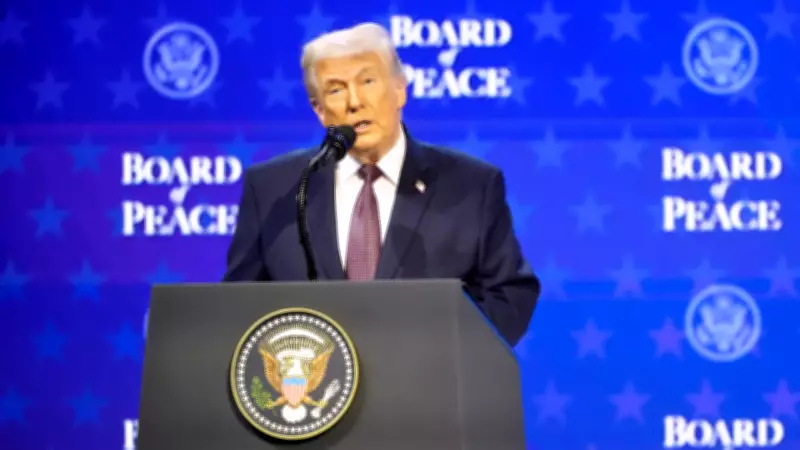
US President Donald Trump's Board of Peace has received no money in its official fund despite billions of dollars in pledges from member countries, the Financial Times reported on Wednesday. The board, established in January after the October ceasefire agreement to support Gaza's reconstruction, was proposed by Trump to help rebuild the territory, where an EU-UN assessment estimated over $71 billion would be needed over the next decade.
No Funds Deposited
According to the Financial Times, cited by AFP, the board's official fund, administered by the World Bank and endorsed by the United Nations, has not received any donor money since its launch. "Zero dollars have been deposited," one source told the newspaper. Donations have instead been directed to a JPMorgan account, according to the board's spokesperson, which has no independent transparency requirements.
Pledges vs. Reality
Trump had earlier said the United States would contribute $10 billion, while Qatar, Saudi Arabia, and the United Arab Emirates each pledged at least $1 billion. Under the board's charter, member countries must contribute $1 billion to secure a permanent seat. The initiative extended invitations to countries outside traditional Middle East diplomacy, including Russian President Vladimir Putin.

Several major European powers, including France and Britain, declined to join. The board is largely composed of long-time US allies in the Middle East, ideological allies of Trump, and smaller nations seeking closer ties with Washington. The board is closely tied to Trump personally, with its charter giving him final authority and allowing him to remain in charge beyond his presidency.
Impact on Gaza Administration
The funding shortfall has already affected plans for the National Committee for the Administration of Gaza (NCAG), a US-backed body of Palestinian technocrats intended to take over administration from Hamas. Reuters reported in April that the board informed Hamas and other factions that the NCAG could not enter Gaza due to a lack of funds. Sources said both funding shortages and security concerns have delayed the committee's deployment.
Despite the October ceasefire, violence has continued in Gaza, with Israeli strikes reportedly killing at least 700 people since then, according to local health officials. The war began after Hamas's October 7, 2023 attacks on Israel, which killed around 1,200 people. Israel's military campaign has since killed more than 72,000 Palestinians, according to local health authorities, and displaced much of the population.