Why Ground Troops in Iran Could Be America's Biggest Strategic Mistake
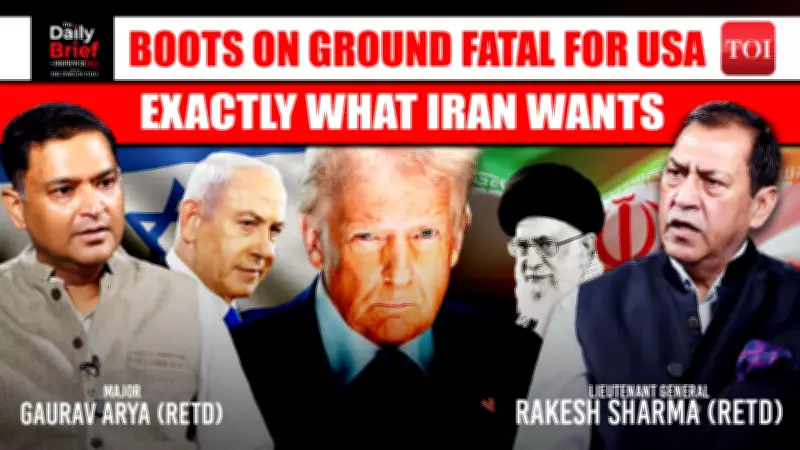
In a detailed analysis on The Daily Brief by DefenceHQ, military experts Major Gaurav Arya and Lt. Gen. Rakesh Sharma dissect the escalating US–Israel confrontation with Iran, focusing on the potential deployment of American ground forces. The discussion highlights critical strategic, operational, and political pitfalls that could make such a move a monumental error.
The Absence of a Clear Political End State
The conversation begins by interrogating Washington's stated objectives. Is the aim to counter an existential threat, roll back Iran's nuclear program, or achieve regime change? Experts point out a glaring absence of a clearly defined political end state. Since 1945, modern wars have demonstrated that inserting troops does not guarantee regime change or stable outcomes. Without a coherent strategic aim, military action risks becoming an open-ended commitment with no exit strategy.
Operational Realities and Logistical Burdens
Deploying ground forces into Iran, a vast civilisational state with complex terrain, presents immense operational challenges. The discussion delves into logistical burdens, including missile interception ratios and the vulnerability of Gulf airbases to drone and missile saturation. The scale of force required for a land campaign would be enormous, straining US military resources and potentially leading to interceptor exhaustion.

Iran's Layered Governance and IRGC Strength
Analysts examine Iran's layered governance model, succession planning, and the entrenched role of the Islamic Revolutionary Guard Corps (IRGC). Expectations of an internal uprising may be misplaced due to the system's resilience. The IRGC's embedded strength and Iran's power structure make regime change a highly uncertain endeavor, further complicating any ground intervention.
Regional Escalation and Defense Pacts
The episode explores regional dynamics, including missile and drone attacks on Saudi infrastructure. A key focus is the September 2025 Saudi–Pakistan defense pact, which includes a NATO-style collective defense clause. Experts question whether Pakistan, amid internal security pressures from the TTP, Afghan frontier instability, and domestic unrest, is realistically positioned to honor this commitment if Saudi Arabia remains under Iranian attack.
Conclusion: A Cautionary Tale
In summary, the analysis suggests that deploying US ground troops in Iran could be America's biggest strategic mistake. The combination of unclear political aims, daunting operational realities, Iran's robust governance, and uncertain regional alliances creates a high-risk scenario. Military action without a coherent strategy may lead to prolonged conflict with no clear resolution, echoing past failures in regime-change doctrines.