

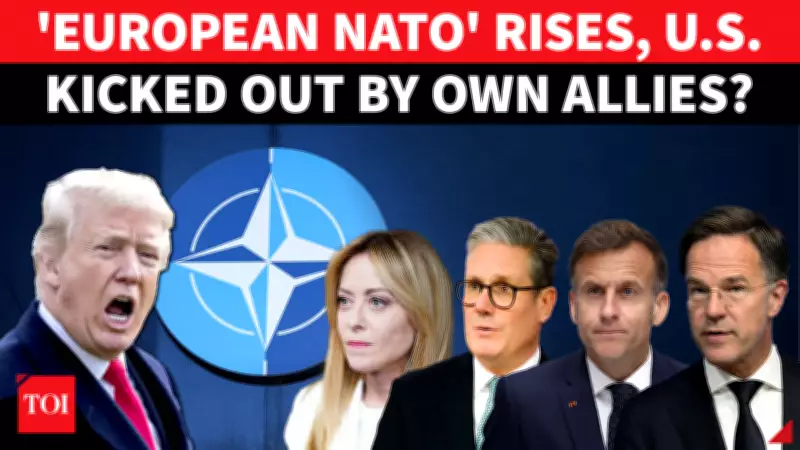
Europe Quietly Prepares 'European NATO' Contingency Plan Amid US Commitment Doubts
A historic and potentially seismic shift is currently unfolding within the corridors of the North Atlantic Treaty Organization (NATO), one of the world's most formidable military alliances. As profound uncertainty clouds the future of America's commitment to the bloc it has historically led, European nations are now discreetly but decisively preparing for a strategic future that may not center around the United States.
The 'European NATO' Blueprint Emerges
According to an exclusive report by The Wall Street Journal, senior European officials and defense planners have initiated the development of detailed contingency plans. These plans are being formulated for a scenario some are already referring to as a 'European NATO'—a standalone, European-led defense and security architecture. This initiative represents a fundamental re-evaluation of transatlantic security dependencies that have defined the post-World War II order.
Catalysts for the Strategic Pivot
The drive to create independent European security structures is not occurring in a vacuum. It is a direct response to growing geopolitical instability and specific political signals from across the Atlantic. The report highlights that the planning has intensified against a backdrop of:

- Ambiguous US Commitments: Deepening concerns over the reliability and long-term nature of American security guarantees to its European allies.
- Political Volatility: The potential for a shift in US foreign policy, particularly with former President Donald Trump's previous threats to reconsider US participation in NATO and his recent statements regarding conflicts like the Iran war.
- Regional Instability: Ongoing conflicts, including the war in Ukraine and tensions in the Middle East involving Iran, which underscore the need for resilient and autonomous European defense capabilities.
Monumental Challenges on the Horizon
While the concept of a European-led alliance is gaining traction, the path to its realization is fraught with monumental logistical, financial, and political hurdles. European defense integration has long been discussed but often stalled. Key challenges include:
- Military Integration: Harmonizing the diverse military doctrines, equipment, and command structures of over two dozen sovereign nations into a cohesive, rapid-response force.
- Financial Burden-Sharing: Establishing a sustainable funding model to replace the massive financial and material contributions currently provided by the United States, which has long been the alliance's primary military power.
- Strategic Autonomy: Developing independent intelligence, surveillance, reconnaissance (ISR) capabilities, and long-range strategic assets that Europe has traditionally relied on the US to provide.
- Political Cohesion: Maintaining unity and a common strategic vision among member states with varying threat perceptions and domestic political pressures.
The Wall Street Journal report suggests that these contingency plans are currently in a formative, exploratory phase. They are designed to ensure European security is not left vulnerable by any potential future reduction in American engagement. The very existence of such planning marks a significant psychological and strategic departure from decades of Atlantic-centric defense policy.
This development signals a potential re-drawing of the global security map. Whether these plans evolve into a fully-fledged alternative alliance or remain a strategic insurance policy, they underscore a new era of strategic calculation in Europe, where self-reliance is no longer just an aspiration but a contingency actively being prepared for.

