The Arctic's Strategic Transformation: From Frozen Frontier to Global Trade Highway
While conventional wisdom suggests the world operates on financial systems or natural resources, a deeper truth emerges during conflicts: global commerce fundamentally depends on maritime corridors. From essential crude oil and liquefied natural gas to advanced semiconductors and consumer goods, modern economies rely on strategic sea lanes that pass through critical chokepoints before reaching their destinations.
The current tensions between the United States and Iran have vividly demonstrated this reality. Disruptions around vital straits and shipping corridors rarely remain localized—they create continental ripple effects that destabilize supply chains, increase costs, and introduce volatility into international markets. Control over these routes has historically provided geopolitical leverage, allowing nations positioned along them to influence trade flows far beyond their immediate geography.
The Search for Alternatives and Arctic Re-emergence
This very dominance has sparked a determined, albeit quiet, search for alternatives. Countries vulnerable to these chokepoints are increasingly exploring new corridors that can bypass traditional routes and reduce dependence on contested waters. Within this shifting landscape, the Arctic is re-emerging—not as a distant, frozen wilderness, but as a potentially game-changing maritime highway.

Russia and China are advancing with calculated intent in this arena. Moscow brings decades of Arctic experience, having developed technological and military capabilities to operate in some of Earth's harshest conditions. Its fleet of nuclear-powered icebreakers and submarines—capable of remaining deployed for months without docking—reflects sustained strategic focus on the High North.
Beijing, aligning its ambitions with Russia, sees in these icy waters an opportunity to redraw global trade maps through what it calls the Polar Silk Road, an Arctic extension of its broader connectivity strategy. Their combined push into the Arctic is not merely exploratory—it represents a strategic effort to reshape global trade architecture, challenge traditional maritime order, and open a new frontier where control over ice-bound routes could redefine power in our rapidly evolving world.
Russia's Arctic Dominance: Energy, Infrastructure and Control
Russia currently maintains a commanding position in the Arctic region, both in infrastructure development and natural resource control. Moscow controls significant portions of Arctic oil and gas reserves, with Arctic fields accounting for approximately 20% of its total oil output and containing an estimated 35.7 trillion cubic meters of natural gas—nearly 75% of its proven reserves.
This concentration of resources provides Russia with both economic leverage and strategic control. Moscow has invested substantially in developing the Northern Sea Route as a key export corridor, particularly after Western sanctions following its 2022 invasion of Ukraine forced energy export rerouting toward Asia. Crucially, Russia dominates icebreaker capabilities with a fleet of 45 icebreakers, including eight nuclear-powered vessels—the only such fleet globally. These ships are essential for carving navigable paths through thick Arctic ice, enabling year-round shipping operations.
Russia's long-term ambitions receive support from substantial investment commitments, including a €20 billion ($23.4 billion) plan approved for Arctic infrastructure and shipping route development through 2035. Despite current limitations—such as relatively low cargo volumes of 37 million tonnes transported via the Northern Sea Route in 2025—Russia continues expanding its capabilities steadily.
China's Polar Silk Road Strategy
China, though not an Arctic nation, has emerged as a key player through its "Polar Silk Road" initiative launched in 2018 as part of its broader Belt and Road framework. Beijing aims to become a "polar power" by 2030, investing in infrastructure, scientific research, and energy projects across the region.

Chinese firms have secured significant stakes in Arctic energy projects, including a nearly 30% share in Russia's $27 billion Yamal LNG project. This partnership ensures long-term access to liquefied natural gas while providing China with a foothold in Arctic shipping and technology development.
China's involvement extends beyond economic interests. Beijing operates icebreakers equipped with seabed-mapping mini-submarines and maintains Arctic observation satellites, which it claims serve scientific purposes. Joint military activities with Russia—including bomber patrols near Alaska in 2024—signal growing strategic alignment between the two powers.
Addressing the Malacca Dilemma
China's Arctic push also addresses a long-standing strategic vulnerability closer to home—the "Malacca dilemma." A significant share of China's energy imports and trade flows passes through the Strait of Malacca, one of the world's busiest and most tightly controlled maritime chokepoints. Analysts suggest any disruption in this narrow corridor—whether from conflict, blockades, or heightened naval presence—could severely impact Beijing's energy security and supply chains.
India's strategic geography becomes relevant here. Positioned astride key Indian Ocean sea lanes with growing naval capabilities, New Delhi is widely seen by strategic experts as having an advantage in monitoring and potentially influencing traffic through the Malacca Strait. India's partnerships with countries like the United States, Japan, and Australia under frameworks such as the Quad have further strengthened its maritime posture in the region, raising concerns in Beijing about overdependence on a single chokepoint.
In this context, China's interest in alternative routes—from the China-Pakistan Economic Corridor to the Arctic's Polar Silk Road—appears less exploratory and more strategic. By investing in northern sea routes that bypass Malacca entirely, Beijing attempts to diversify its trade arteries, reduce geopolitical risk, and ensure economic lifelines remain insulated from regional power dynamics dominated by rivals.
Arctic Shipping Routes: Economic Advantages and Challenges
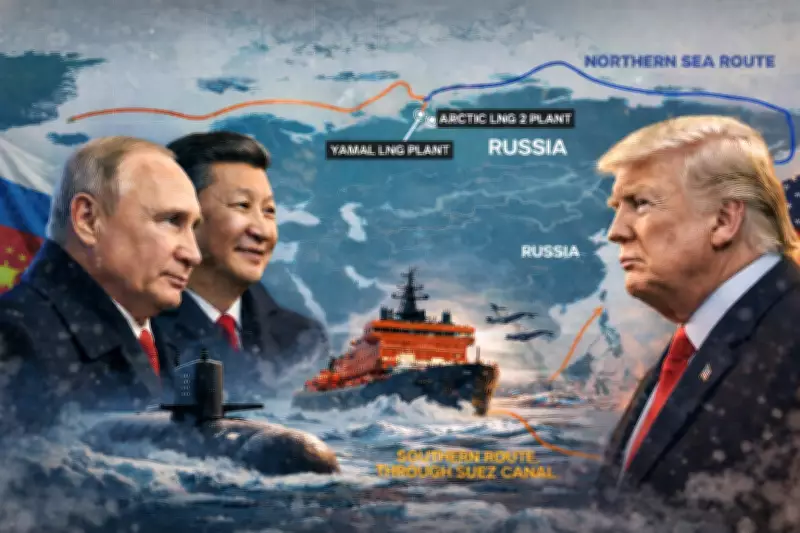
At the heart of the Arctic race are two major shipping corridors: the Northwest Passage running through Canada's Arctic archipelago, and the Northern Sea Route stretching along Russia's northern coastline. These routes can cut transit distances between Asia and Europe by as much as 4,500 nautical miles, effectively halving travel time compared to traditional routes via the Suez Canal. This reduction translates into lower fuel costs, faster delivery times, and increased commercial efficiency.
Shipping activity reflects growing interest, with more than 1,800 ships traversing Arctic waters in 2025—a 40% increase from 2013 levels. China has particularly tested commercial viability, completing 14 voyages in 2025, including the first-ever journey by a COSCO container ship through Arctic waters.
Despite these gains, Arctic shipping remains complex and costly due to harsh weather, limited infrastructure, and seasonal ice conditions. However, as ice continues to recede, these routes are expected to become increasingly viable and strategically indispensable.
Militarization and Strategic Competition
Beyond trade and energy, the Arctic is increasingly becoming a militarized zone. Russia has significantly expanded its military infrastructure in the region, including deploying S-400 air defense systems, building radar bases, and constructing a 3.5-kilometer runway capable of hosting nuclear-capable bombers on Franz Josef Land.
Military exercises have intensified, with Russia's Northern Fleet conducting large-scale drills involving troop landings and live-fire exercises from ships and nuclear submarines in September 2025. China's military footprint, while smaller, grows in collaboration with Russia through joint patrols and increasing technological capabilities.
Experts warn the region's geography makes it strategically critical, representing the shortest route between Russia and the United States—vital for missile defense, surveillance, and early warning systems.
United States Response and Strategic Gap
In contrast to Russia and China, the United States is widely seen as lagging in Arctic capabilities. The US currently operates just three icebreakers, one of which is over 50 years old—far behind Russia's fleet of 45. Chronic underfunding and maintenance issues have hampered US Coast Guard capabilities, with former officials noting ships have been cannibalized for parts.
Recognizing this gap, the US government launched a renewed push to expand its Arctic presence through a $30 billion shipbuilding initiative announced in 2025, including plans for 11 new Arctic security cutters and additional medium-sized icebreakers. The program involves multiple international partnerships with companies like Davie Defense, Bollinger Shipyards, and Finland-based Rauma Marine Constructions.
However, timelines remain extended, with the first US-built icebreakers not expected until the early 2030s, highlighting the scale of the gap the US is attempting to close.
Global Implications and Shifting Power Dynamics
The rapid transformation of the Arctic represents not merely a regional development but a structural shift in the global economic and geopolitical order. The emergence of Arctic trade corridors could create an alternative system of shipping and energy flows, reducing the influence of traditional Western-controlled chokepoints.
Russia's control over resources and infrastructure, combined with China's financial and technological investments, creates a powerful axis in the High North. Meanwhile, fragmented Western holdings and slower investment cycles have left the US and Europe struggling to maintain pace.
This imbalance could have cascading effects on global supply chains, energy pricing, and geopolitical leverage. Disruptions—whether from sanctions, cyberattacks, or regulatory changes—could ripple through the global economy given the increasing importance of Arctic routes.
The Arctic has evolved from a distant, frozen expanse into a rapidly developing arena where climate change, commerce, and conflict intersect. As Russia and China move decisively to capitalize on this transformation, building infrastructure, expanding military capabilities, and forging strategic partnerships, the United States faces significant challenges in closing the capability gap.
What unfolds in the Arctic represents more than a race for resources or shipping lanes—it constitutes a contest over the future architecture of global power that will likely define international relations for decades to come.