

Asian Markets Decline as Middle East Conflict Weighs on Global Sentiment
Asian stocks experienced widespread losses on Friday, driven by persistent uncertainty surrounding the ongoing conflict in the Middle East. The situation continues to unsettle global financial markets, with oil prices remaining elevated despite some initiatives aimed at easing supply concerns.
Investor Anxiety Peaks Amid Prolonged Hostilities
After a turbulent week on trading floors, investors are heading into the weekend with heightened anxiety over the duration and intensity of the conflict. The war between the US-Israel coalition and Iran, coupled with Tehran's attacks across the Gulf region, shows no signs of abating, leaving markets in a state of flux.
Global equities have been severely impacted by the crisis, which has propelled crude prices sharply higher and reignited fears of renewed inflation. This inflationary pressure could potentially hinder the global economic recovery. Since last Friday, oil prices have surged by approximately one-fifth, reflecting the immediate market reaction to the escalating tensions.

Although a mid-week rebound provided temporary relief, analysts caution that the longer the conflict persists, the greater the strain on financial markets. Chris Beauchamp, chief market analyst at IG, emphasized in a statement quoted by AFP, "It is too soon to suggest that stocks have bottomed. Unless the war ends soon—and if anything a more intense conflict seems more likely—markets will struggle."
He further noted that volatility remains elevated, indicating expectations of significant two-way price movements, but a continued decline appears probable, even with occasional short-term recoveries.
Diplomatic Stalemate and Market Reactions
The conflict's trajectory suggests no imminent resolution. Iranian Foreign Minister Abbas Araghchi stated on Thursday that Iran is neither seeking a ceasefire nor negotiations with the United States, underscoring the entrenched positions of the involved parties.
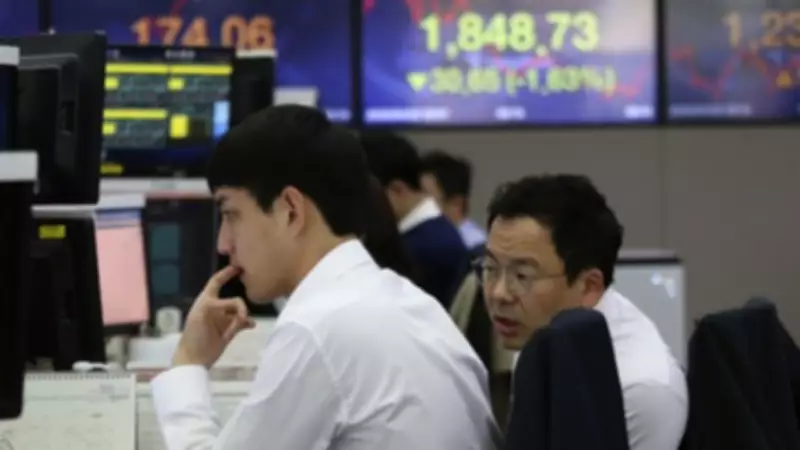
Asian markets largely mirrored losses from Wall Street, where all three major indexes closed lower despite late-session rallies. Seoul's Kospi index exhibited particularly sharp movements, falling another 1.5 percent after plunging nearly 19 percent earlier in the week and then rebounding over nine percent on Thursday.
Other Asian markets, including Sydney, Singapore, Wellington, Manila, and Jakarta, also recorded declines. In contrast, Tokyo, Hong Kong, Shanghai, and Taipei managed to post gains, highlighting the uneven impact across the region.
Oil Market Dynamics and Supply Concerns
Rising crude prices have intensified concerns about a potential resurgence in inflation, which could compel central banks to reconsider plans for interest rate cuts. Some analysts even warn that rate hikes might return, adding another layer of complexity to the economic outlook.
While Iran has not officially closed the Strait of Hormuz, shipping through this critical waterway has nearly ceased. Approximately one-fifth of the world's crude supply and significant volumes of natural gas typically transit through the strait, making its disruption a major global concern.
There was a slight respite in oil markets after US Interior Secretary Doug Burgum mentioned that officials are considering measures to mitigate the price surge. Additionally, the White House temporarily eased sanctions against Russia on Thursday, granting India a 30-day waiver to purchase Russian oil stranded at sea until April 3.
Scott Bessent, Treasury Secretary, explained that the waiver was issued "to enable oil to keep flowing into the global market." Earlier in the week, US President Donald Trump pledged to protect ships navigating the Strait of Hormuz.
Other nations are also taking proactive steps to secure energy supplies. According to Bloomberg News, China has instructed its largest oil refiners to halt exports of diesel and gasoline amid fears of potential shortages.

Current Market Data and Outlook
Despite a minor pullback, oil prices remain at elevated levels. By the close of trading on Thursday, Brent crude had risen about 19 percent since last Friday, while West Texas Intermediate climbed more than 22 percent, briefly surpassing $80 per barrel for the first time since January of the previous year.
As of approximately 0230 GMT on Friday, oil prices continued to trend higher. West Texas Intermediate increased by 2.0 percent to $79.38 per barrel, and Brent North Sea Crude advanced 1.5 percent to $84.10 per barrel.
In equity markets, Seoul's Kospi fell 1.6 percent to 5,497.51, while Tokyo's Nikkei 225 rose 0.4 percent to 55,490.04. Hong Kong's Hang Seng Index gained 0.9 percent to 25,557.59, and Shanghai's Composite edged up 0.1 percent to 4,111.86.
Currency markets also reflected the ongoing volatility. The euro strengthened to $1.1617 from $1.1604, and the pound rose slightly to $1.3367 from $1.3357. The dollar slipped to 157.51 yen from 157.55 yen, while the euro increased to 86.91 pence from 86.87 pence.
Investors are closely monitoring the release of US jobs data later on Friday, seeking insights into the resilience of the world's largest economy amidst these geopolitical challenges.





