

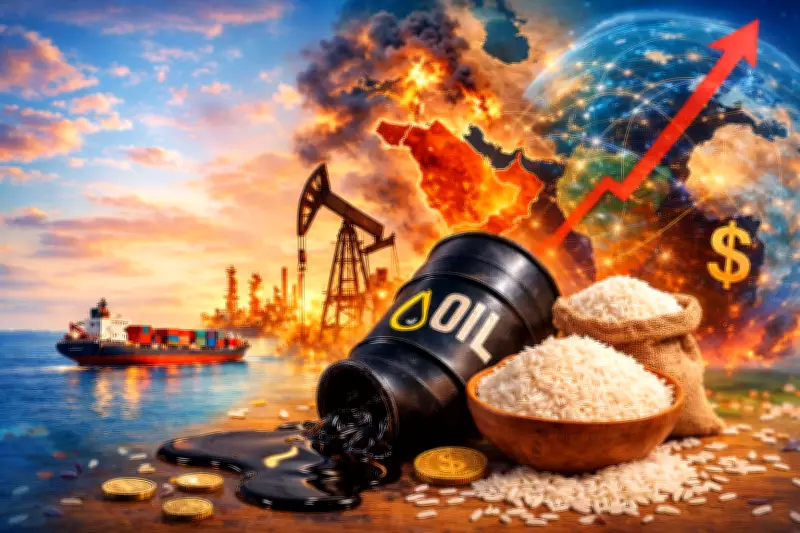
Middle East Conflict Intensifies, Global Economy Feels Immediate Strain
The ongoing conflict in the Middle East has entered a critical phase, with its economic repercussions already rippling across the globe. As tensions between Israel, Iran, and the United States escalate, key sectors such as trade, energy, and agriculture are experiencing significant disruptions. This comes at a time when markets are still recovering from recent tariffs and other geopolitical challenges.
Early Signs of Economic Pressure Emerge
Despite the conflict being only a week old, early indicators show mounting pressure on global trade networks. Shipments of essential commodities have faced delays, critical shipping routes are being rerouted, and prices for vital inputs have surged sharply. Economists, including those cited by CNN, emphasize that the extent of economic damage will hinge on the conflict's duration.
Prior to the recent attacks by the United States and Israel on Iran, the International Monetary Fund (IMF) had projected global economic growth at 3.3% for this year. The IMF has not yet updated this forecast, stating it is "too early" to assess the full impact. However, the institution is closely monitoring developments and has highlighted several potential risks, including further trade disruptions, surges in energy prices, and increased volatility in financial markets.

Dan Katz, deputy managing director at the IMF, warned that the expanding conflict could have broad consequences, affecting inflation and economic growth across multiple metrics.
Key Economic Impacts of the Conflict
Based on early assessments, the conflict is impacting the global economy through several major channels:
1. Rising Energy Prices
Energy markets are at the forefront of economic risks. Fears over supply disruptions have driven Brent crude oil to its highest levels in over 18 months. A primary concern is the potential closure of the Strait of Hormuz, a crucial waterway for global energy shipments. According to the US Energy Information Administration, approximately one-fifth of the world's daily oil and liquefied natural gas production passes through this corridor.
If the strait becomes impassable, the effects could be severe. Goldman Sachs estimates that European natural gas futures could more than double if shipments are halted for over two months. Higher energy prices are likely to fuel broader inflation. In Europe, consumer inflation could rise by more than one percentage point if the conflict persists for several months, potentially reducing EU economic growth by up to half a percentage point.
Fuel costs are already climbing. Germany has reported double-digit increases in petrol and diesel prices, while the United Kingdom and the United States have seen prices reach multi-month highs. Goldman Sachs projects that sustained high oil prices could push US consumer inflation from 2.4% to 3% by year-end, complicating the Federal Reserve's ability to cut interest rates.
2. Vulnerability of Asian Economies
Asian economies are particularly exposed to energy shocks. Capital Economics estimates that 80-90% of crude oil and liquefied natural gas from the Strait of Hormuz is destined for Asia. China, a major buyer, faces this challenge as it grapples with its lowest economic growth target in decades.
The consultancy warns that attacks on Iran could drive inflation higher across Asia, with many countries potentially seeing inflation rise by around half a percentage point if Brent crude prices remain elevated.
3. Disruption to Exports and Global Trade
Trade flows are beginning to suffer. Shipping disruptions in the Middle East are affecting exports, with India experiencing significant setbacks. Over 400,000 metric tons of basmati rice for export are stuck at ports or in transit due to disrupted routes. Approximately 75% of India's annual basmati rice exports, about 6 million tons, are shipped to the Middle East.
Deepali Bhargava of ING notes that if the conflict continues, exporters in India and China could be among the hardest hit, especially as the region has become a key export destination amid higher US tariffs.

4. Pressure on Fertilizer Supply and Food Production
The conflict threatens global food production through its impact on fertilizer supplies. Svein Tore Holsether, CEO of Yara International, emphasized that the Strait of Hormuz is vital for the fertilizer trade, with around one-third of global urea exports passing through it. Significant volumes of other raw materials for fertilizers also use this route.
Prices are already reacting, with Egyptian urea prices surging 35% this week and sulphur prices rising sharply. Nearly half of global sulphur trade originates from Middle Eastern countries, exacerbating the strain.
5. Shipping Congestion and Supply Chain Delays
Shipping networks are facing disruptions, with containers accumulating at Indian ports as major shipping companies suspend services to the Middle East. Judah Levine of Freightos warns that continued issues could lead to container shortages and reduced capacity spreading to other markets.
Xeneta, a shipping analytics firm, highlighted the immediate uncertainty for logistics networks, noting that vessel movements are changing rapidly, leaving shippers to manage cargo that may not reach intended ports.
6. Impact on Air Cargo and Global Trade Flows
Air freight operations are also disrupted, with many aircraft grounded and airspace heavily restricted in parts of the Middle East. Adidas has already warned of potential delays in air freight shipments. Middle Eastern carriers like Emirates, Qatar Airways, and Etihad account for about 13% of global air cargo capacity, crucial for high-value goods such as smartphones and electronics.
The International Air Transport Association estimates that air freight carries roughly one-third of global trade by value, underscoring its importance.
Conclusion
With vessel routes shifting, shipments stalled, and airspace restricted, the Middle East conflict is testing the resilience of global supply chains. As the disruption continues, its economic effects are likely to widen, posing significant challenges to recovery and stability in the global economy.





