

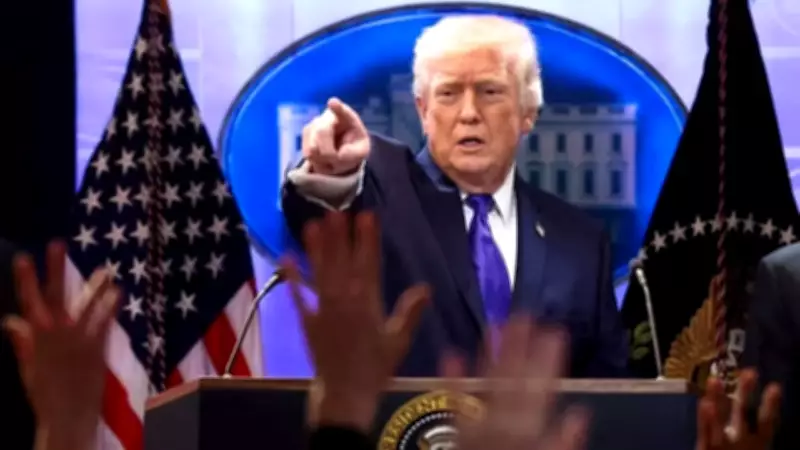
Trump Announces 15% Global Tariff Hike in Response to Supreme Court Ruling
In a significant escalation of trade policy, former US President Donald Trump has declared a worldwide tariff increase to 15%, up from a previously proposed 10%. This decision comes directly after the US Supreme Court delivered a sharp rebuke of his authority on the matter, marking a contentious turn in international economic relations.
Supreme Court Ruling Sparks Presidential Reaction
The move follows a 6-3 opinion from the Supreme Court, which Trump vehemently criticized as "ridiculous, poorly written, and extraordinarily anti-American." Expressing his frustration on the Truth Social platform, Trump framed the tariff hike as a necessary response, citing Section 122 of the Trade Act. This provision allows the US President to impose tariffs of up to 15% for 150 days to address "large and serious United States balance-of-payments deficits."
Trump asserted that his administration conducted a "thorough, detailed, and complete review" of the court's decision before proceeding. He emphasized that the new tariffs are "fully allowed, and legally tested," and promised that within the coming months, his team would determine and issue further legally permissible tariffs to advance his "Making America Great Again" agenda.

Global Trade Systems Thrown Into Uncertainty
Trade experts warn that this announcement, perceived as driven by political pique, is likely to disrupt global trading systems. Countries and corporations worldwide, including within the United States, now face heightened uncertainty in planning exports and imports. Legal challenges are anticipated, particularly because the US trade balance varies significantly across nations.
For instance, the United States maintains a trade surplus of $14 billion with Brazil, yet Trump imposed a 50% tariff on the country. This move is viewed as politically motivated, aimed at punishing the ruling Lula government for prosecuting former President Jair Bolsonaro, whom Trump supports. Similarly, Trump has openly used tariff threats with countries like India to achieve objectives beyond addressing trade deficits, raising questions about the legitimacy of such actions under US law.
Potential Shift to Longer-Lasting Tariff Authority
While Section 122 permits temporary tariffs, Trump indicated plans to transition to a more permanent framework under Section 301 of the Trade Act after the initial 150-day period. Section 301 addresses "unfair" foreign trade practices but requires detailed investigations and notifications. Each country and product must undergo separate scrutiny by the US Trade Representative to determine if "unjustifiable" or "discriminatory" acts burden US commerce.
A notable precedent involves the US using Section 301 against India in 2020 over its Digital Services Tax (DST). The investigation alleged that India's 2% tax on foreign e-commerce companies unfairly targeted American tech giants such as Google, Amazon, and Meta. Under a recent "Framework of an Interim Agreement," India agreed to phase out these levies to avoid the reimposition of Section 301 tariffs.
This latest tariff escalation underscores the ongoing volatility in global trade policies and sets the stage for further legal and economic confrontations in the international arena.






