

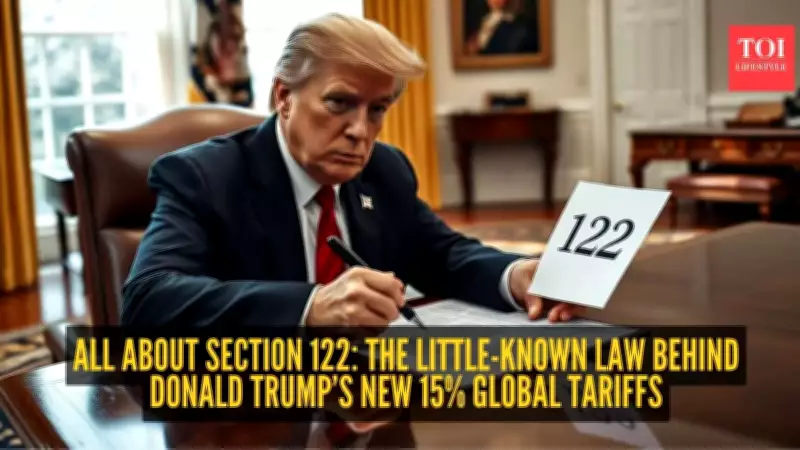
Trump's 15% Tariffs: How a 1970s Law Became the Unexpected Legal Weapon
Global trade discussions often get dismissed as dry, technical affairs filled with impenetrable jargon and mind-numbing statistics. However, the current landscape is anything but dull, capturing international attention with unprecedented urgency.
The Legal Foundation Behind the Tariff Surge
The catalyst for this heightened focus stems from U.S. President Donald Trump's decision to elevate global import tariffs to 15%. While the tariff increase itself represents significant economic policy, the more compelling narrative lies in the surprising legal mechanism enabling this move.
Following judicial challenges to previous tariff initiatives, where courts questioned the administration's expansive use of emergency powers without explicit Congressional authorization, policymakers needed an alternative approach. Their solution emerged from historical archives: Section 122 of the U.S. Trade Act of 1974, a decades-old provision that has suddenly become central to contemporary trade discourse.

Understanding Section 122: The Emergency Economic Tool
Section 122 grants the President temporary authority to implement an import surcharge—essentially an additional tariff—of up to 15% on imported goods. What distinguishes this legislation is its expedited implementation process.
Unlike conventional trade measures that involve prolonged investigations, negotiations, and bureaucratic procedures spanning months, Section 122 bypasses much of this complexity, permitting nearly immediate tariff imposition.
Utilizing this provision, the administration initially introduced a 10% tariff before escalating to the maximum 15% permitted under the law.
Historical Context and Modern Application
Originally conceived during the 1970s, Section 122 was designed as an emergency economic instrument, not as a tool for modern trade conflicts. The law targeted situations where the United States experienced substantial balance-of-payments deficits—importing significantly more than exporting, resulting in excessive capital outflow.
In practical terms, Section 122 functioned as an economic emergency brake, providing the government with a rapid mechanism to curb imports and stabilize the national economy during financial crises.
The Critical Time Constraint
A crucial limitation accompanies Section 122: its temporary nature. Tariffs enacted under this law remain effective for only 150 days unless Congress explicitly approves an extension. Absent Congressional authorization, the tariffs automatically expire, creating a built-in countdown mechanism.
This means the current 15% tariffs, while active, exist under a strict temporal constraint, with the expiration clock already in motion.
Expert Analysis and Future Implications
Economists and legal experts are monitoring this development closely because Section 122 has rarely been deployed for comprehensive global tariffs in contemporary times. Applying it on such an extensive scale may provoke new legal challenges, particularly since the law was originally intended for financial emergencies rather than broad trade disputes.
The administration's reliance on this historical provision represents a strategic pivot in trade policy execution, but its sustainability remains uncertain.
Presently, the tariffs continue in force, yet their endurance through political and judicial examination will likely influence global trade dynamics significantly in the coming months. This situation underscores how obscure legislative provisions can unexpectedly reshape international economic relationships when contemporary circumstances intersect with historical legal frameworks.






