

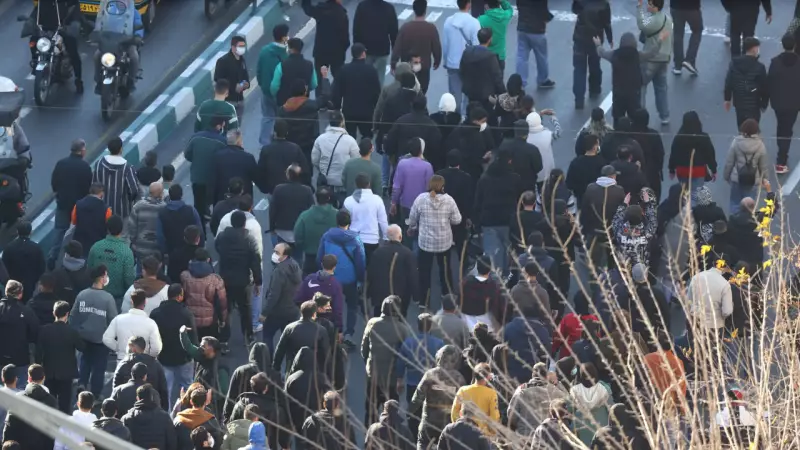
Iran has witnessed its first reported fatalities amid a new wave of protests, with at least three people killed as demonstrations driven by severe economic hardship spread from the capital into rural provinces. This marks the largest wave of public dissent since the 2022 nationwide protests triggered by the death of Mahsa Amini.
Deaths in Lur Ethnic Region Signal Escalation
The deaths occurred in two cities largely inhabited by Iran's Lur ethnic group, potentially indicating a heavier-handed response from the country's theocratic authorities. One person was killed on Wednesday, and two more lost their lives on Thursday.
In Lordegan, a city in Chaharmahal and Bakhtiari province located about 470 kilometers south of Tehran, online videos depicted demonstrators gathered in streets with audible gunfire. The semiofficial Fars news agency, citing an anonymous official, reported that two people were killed during protests there on Thursday. The Washington-based Abdorrahman Boroumand Center for Human Rights confirmed the two deaths and shared an image appearing to show an Iranian police officer in body armor carrying a shotgun.

Basij Force Member Among the Dead
Separately, a demonstration on Wednesday night in the city of Kouhdasht, over 400 kilometers southwest of Tehran, resulted in the death of a 21-year-old volunteer with the paramilitary Revolutionary Guard's Basij force. State-run IRNA reported the member's death without details.
Saeed Pourali, a deputy governor in Lorestan province, stated the Guard member "was martyred ... at the hands of rioters during protests in this city in defense of public order." He added that 13 Basij members and police officers were injured. Pourali acknowledged the protests stem from "economic pressures, inflation and currency fluctuations" but warned against exploitation by "profit-seeking individuals."
Local prosecutor Kazem Nazari said 20 people were arrested in Kouhdasht and calm had been restored, according to the judiciary's Mizan news agency.
Government Response and Wider Context
While demonstrations have slowed in Tehran, they have expanded to other regions. The civilian government, led by reformist President Masoud Pezeshkian, has signaled a willingness to engage with protesters but admits limited options as the national currency plummets, with $1 now costing about 1.4 million rials.
Authorities declared Wednesday a public holiday across much of the country, officially citing cold weather, in a move seemingly aimed at drawing people out of Tehran ahead of a long weekend.
State television reported the arrest of seven people, including five described as monarchists and two allegedly linked to European-based groups. Security forces also reportedly seized 100 smuggled pistols in another operation.
The protests, though rooted in economic hardship, have also included chants against Iran's theocratic system. This unrest unfolds as Iranian leaders grapple with the aftermath of a 12-day war launched by Israel in June, during which the U.S. bombed Iranian nuclear sites.
Iran has stated it is no longer enriching uranium at any location in the country, signaling openness to negotiations with Western powers to ease sanctions. However, talks have yet to begin, with U.S. President Donald Trump and Israeli Prime Minister Benjamin Netanyahu warning Iran against rebuilding its nuclear program.






