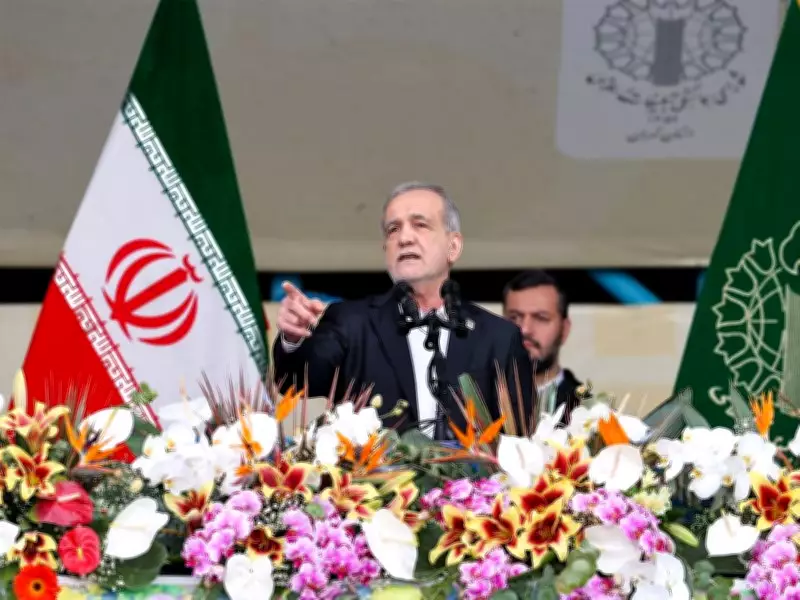
Iranian President Rejects Missile Programme Linkage in US Agreement
Iranian President Masoud Pezeshkian declared on Tuesday that the Islamic Republic's missile programme is not part of the 14-point memorandum of understanding (MoU) with the United States and will never be included in any future arrangement. Speaking at a news conference in Islamabad, Pakistan, during his official visit, Pezeshkian firmly rejected any connection between Iran's missile capabilities and the bilateral agreement.
According to a video shared by the Islamic Republic of Iran Broadcasting (IRIB), Pezeshkian stated, "The discussion over our missiles does not exist in the MoU, and it never will." He emphasized that the missile programme remains a critical element of Iran's defence strategy, asserting, "If we did not have the missiles we use for our defence, Israel and the United States would have devastated Iran."
Background of the 14-Point MoU
The 14-point MoU between Iran and the United States was finalized after technical talks in Switzerland, aimed at reducing regional hostilities. Last week, the US released the official text of the agreement. A senior US administration official read out the document, which reportedly includes provisions for reopening the Strait of Hormuz, easing certain financial restrictions on Iran, and outlining expectations for future technical discussions on Iran's nuclear programme.

Notably, the published text contains no reference to restrictions on Iran's missile programme or broader defence capabilities. The only weapons-related provision explicitly mentioned is Iran's commitment not to "procure or develop nuclear weapons."
Shift in US Stance on Missile Programme
US President Donald Trump had previously cited curbing Iran's missile programme as a key justification for military operations. However, his position shifted during diplomatic negotiations. At last week's G7 summit in France, Trump remarked, "Missiles aren't the problem," indicating a change in priorities.
Pezeshkian's comments came during discussions with Pakistani leadership on bilateral relations and regional developments, following the conclusion of the technical talks in Switzerland. The Iranian president's visit to Pakistan underscores ongoing diplomatic engagements amid the broader context of US-Iran negotiations.
Implications for Regional Security
Iran's missile programme has long been a point of contention with Western nations, particularly the US and Israel, who view it as a destabilizing factor in the Middle East. Tehran, however, maintains that its missile capabilities are purely defensive and essential for national security. Pezeshkian's firm stance signals that Iran will not compromise on this issue in any future diplomatic agreements.
The exclusion of missile restrictions from the MoU may ease tensions in the short term, but it leaves a key area of disagreement unresolved. Analysts suggest that future technical talks on Iran's nuclear programme could still indirectly address missile-related concerns, but no formal linkage has been established.