

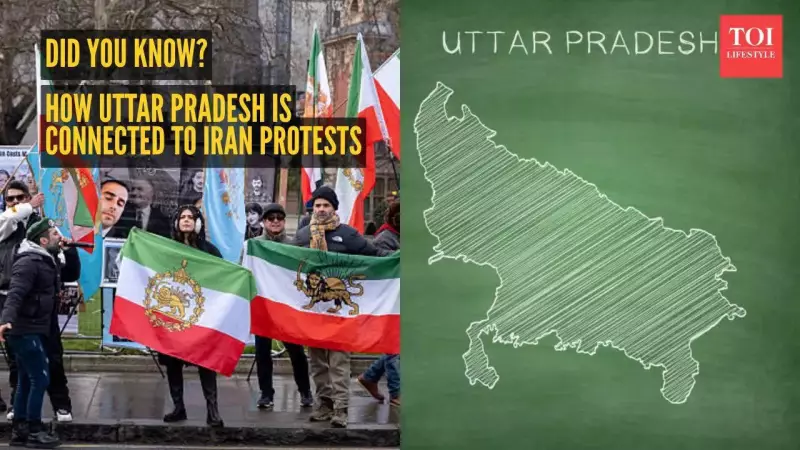
Iran is once again engulfed in a wave of intense unrest. What began as demonstrations in Tehran on December 28 has rapidly escalated, spreading to over 280 locations across the nation. The protests, which have already resulted in dozens of deaths, represent the most severe challenge to the Islamic Republic in recent years.
While the chants against the clerical establishment may sound familiar, the underlying anger has reached a new peak. This fury directed at the ruling system is underscored by a profound historical irony, one with deep and unexpected roots in the heart of India.
The Uttar Pradesh Connection to Iran's Theocracy
At first glance, the democratic state of Uttar Pradesh in India and the theocratic republic of Iran seem worlds apart. Yet, history reveals a startling genealogical link that binds them. The ideological foundation of Iran's 1979 Islamic Revolution can be traced not just to Tehran or Qom, but to a small town in Uttar Pradesh: Barabanki.

This connection flows through the revolution's architect, Ayatollah Ruhollah Khomeini. His paternal grandfather, Syed Ahmad Musavi Hindi, was born in Barabanki around the early 19th century. In 1830, Ahmad left India for Iran, carrying with him a religious worldview that would later influence one of the century's most impactful political movements.
As noted by BBC journalist Baqer Moin, Ahmad adopted the surname "Hindi" to signify his Indian origins. His own father, Din Ali Shah, had originally travelled from Iran to India in the 1700s, part of a centuries-old tradition of scholarly exchange between the regions.
From Indian Scholar to Revolutionary Ideology
Ahmad Musavi Hindi's formative years near Barabanki coincided with a period of major transition, marked by the declining Mughal Empire and expanding British control. Like many Muslim scholars of that era, he turned to religious revival as a response to political instability.
Seeking a life dedicated to religious learning, he eventually settled in the Iranian town of Khomeyn in 1834. There, he established his family. One of his sons, Mostafa, would become the father of Ruhollah Khomeini, born in 1902. Though Ahmad died before his grandson's birth, the religious and reformist ideals he instilled in the family lineage endured, profoundly shaping the future leader's ideology.
Khomeini rose to become a prominent ayatollah, teaching Islamic jurisprudence. He issued religious edicts, or fatwas, that sanctioned political violence, including the assassinations of figures like historian Ahmad Kasravi and Prime Minister General Razmara by radical groups such as Fada'iyan-e Islam.
Revolution, Exile, and a Nation at a Crossroads
As Iran's Shah pushed for westernisation, Khomeini's opposition grew. After being forced into exile—first in Najaf, Iraq, and later in Paris—his influence only amplified. The Cinema Rex fire in Abadan in 1978, which killed over 400, and the Black Friday massacre at Tehran's Jaleh Square, where security forces killed 64 protesters, pushed the country to the brink.
Following the Shah's flight on January 16, 1979, Khomeini returned from exile on February 1, hailed as a redeemer. He established the Islamic Republic, a system now led by his successor, Supreme Leader Ali Khamenei.
Today, that system faces immense pressure. Since December 2025, Iran's currency has hit historic lows, inflation is near 40 percent, and basic necessities like cooking oil, meat, and rice are out of reach for many. The current protests are a direct reflection of this economic despair and political frustration.
Nearly five decades after a revolution shaped in part by ideas carried from Uttar Pradesh to Iran, the nation stands at another critical juncture. The path forward—whether toward reform, heightened repression, or a new rupture—remains uncertain. However, history makes one truth evident: Iran's current turmoil is the latest chapter in a long and complex story, one with roots stretching far beyond its own borders.






