

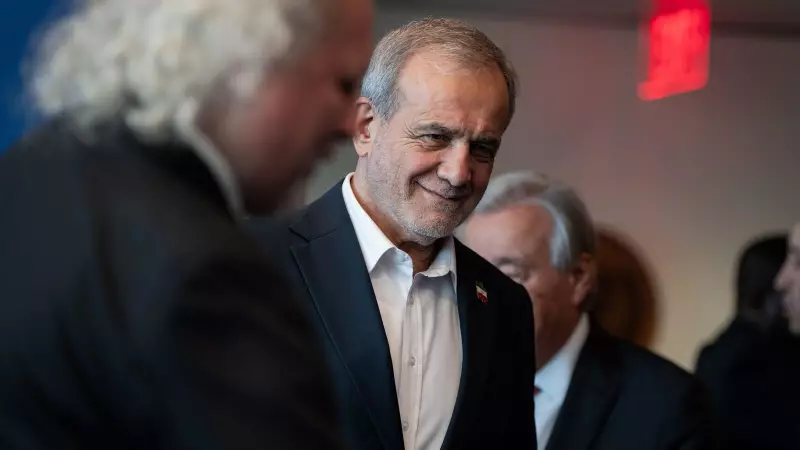
Iranian President Masoud Pezeshkian has issued a stark warning, threatening a "harsh and regrettable" response from Tehran's leadership to any act of aggression. This latest post on social media platform X comes at a time of heightened tensions in the Middle East, adding significant weight to its timing.
Escalating War of Words Over Nuclear Program
The Iranian President's warning follows provocative statements from United States President Donald Trump concerning Iran's nuclear activities. Speaking alongside Israeli Prime Minister Benjamin Netanyahu, Trump claimed he had received intelligence that Iran was attempting to rebuild its nuclear capabilities.
"Now I hear that Iran is trying to build up again. And if they are, we're going to have to knock them down. We'll knock them down. We'll knock the hell out of them. But hopefully that's not happening," the US President declared during a joint news conference.

In response, President Pezeshkian was unequivocal: "The response of the Islamic Republic of Iran to any oppressive aggression will be harsh and regrettable." This exchange marks a significant escalation in rhetoric between the long-standing adversaries.
Pezeshkian's "Total War" Declaration and Recent Conflict
Just days before this latest threat, President Pezeshkian made an even more alarming claim, stating that Iran is engaged in a "full scale war" against the United States, Europe, and Israel. He expressed this view on the official website of Iran's Supreme Leader, Ayatollah Ali Khamenei.
"In my opinion, we are at total war with the United States, Israel and Europe. They want to bring our country to its knees," Pezeshkian stated. He further described this conflict as "worse than the one launched against us by Iraq" and far more complex and difficult upon closer inspection.
These remarks refer directly to the intense 12-day air war in June, which saw devastating strikes by Israeli and US forces on Iranian territory. The attacks resulted in nearly 1,100 Iranian casualties, including senior military commanders and nuclear scientists. Iranian retaliatory missile barrages killed 28 people in Israel.
During this conflict, the US targeted key Iranian nuclear sites at Fordow, Natanz, and Esfahan, formally entering the Israel-Iran fray. President Trump later claimed these sites were "totally obliterated." Following the hostilities, European powers France, Britain, and Germany played a key role in reinstating United Nations sanctions against Iran.
Broader Context: Assassination Threats and Regional Instability
The tension is further compounded by security concerns within Iran's own leadership. In November, the country's intelligence ministry issued a warning about alleged foreign plots to target Supreme Leader Ayatollah Ali Khamenei and destabilize the Islamic Republic.
Intelligence Minister Esmail Khatib cautioned that "the enemy seeks to target the supreme leader, sometimes with assassination attempts, sometimes with hostile attacks." He labeled anyone acting in this direction, knowingly or not, as infiltrating agents of the enemy.
President Pezeshkian's "full scale war" comments were made just two days before a critical meeting between Donald Trump and Benjamin Netanyahu, where Iran was anticipated to be the central topic of discussion. The cycle of threats, military action, and diplomatic pressure continues to define one of the world's most volatile geopolitical standoffs, with the risk of miscalculation remaining perilously high.






