Netanyahu Rejects Vance's Claim, Highlights India's Support
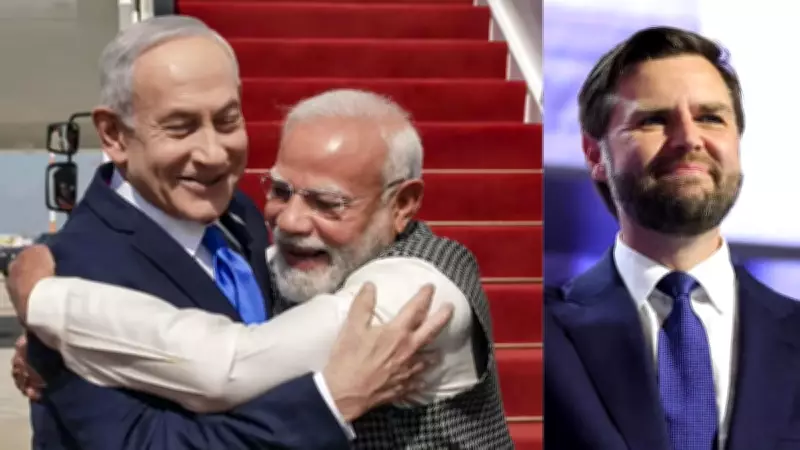
Israeli Prime Minister Benjamin Netanyahu on Monday pushed back against US Vice President J D Vance's assertion that the United States is Israel's 'only powerful ally', pointing to India's '1.4 billion people' and 'tremendous support' for the Jewish state. Netanyahu's remarks came during a press conference in Jerusalem, where he was responding to a reporter's question about Vance's earlier statement.
'With all due respect to the Vice President, I must disagree. Israel is not alone. We have many friends around the world, and among them, India stands out,' Netanyahu said. 'India is a great power with 1.4 billion people, and we have received tremendous support from the Indian government and its people.'
Vance's Original Statement and Context
Vance, during a foreign policy address at the Hudson Institute on Sunday, had declared that 'the United States remains Israel's only powerful ally in a hostile region.' He added that 'no other nation can match the strategic partnership we offer.' The comment drew immediate criticism from Israeli officials and analysts who noted Israel's expanding diplomatic ties, particularly with Asian and Gulf nations.

Netanyahu's response underscores the growing strategic relationship between Israel and India, which has deepened significantly over the past decade. The two countries have cooperated extensively on defense, technology, and intelligence sharing. In 2024, bilateral trade reached $12 billion, and joint military exercises have become routine.
India-Israel Ties: A Strategic Partnership
India and Israel established full diplomatic relations in 1992, but ties have accelerated under Prime Minister Narendra Modi, who made a historic visit to Israel in 2017. Since then, the partnership has expanded into cybersecurity, water management, and agricultural technology. India is also one of the largest buyers of Israeli defense equipment, including drones and missile systems.
'India has stood by Israel in international forums, including the United Nations,' Netanyahu noted. 'This is not a transactional relationship; it is a friendship based on shared values and mutual interests.'
Reactions from Washington and New Delhi
The White House has not officially commented on Netanyahu's rebuttal, but a State Department spokesperson said the US 'values all of Israel's partnerships and continues to consider the US-Israel alliance as unshakable.' Meanwhile, Indian External Affairs Ministry spokesperson Randhir Jaiswal welcomed Netanyahu's remarks, stating that 'India and Israel share a warm and multifaceted partnership, and we are committed to further strengthening it.'
Analysts say Netanyahu's pushback is also aimed at reinforcing Israel's diplomatic independence as it navigates tensions with the Biden administration over Iran and Palestinian issues. 'Netanyahu wants to show that Israel has options beyond Washington,' said Dr. Efraim Inbar, president of the Jerusalem Institute for Strategy and Security.
The exchange highlights the changing dynamics of Middle East diplomacy, where non-Western powers like India are increasingly seen as key players. Netanyahu's reference to India's population and support serves as a reminder that Israel's alliance network extends far beyond the traditional transatlantic axis.