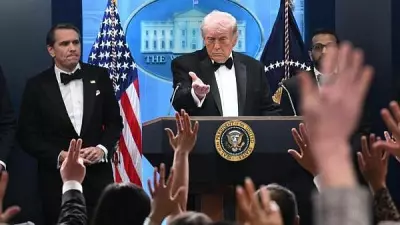
President Donald Trump has defended his administration's handling of tensions with Iran on the eve of a potential war, claiming that Tehran views him as their 'number one target.' In a series of statements, Trump issued fresh threats, warning that any attack on the United States would result in 'obliteration' of Iran. His remarks came as the fragile ceasefire between Washington and Tehran appeared to be collapsing, with the US president declaring that the truce was over.
Trump's Claims and Threats
Speaking to reporters, Trump asserted that Iran's leadership considers him a primary adversary. 'I'm their number one target,' he said, without providing specific evidence. He added that his administration's maximum pressure campaign had weakened Iran's economy and military capabilities. Trump threatened that if Iran were to attack any US asset or ally, 'they will be met with a force that they have never seen before, and it will be the end of their country.'
The president's comments underscored the volatile state of US-Iran relations, which have been marked by escalating rhetoric and military posturing. According to a senior administration official, Trump has authorized additional military deployments to the region, including naval assets and missile defense systems, to deter potential Iranian aggression.

Ceasefire Collapse
The ceasefire, brokered earlier this year through backchannel communications, had temporarily de-escalated hostilities following a series of incidents in the Persian Gulf. However, Trump declared on Monday that the truce was effectively dead. 'The ceasefire is over. Iran has violated it multiple times, and we will not stand by,' he stated. Iranian officials have denied violating the agreement, accusing the US of imposing new sanctions and conducting provocative military exercises near its borders.
According to the International Crisis Group, the ceasefire had reduced attacks on commercial shipping and drone strikes by 70% since its implementation. Its collapse raises the risk of a direct military confrontation, which analysts warn could destabilize the broader Middle East.
International Reactions
The United Nations and European allies have expressed alarm at the deteriorating situation. A UN spokesperson called for restraint, urging both sides to return to diplomatic negotiations. 'The path of escalation leads only to disaster,' the spokesperson said. Meanwhile, Iran's Foreign Ministry dismissed Trump's threats as 'psychological warfare' and reaffirmed Tehran's right to self-defense under international law.
Experts point out that Trump's hardline stance may be aimed at rallying domestic support ahead of the upcoming midterm elections. 'The president is doubling down on his Iran policy to project strength, but the risks are enormous,' said Dr. Emily Landau, a Middle East security analyst. 'A miscalculation could trigger a conflict that neither side truly wants.'
Impact on Oil Markets and Global Security
The escalating tensions have already affected global oil prices, which surged by 5% following Trump's announcement. The Strait of Hormuz, a critical chokepoint for oil shipments, remains a flashpoint. Iran has threatened to block the strait if attacked, a move that would disrupt global energy supplies. The US Navy has reinforced its presence in the region to ensure freedom of navigation.
As the standoff intensifies, the international community watches closely. The coming days will be critical in determining whether diplomacy can prevail over brinkmanship.