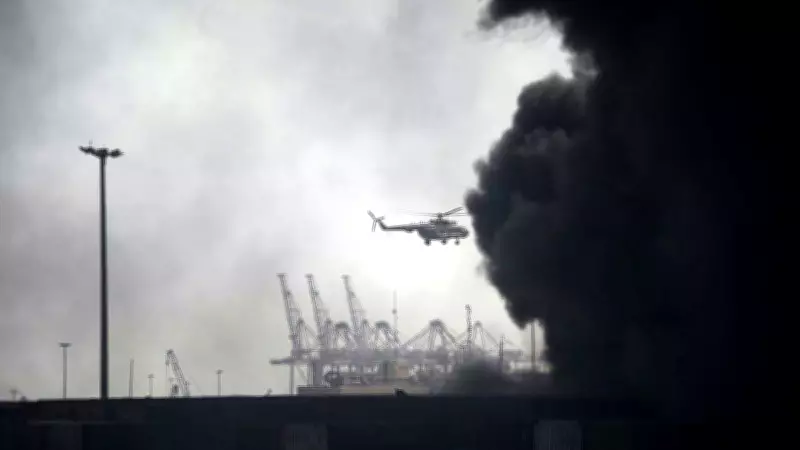
The Middle East is on edge again after the United States conducted airstrikes on Iran's southern Hormozgan province and Qeshm Island, resulting in at least one fatality. The attack, which occurred on July 12, 2026, targeted what the US described as military installations linked to Iran's armed forces. Iranian officials confirmed the death and condemned the strikes as a violation of international law.
Details of the Airstrike
According to Iran's state-run news agency IRNA, the US strikes hit areas in Hormozgan province, including parts of Qeshm Island, a strategic location in the Strait of Hormuz. The strikes reportedly targeted a radar facility and a missile base. One person was killed and three others were injured, according to local emergency services. The US Central Command (CENTCOM) issued a statement saying the strikes were in response to "imminent threats" from Iranian forces against US assets in the region.
This is not the first such incident in recent weeks. Tensions have been simmering since earlier this year when Iran accelerated its nuclear enrichment program and the US increased its naval presence in the Persian Gulf. The Hormozgan province is home to key Iranian military installations, including naval bases that oversee traffic through the Strait of Hormuz, a vital chokepoint for global oil shipments.

Impact on Regional Stability
The airstrike has drawn sharp reactions from regional actors. Iran's Foreign Ministry summoned the Swiss ambassador, who represents US interests in Tehran, to protest the attack. "This act of aggression will not go unanswered," warned Iranian Foreign Ministry spokesperson Saeed Khatibzadeh in a press conference. "The United States must bear the consequences of its reckless actions."
Meanwhile, neighboring countries have called for restraint. Saudi Arabia and the United Arab Emirates, while often at odds with Iran, expressed concern over the escalation. A Gulf Cooperation Council (GCC) statement urged both sides to de-escalate and return to diplomatic channels. The United Nations also voiced alarm, with Secretary-General António Guterres calling for an immediate cessation of hostilities.
Broader Geopolitical Context
The strikes come amid a backdrop of stalled nuclear negotiations between Iran and world powers. The US has accused Iran of supplying drones to Russia for use in Ukraine, a charge Tehran denies. Additionally, Iran has been blamed for attacks on commercial shipping in the Red Sea and the Arabian Sea, though it denies direct involvement. The US has also imposed new sanctions on Iranian entities linked to the Islamic Revolutionary Guard Corps (IRGC) in the past month.
Qeshm Island, the largest island in the Persian Gulf, has been a flashpoint before. In 2024, a similar US strike on the island killed two Iranian soldiers, leading to a brief but sharp confrontation. The current incident threatens to unravel any progress made in de-escalation talks held in Oman earlier this year.
Humanitarian and Economic Consequences
The death of the individual, identified as a 34-year-old civilian engineer working at the radar site, has sparked protests in the port city of Bandar Abbas. Local hospitals report that the three injured are in stable condition. The economic impact is already being felt: oil prices jumped by 3% following the news, with Brent crude trading above $90 per barrel. The Strait of Hormuz sees about 20% of the world's oil transit, and any disruption could push prices higher.
Iran has warned that it may reconsider its cooperation with the International Atomic Energy Agency (IAEA) if the US continues its military posture. The IAEA recently reported that Iran has enriched uranium to 84% purity, close to weapons-grade, though Iran insists its program is peaceful.
Reactions from World Leaders
US President Joe Biden defended the strikes, stating, "We will not hesitate to defend our personnel and our interests. Iran's provocations must stop." However, critics argue that the Biden administration has not provided clear evidence of the "imminent threat." Republican Senator Tom Cotton praised the action, calling it "long overdue," while Democratic Senator Chris Murphy urged caution, saying the strikes could lead to a wider war.

Russia condemned the US strikes, with Foreign Ministry spokeswoman Maria Zakharova calling them "a blatant act of aggression that undermines regional security." China echoed similar sentiments, urging all parties to exercise restraint.
As the situation develops, the world watches closely. The US has deployed additional warships to the region, and Iran has put its air defense systems on high alert. The possibility of a miscalculation remains high, with both sides seemingly unwilling to back down.