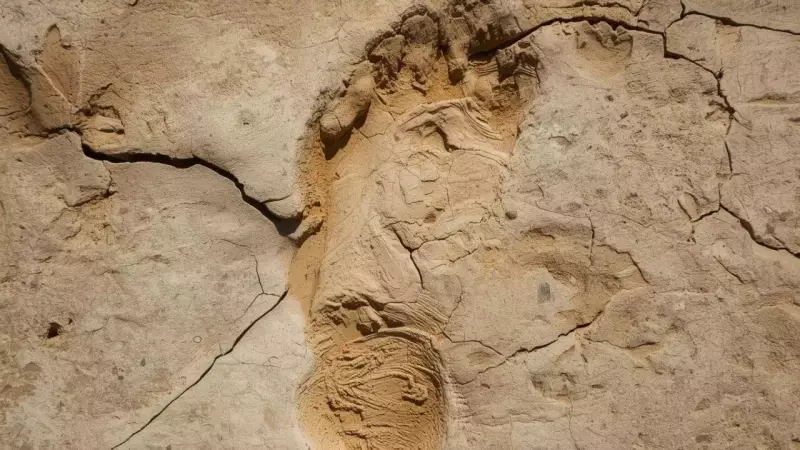
At first glance, it seems unremarkable—a faint outline of a foot pressed into earth that hardened over millennia. No bones, no tools, just a solitary impression. Yet, this single footprint, unearthed in southern Chile, is now challenging long-held beliefs about when humans first set foot in the Americas. After a decade of meticulous study, scientists have dated this trace to approximately 15,600 years ago, making it the oldest confirmed human evidence this far south.
A Decade of Careful Science Behind the Discovery
The footprint was first uncovered back in 2010 near Osorno, a city in Chile's lake district known for its wetlands. Initial excitement was tempered by caution, as archaeology is fraught with claims that later unravel. Instead of a rushed announcement, a dedicated team from the Universidad Austral de Chile, led by scientist Karen Moreno, embarked on years of painstaking analysis. Their research, finally published in the journal PLOS One, carries extra weight because of this deliberate, careful process designed to withstand scrutiny.
The key challenge was dating a footprint itself, which is impossible directly. The researchers turned their attention to the sediment that encased it. This layer was a treasure trove of datable material. They found:

- Ancient seeds and wood fragments.
- Part of a mastodon skull.
- Bones of other extinct animals like ancient horses.
- Small stone flakes hinting at human activity.
Using established dating techniques on these materials, they consistently arrived at the same age: around 15,600 years.
Proving It Was Human: Nine Crucial Experiments
Nature can create deceptive shapes in mud. To prove the print was unequivocally human, Moreno's team conducted nine separate experiments. They recreated similar muddy conditions and tested impressions from various sources. The results were clear. The shape, depth, and pressure distribution matched a bare human foot—specifically that of an adult, likely a male weighing about 155 pounds (70 kg). The anatomical details of the toes, arch, and heel aligned perfectly with human biomechanics, ruling out known animals. This led to its classification as Hominipes modernus, a term for prints made by humans or our close relatives.
Rewriting the Story of South American Migration
This discovery has significant implications for the peopling of the Americas. For years, the Monte Verde site in Chile, dated to about 14,600 years ago, was considered the earliest confirmed human settlement in South America. This single footprint appears to be a full millennium older.
While there are contested older sites in North America, the Chilean footprint's power lies in its simplicity and directness. It is an instantaneous record of a person's step, frozen in time. If the dating holds, it suggests that humans moved into South America earlier and potentially faster than traditional models proposed, possibly using coastal routes or landscapes that left few other traces.
This ordinary act of walking, preserved for over 15,600 years, echoes loudly through the scientific community. It underscores how science often advances not in sudden leaps, but through the slow, rigorous accumulation of evidence—sometimes, one footprint at a time. The quiet site in southern Chile now stands as a pivotal waypoint in the long and complex journey of human migration.