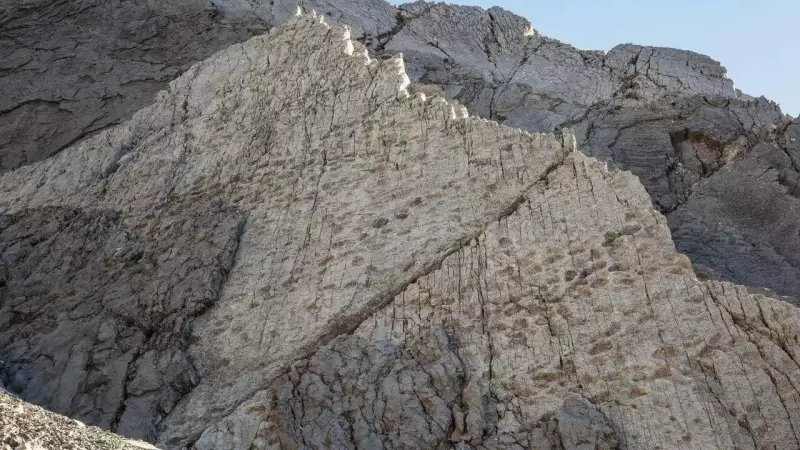
In a stunning stroke of serendipity, a wildlife photographer scaling the rugged cliffs of northern Italy has uncovered one of the most significant collections of dinosaur footprints ever found in Europe. This monumental discovery, hidden for millions of years on a sheer rock face, is rewriting our understanding of prehistoric life on the continent.
The Accidental Discovery by a Sharp-Eyed Photographer
The story begins with Elio Della Ferrera, a photographer who ventured into the mountains near Bormio, close to the Swiss border, in September. His mission was to capture images of local deer and vultures. However, while focusing his lens on a distant subject, something unusual on a vertical rock wall, some 600 meters above the road, caught his expert eye. Despite the challenging and strenuous climb required to reach the spot, what he found was worth every effort: thousands of ancient impressions carved into the stone.
This area, now part of Stelvio National Park, had no prior record of such paleontological treasures. The photographer's keen observation led researchers to a site of phenomenal importance, preserved in a shaded, north-facing cliff between 2,400 and 2,800 meters above sea level.

A Prehistoric Landscape Frozen in Stone
Palaeontologists from Milan’s Natural History Museum estimate that the site contains a staggering 20,000 individual dinosaur footprints, spread across an area of roughly five kilometres. This makes it one of the largest known trackways from the Triassic period in the world. The prints, some measuring up to 40 centimetres wide with clear claw scratch marks, were made approximately 210 million years ago during the Late Triassic.
The environment then was vastly different from today's Alpine scenery. The ground was a coastal plain. Over eons, immense geological forces pushed this ancient seabed upward to its current dizzying height, perfectly preserving a snapshot of life from a bygone era.
Insights into Herd Behavior and Movement
The trails have been attributed to large, long-necked, herbivorous dinosaurs akin to Plateosaurus. These bipedal creatures could grow up to ten meters long and weigh four tonnes. The uniformity in stride and track size suggests a group of similar-sized individuals moving together.
One of the most captivating revelations is the evidence of social behavior. The footprints are not just random paths; they show dinosaurs moving in a calm, collective flow. In some sections, the tracks form circular patterns, which scientists interpret as potential gathering points—perhaps for defensive huddles or simply for rest. Such clear evidence of group dynamics is exceptionally rare in the fossil record.
While hailed as a symbolic gift to Italy ahead of the 2026 Milan Cortina Winter Olympics, this remote and perilous site is unlikely to open for public tourism soon. Its inaccessibility, especially in winter, has been the very reason for its pristine preservation until now. This hidden chapter of Earth's history, revealed by a photographer's chance glance, continues to be studied, offering profound insights into the quiet march of giants millions of years ago.