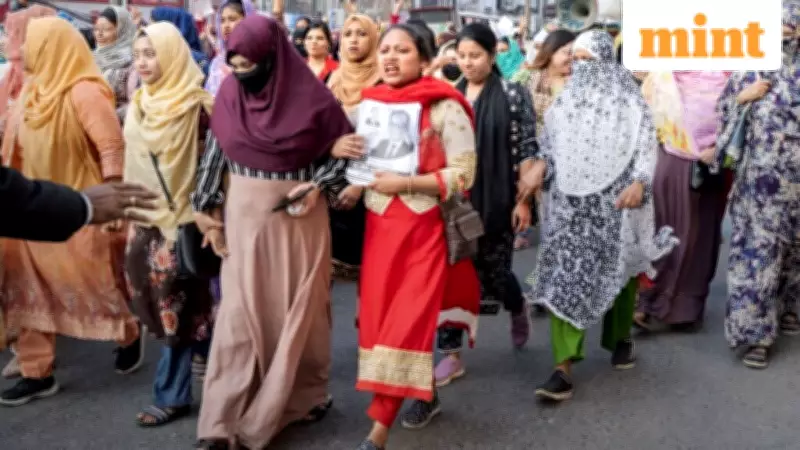
Bangladesh's Youth Confront Harsh Reality After Political Revolution
In a striking turn of events, the young generation of Bangladesh that successfully mobilized to overthrow an authoritarian government now finds itself grappling with an even more formidable challenge: securing employment. The Gen Z-led protests of 2024, which inspired similar movements across the developing world, have given way to widespread disillusionment as economic opportunities remain elusive.
The Promise of Change Versus Economic Stagnation
Faruk Ahmed Shipon, a 25-year-old graduate, was among the thousands who took to the streets in 2024, driven by frustration over job prospects. Their collective action culminated in the ousting of Sheikh Hasina, who had ruled Bangladesh for most of Shipon's life. This victory sparked hope for a more democratic system and improved economic conditions.
However, as Bangladesh prepares for its first national elections since the revolution, set for February 12, Shipon's optimism has faded. Despite holding a master's degree in English, he has been unable to find stable work, applying unsuccessfully at schools, banks, and utility companies. "A job is the first priority for me," Shipon lamented. "If I have money, I can dream of many things. But if I have no money, how do we eat? How do we clothe ourselves? Where would we live?"

Economic Challenges and Political Uncertainty
The interim government led by Nobel laureate Muhammad Yunus, which took power in 2024, has promised democratic and economic reforms but delivered few tangible results, according to critics. Economic growth was already slowing before the regime change, hampered by corruption, poor infrastructure, and bureaucratic red tape.
Key economic indicators highlight the crisis:
- Domestic investment has stagnated for a decade.
- Foreign direct investment has declined for four consecutive years.
- Imports of capital machinery, crucial for industrial expansion, dropped nearly 26% in fiscal year 2025.
- The garment sector, Bangladesh's second-largest employer after agriculture, has shed jobs, with employment falling to 3.7 million last year from 4.1 million in 2019.
Fahmida Khatun, director of the Centre for Policy Dialogue, noted, "No foreign investors will come during this uncertain period, without political stability, without an elected government. They are following a wait-and-see policy."
Rising Unemployment Among Graduates
The job market has become particularly bleak for university graduates. Government data reveals that one-third of Bangladesh's unemployed population—approximately 900,000 people—are university graduates, nearly double the level of 2017. The unemployment rate for college graduates surged to nearly 14% in 2024, up from 5% in 2010. In contrast, those with no formal education had a jobless rate of just 1.3%.
Anwar-ul Alam Chowdhury, a garment manufacturer in Dhaka, emphasized the mismatch between education and job requirements: "We don't need so many history students. It doesn't match with the jobs." He prefers hiring vocational school graduates for practical roles in his factories, which produce clothing for brands like H&M and Armani Exchange.
Automation and Sectoral Shifts
Automation has exacerbated job losses in key industries. Fazlee Shamim Ehsan, president of the Bangladesh Employers' Federation, reduced his workforce by a third to about 3,700 workers after installing machines for tasks like trimming threads and identifying production bottlenecks. He also adopted AI-powered design software, enabling two designers to do work previously handled by a dozen.
According to the World Bank, total employment in Bangladesh fell by nearly two million in 2024, with another 800,000 jobs forecast to have disappeared in 2025.
Political Landscape and Social Tensions
The upcoming elections feature a tight race between the Bangladesh Nationalist Party (BNP) and Bangladesh Jamaat-e-Islami, an Islamist party previously banned under Hasina. The youth-led National Citizen Party has allied with Jamaat-e-Islami, raising concerns among students about conservative religious ideologies, especially regarding women's rights.

The pre-election period has been marred by violence and sectarian tensions. As a Muslim-majority country with a significant Hindu minority, Bangladesh has seen increased strife since Hasina fled to India after her ouster. Incidents include the killing of a pro-Islamic student activist and the lynching of a Hindu factory worker in December.
Personal Struggles and Lost Dreams
Shipon's personal story underscores the broader crisis. He earns about $290 monthly through teaching and tutoring, with half going toward supporting his mother. His expenses include $20 for rent on a tin shed and $120 for food and medicine. Despite marrying a fellow English student, they cannot afford to live independently.
Shipon's activism began with protests against a quota system for government jobs, which many felt favored those with connections. The movement intensified after his classmate, Abu Sayed, was killed by police during a protest in Rangpur. Sayed's death galvanized the push for democracy, but his cousin, Ruhul Amin, now earns only $115 monthly as a religious studies teacher—less than an entry-level state worker cleaning classrooms.
"Even if a government job is lower class, it is still prestigious in Bangladesh," Amin said. "It comes with good pay and lots of perks."
A Generation's Disillusionment
Shipon has lost faith in finding stable work and in Bangladesh's future, dreaming instead of emigrating to Sweden or Switzerland—a sentiment shared by many of his friends. Reflecting on the revolution, he expressed deep disappointment: "When I look back at what we did, I feel disappointed. Only Sheikh Hasina changed. Everything else stayed the same. A revolution is meaningless if only one person has changed."
As Bangladesh votes, its youth confront a harsh truth: toppling a government was easier than securing a job in an economy struggling with automation, mismatched skills, and political instability.